




The right spark plug interval is the one in your owner’s manual. Most modern cars with platinum or iridium plugs call for new plugs somewhere between 60,000 and 120,000 miles, while old-style copper plugs need attention at 20,000 to 30,000 miles. Your driving can move that number, and a rough idle, a misfire or a check engine light means the plugs deserve a look sooner. Here is how to find your interval, how plug types compare, and what stop-and-go Dallas driving does to them.
TL;DR
- Follow the interval in your owner’s manual or maintenance schedule first. It is written for your engine.
- Typical ranges: copper 20,000 to 30,000 miles, platinum 60,000 to 100,000 miles, iridium 60,000 to 120,000 miles.
- Iridium is harder and costs more. Platinum sits in the middle. Use the type your manufacturer specifies.
- Rough idle, hesitation, weaker fuel economy and misfire codes can point to worn plugs, but also to coils, injectors or sensors, so get a diagnosis before replacing parts.
- Heavy stop-and-go traffic, towing and poor fuel can shorten plug life.
Table of Contents
- How often should spark plugs be replaced?
- Can spark plugs last 20 years?
- Iridium vs. platinum spark plugs: which is better?
- What are the signs your spark plugs are wearing out?
- What shortens spark plug life in Dallas driving?
- What happens during a spark plug service?
- Our perspective on spark plug service
- Schedule your spark plug check in Dallas
- Frequently asked questions
- Sources
How often should spark plugs be replaced?
There is no single number, because the answer depends on the plug material and on what your engine’s maker tested it with. One manufacturer’s guidance puts its own plugs at around 80,000 miles, with the schedule for your specific make and model deciding the real figure. Other makers call for 30,000 miles, and some turbocharged or direct-injection engines call for shorter intervals than a naturally aspirated engine of the same era.
The general ranges by plug type look like this, according to one widely cited maintenance guide:
| Plug type | Typical interval | Cost position | Best for |
|---|---|---|---|
| Copper | 20,000 to 30,000 miles | Lowest | Older engines that were designed for copper |
| Platinum | 60,000 to 100,000 miles | Middle | Many mid-2000s and later engines, including waste spark systems |
| Iridium | 60,000 to 120,000 miles | Highest | Most modern engines that specify iridium from the factory |
Treat these as ranges, not promises. A plug rated for 100,000 miles in a commuter sedan on the highway is not always getting 100,000 miles in a truck that tows or a car that idles through rush hour.
Where do you find the interval for your vehicle?
Start with three places:
- The owner’s manual maintenance schedule. Look for “spark plugs” under the scheduled maintenance table. Some manuals list a mileage and a time limit, and the earlier one applies.
- The manual’s severe-service schedule. Short trips, towing, dusty roads and heavy stop-and-go driving often fall under the tighter schedule.
- A technician with your VIN. A shop can look up the plug type and gap your engine requires, and confirm whether an earlier service bulletin applies.
If you bought the car used and have no service history, assume the plugs are due as soon as you reach the mileage in the manual. Do not guess from the odometer alone if the previous owner may have swapped plug types.
Should you replace plugs on schedule or wait for symptoms?
Replace them on schedule. Waiting for symptoms means running them past their useful life. Denso’s engineers describe the service life of a plug as the point where misfiring begins, and note that driving beyond it wastes fuel, adds engine vibration and can harm emission controls. The same source explains why: as electrodes wear, the gap widens and the voltage required to fire the plug climbs with distance driven, until stable ignition is no longer possible.
A car with 105,000 miles on a 60,000-mile interval and no symptoms is not a happy accident. It is a car with worn plugs that the engine computer is still compensating for. A worn plug can also be harder to remove, which is one more reason to stay on schedule.

Can spark plugs last 20 years?
Not in any way worth relying on. A plug does not have an expiry date the way milk does, but it ages through heat cycles, deposits and electrode erosion. Some manufacturers also add a time limit to the mileage interval, often expressed in years, so a low-mileage car can come due by age alone. Check your manual for a line like that.
The bigger risk with very old plugs is not the plug itself. It is that plugs left in an aluminum cylinder head for many years can seize in their threads, and a rushed removal can break one. If that has happened to you, our guide on fixing a broken spark plug explains what is involved.
Iridium vs. platinum spark plugs: which is better?
The better plug is the one your engine was designed for. Iridium is not automatically better in an engine built around copper or platinum, and downgrading from iridium to a cheaper plug in an engine that specifies iridium can shorten your interval and hurt performance.
How do the two differ?
- Material. Iridium is one of the hardest metals used in plugs and has a very high melting point, which makes it very resistant to spark erosion. Platinum plugs use a platinum disc welded to the center electrode and last longer than copper.
- Electrode size. Because iridium is so hard, the center electrode can be made very fine, which lowers the voltage needed to create a spark.
- Life. Iridium plugs can often last around 100,000 miles. Platinum commonly runs at the lower part of the ranges in the table above.
- Price. Iridium is at the upper end of the price range per plug. Platinum is in the middle. Over a long interval, the cost per mile can be close, because you replace iridium less often.
What about double platinum and waste spark engines?
Some engines fire plugs in pairs, with the spark traveling in opposite directions on each plug of the pair. In these waste spark systems, one plug can wear differently from the other unless a double-precious-metal plug is used. That is one reason you should not mix and match plug types across cylinders, and why the part number in your manual matters.
A quick way to choose
- Use the plug type and heat range the manufacturer specifies.
- If the manual lists iridium, stay with iridium.
- If your older engine specifies copper, you can often upgrade to platinum or iridium for a longer interval, but confirm the part number fits your engine first.
- Replace plugs as a full set, and have them gapped and torqued correctly.
That last point is not minor. NGK notes that incorrect tightening torque, either too low or too high, is a leading cause of plug failure, because it can cause compression loss or distort the plug housing.
What are the signs your spark plugs are wearing out?
Common signs include rough idling, slow acceleration, worse fuel economy, misfires and a lit check engine light, as listed by one maintenance guide. You may also notice:
- Hard starting, especially on the first start of the day.
- Hesitation or stumbling when you merge onto Central Expressway, US-75 or the Dallas North Tollway.
- A flashing check engine light, which signals an active misfire. Reduce speed and get the car checked quickly, because raw fuel entering the exhaust can damage the catalytic converter.
Could it be something other than the plugs?
Yes, and this is where parts get replaced unnecessarily. The same symptoms can come from fuel filter or injector problems, oxygen sensor faults or ignition system issues. Before you spend money on plugs, it helps to rule out the neighbors:
- Failing coils often cause a misfire on one cylinder. See our list of ignition coil symptoms.
- A clogged filter can starve the engine and mimic plug trouble. Compare against dirty fuel filter symptoms.
- A random or multiple-cylinder misfire code is explained in our P0300 code guide.
Weak starting can also come from a tired battery rather than the plugs. Knowing when to test and replace a car battery helps you separate a charging or battery problem from an ignition problem.
What do the old plugs tell you?
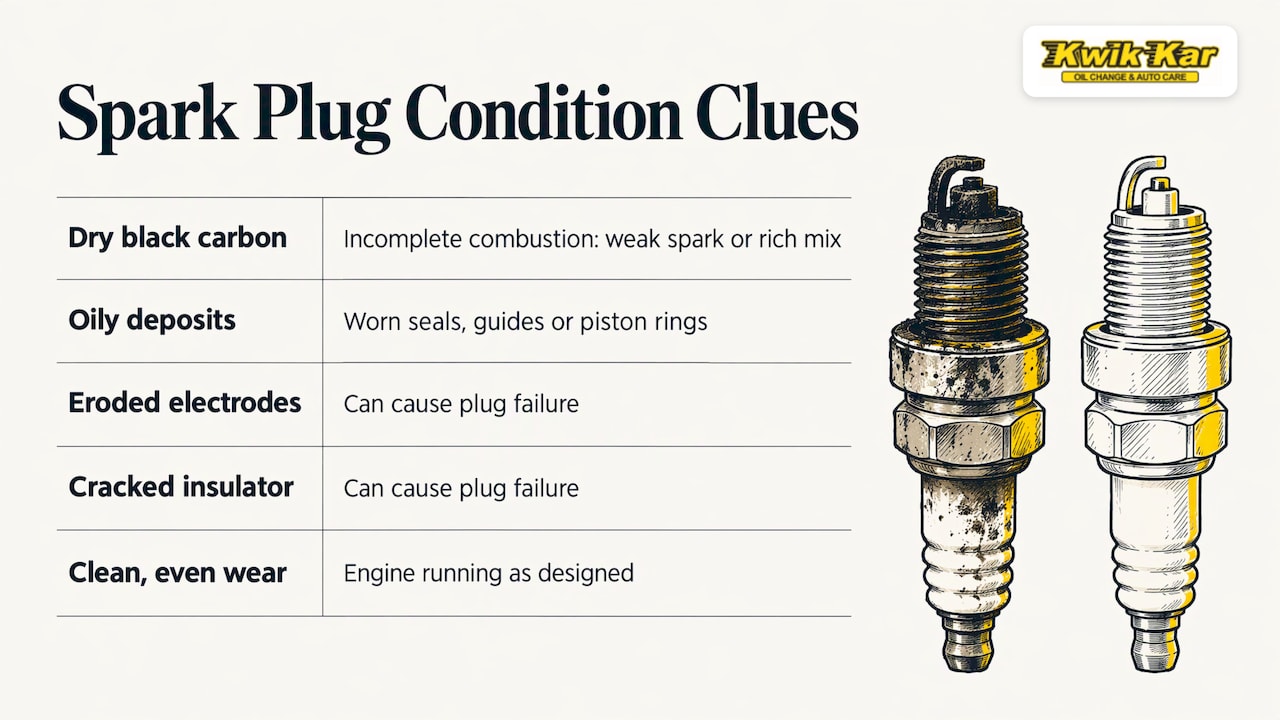
When a technician pulls the plugs, their condition is a clue to the engine’s health. Dry black carbon deposits can mean incomplete combustion from a weak spark or a rich air-fuel mixture, while oily deposits usually point to worn valve stem seals, valve guides or piston rings. Plugs can also fail from carbon fouling, oil deposits, eroded or damaged electrodes, or a cracked insulator. A clean set with even wear says the engine is running as designed. An unusual set says something upstream needs attention, and swapping new plugs in without a diagnosis will only foul them again.
What shortens spark plug life in Dallas driving?
Manufacturers name several conditions that cut plug life: stop-and-go traffic, heavy towing, poor-quality fuel or fuel additives, and ignition-system problems. Others include overheating, prolonged low-speed driving and oil deposits, according to the maintenance guide cited above.
For North Dallas drivers, that translates into a few practical habits:
- If you commute in rush-hour traffic on Preston Road, Coit Road or the Tollway, your engine spends a lot of time idling and at low speed. Treat your schedule as the severe-service version if your manual offers one.
- If you tow or haul a trailer, plan on the shorter end of the range.
- If you take long highway trips, you are in a gentler duty cycle, but check plugs before a big road trip if you are near the interval.
- Keep up with oil changes. Oil that leaks past worn seals fouls plugs, and stretching oil intervals invites sludge. Our synthetic oil change interval tips cover how to set the right schedule.
Summer heat is hard on the whole engine bay, including the cooling and battery systems. We do not have local statistics to cite, so we will say only this: a car that runs hot or has cooling issues should be inspected, because overheating is one of the conditions that damages plugs.
What happens during a spark plug service?
A proper service is more than swapping parts. Here is what you should expect from a professional:
- Scan and check. The technician checks for stored codes and reviews symptoms. A misfire on a single cylinder points elsewhere than a general rough idle.
- Remove and inspect. Each plug comes out and is looked at for wear, deposits and oil. This is the diagnostic value of the job.
- Match the part. The plug type, heat range and gap are matched to your engine’s specification.
- Install and torque. Plugs are installed to the specified torque, with coil boots and connections checked as part of the job.
- Test. The engine is started and checked for smooth idle and no misfire codes.
Some engines make this job simple. Others bury the plugs under intake components, which is why the labor can vary from one vehicle to another. Ask for an estimate before work begins and a written list of what is included.
Our perspective on spark plug service
We see spark plugs as a maintenance item that quietly affects everything else: fuel economy, starting, smoothness and the health of your coils and catalytic converter. The mistake we hear about most is not changing plugs too early. It is waiting for a symptom, then replacing parts based on a guess.
That is why we start with a diagnosis and a look at the plugs themselves. Our ASE-certified technicians work on both domestic and import vehicles, and we give you an estimate before work begins. Where it applies, our digital vehicle inspections show you photo and video of what we find, so you can see the condition of your plugs and the parts around them rather than take our word for it.
We follow the manufacturer’s interval and plug specification, and we adjust our advice when your driving calls for it. If we find that the real cause of a misfire is a coil, a sensor or a fuel problem, we tell you that, and explain what is needed.
Kwik Kar
Schedule your spark plug check in Dallas
If your car is near its interval, or if it is idling roughly, hesitating or showing a check engine light, we can inspect the ignition system and tell you what it needs. Our shop at 8280 Spring Valley Rd, Dallas, TX 75240 serves North Dallas, Far North Dallas, Addison, Richardson and Farmers Branch, and we work on both domestic and import vehicles. See the full list on our auto repair services page.

If the check engine light is on, our engine light diagnostic guide explains what to expect from a scan. Qualifying repairs may be covered by our 24-month/24,000-mile warranty, subject to applicable terms, so ask us about it when you book. You can schedule an appointment online and we will take it from there.
Frequently asked questions
How often should you change spark plugs on a car with iridium plugs?
Usually between 60,000 and 120,000 miles, depending on the engine, as maintenance guidance for iridium plugs indicates. Your owner’s manual sets the exact figure for your vehicle. If you do mostly short trips or heavy stop-and-go driving, follow the severe-service schedule if one is listed.
Do spark plugs give any warning before they fail?
Often, yes, but the warning can be subtle. Rough idle, hesitation, poorer fuel economy and hard starts tend to come on gradually. A misfire code or flashing check engine light is a stronger signal. Because other parts can cause the same symptoms, have a technician confirm the cause.
Is it okay to skip the scheduled spark plug change if the car runs fine?
We do not recommend it. Worn plugs force the ignition system to work harder, since the gap grows and the required voltage rises as the electrodes wear. That can also stress coils. A car can feel normal while the engine computer hides the problem.
Can I upgrade from platinum to iridium plugs?
In many engines you can, as long as the part is correct for your engine, including heat range and thread. Do not upgrade on price or reputation alone. Ask a technician to confirm the right plug, and replace the full set at once.
Does Texas still require inspections, and does that affect spark plugs?
Since January 1, 2025, most non-commercial vehicles in Texas no longer need a safety inspection before registration, but vehicles registered in emissions counties, including Dallas County, still need emissions testing. Qualifying commercial vehicles remain subject to applicable safety inspection requirements. Misfires can raise emissions, so worn plugs can matter when your test comes due. Check the current rules on the Texas DPS and DMV sites.
Sources
- How Often To Change Spark Plugs, Toyota
- Changing Spark Plugs: When to Replace, Which Type to Use, Bumper
- Service Life, Denso Spark Plug Basic Knowledge
- What Kind of Spark Plugs Do I Need? AutoZone
- Spark Plugs, NGK NTK
- Spark Plugs, NGK NTK UK
- Waste Spark Ignitions, NGK Spark Plugs
- Spark Plug Essentials: A Comprehensive Guide, Innova
- DPS Reminds Texans of Vehicle Safety Inspection Changes, Texas DPS
- Car Battery: Test at Year 3, Banshee Battery