



If your engine won’t crank or you only hear clicking, the starter is the likely culprit; if the car runs but the lights dim, the battery warning light glows, or the engine stalls while driving, the alternator is probably failing. Check your battery terminals for corrosion first, and never keep driving if the car stalls repeatedly or you smell something burning. Once you’ve made that quick check, run through the tests below or book a professional diagnostic to confirm the cause.
TL;DR:
- Most starter issues present with clicking sounds or no noise when attempting to start, indicating solenoid failure or poor electrical engagement.
- Alternator failure signs include dim lights, dash warning lights, whining sounds, and car stalls after a jump-start due to inadequate charging.
- A multimeter test showing voltages below 13 volts or above 15 volts while running signals a charging system problem requiring professional diagnosis.
- Corroded battery terminals, loose grounds, blown fuses, or faulty relays can mimic starter or alternator failure and should be ruled out first.
- Professional testing involves a battery load test, voltage checks under load, and bench testing of the starter to accurately identify the faulty component.
Table of Contents
- 1. Starter symptoms: what to listen for and what they mean
- 2. Alternator symptoms: charging-system signs and running problems
- 3. Roadside and workshop tests to distinguish starter vs alternator
- 4. Common confounders: battery, grounds, fuses, and solenoids
- 5. What to expect when you take the car to a shop
- 6. Why professional diagnostics matter for an accurate fix
- What the symptoms really tell you
- Schedule a starter or alternator check at Kwik Kar Spring Valley
- Sources
- FAQ
1. Starter symptoms: what to listen for and what they mean
A failing starter usually announces itself through sound, or the lack of it, rather than through your dashboard. When you turn the key or press the start button, pay attention to what happens in that first second, because the noise pattern tells you almost everything you need to know.
The most recognizable sign is clicking. A single click followed by silence often points to a starter solenoid that isn’t engaging the motor properly, while rapid repeated clicking usually means the starter is trying to engage but doesn’t have enough power to turn the engine over. According to Edmunds, starter solenoid failure typically produces clicking when you turn the key, along with intermittent starting or no crank at all, even while your dashboard lights stay bright.
That last detail matters. If your dash lights, radio, and accessories all work normally but the engine simply won’t turn over, the problem is almost always mechanical, meaning it’s in the starter itself or its wiring, not in the battery or charging system. A weak battery tends to dim everything at once; a bad starter leaves the electrical system alone and just fails to spin the engine.
Slow cranking is another common complaint, and it can be misleading. It often points to low battery voltage or poor connections rather than the starter itself, but if you’ve confirmed the battery and cables are healthy and the engine still turns over sluggishly, the starter motor’s internal components may be wearing out. A whirring sound without the engine catching, sometimes called a “freewheeling” noise, usually means the starter’s pinion gear isn’t meshing with the flywheel correctly.
Common starter symptoms and what they suggest:
- Single click, no crank: points to a solenoid that isn’t engaging or a weak battery connection at the starter.
- Rapid repeated clicking: suggests the starter is drawing power but can’t generate enough torque to turn the engine.
- Slow or labored cranking: often a battery or connection issue, but can signal internal starter wear if the battery tests fine.
- Whirring without engagement: typically a worn starter drive gear that isn’t catching the flywheel.
- No sound at all, dash lights on: may indicate a failed solenoid, blown fuse, or ignition switch problem rather than the starter motor itself.
Some drivers have heard that tapping a starter with a wrench or hammer can get a stalled car running again. That trick sometimes works because it can briefly reseat worn internal brushes or contacts, but it’s a temporary fix, not a diagnosis, and it shouldn’t be relied on more than once. If tapping the starter gets your car going, treat it as a clear sign the part needs replacement soon, not as a repair.
2. Alternator symptoms: charging-system signs and running problems
Where starter problems show up when you turn the key, alternator problems tend to show up while you’re already driving. The alternator’s job is to keep the battery charged and power your electrical accessories once the engine is running, so when it starts failing, the symptoms are electrical rather than mechanical.
The most common early warning is dim or flickering headlights and dashboard lights, especially when you turn on other accessories like the air conditioning or heated seats. A battery-shaped warning light on the dash is another direct signal that the charging system isn’t keeping up. According to AAA Club Alliance, common alternator symptoms include dimming or flickering lights, a battery warning light on the dash, whining or grinding noises from the engine bay, burning smells, and repeated stalls or a car that dies shortly after a jump-start.
Signs your alternator may be failing:
- Dimming or flickering lights, particularly when accessories are running at the same time.
- Battery warning light illuminated on the dashboard while driving.
- Stereo cutting out or whining noise coming from the speakers or engine bay.
- Burning rubber or hot electrical smell, which can point to a slipping belt or overheating alternator windings; you can read more in our guide to burning rubber smells.
- Stalling while driving, especially at idle or when the engine load increases.
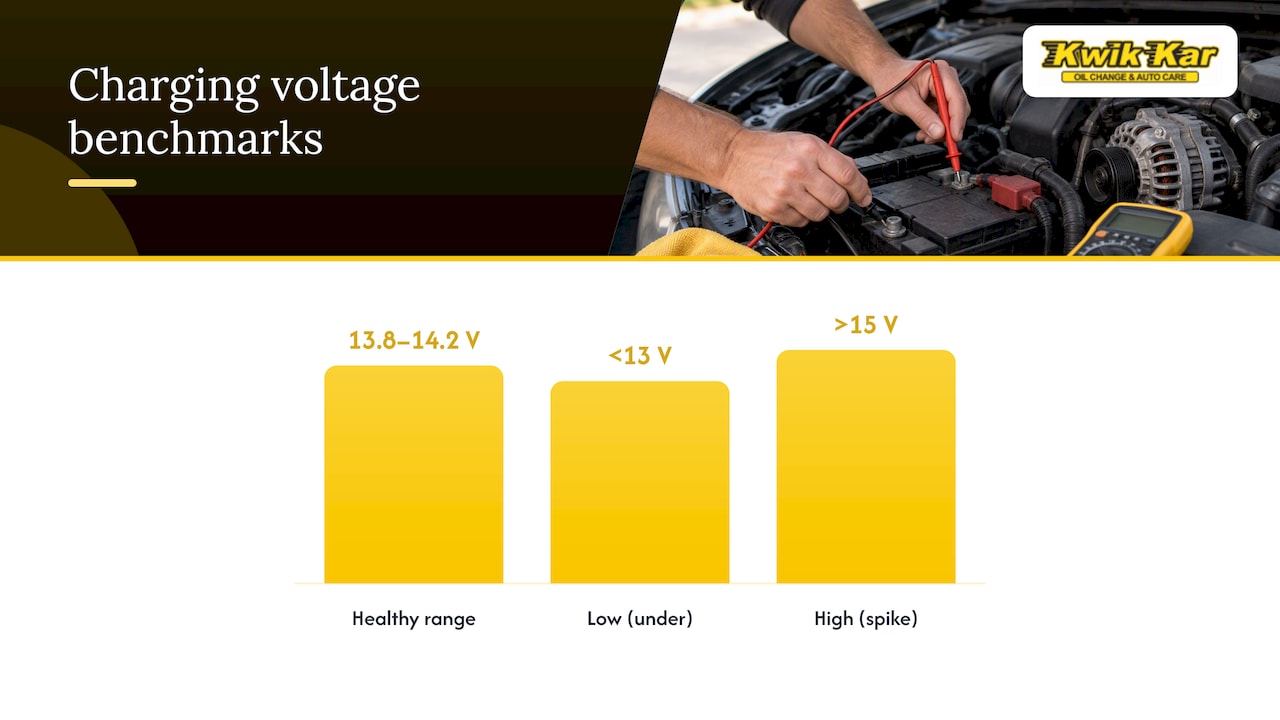
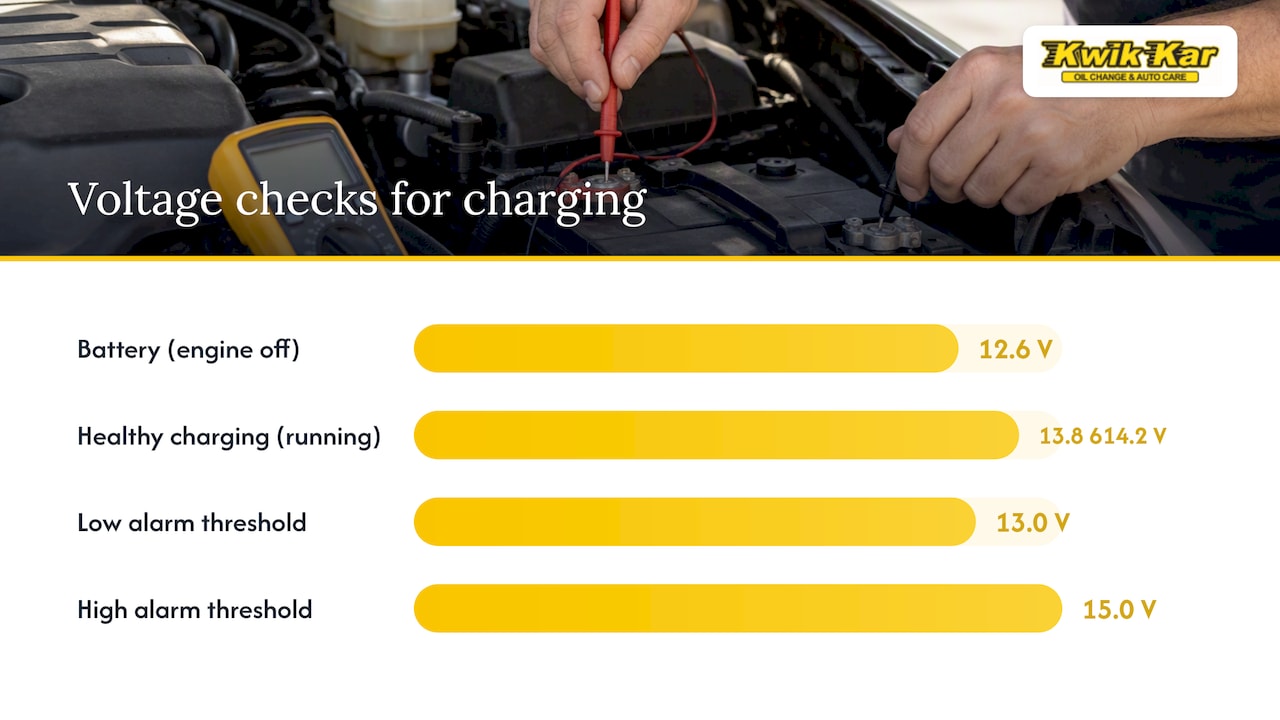
A healthy charging system typically reads 13.8 to 14.2 volts at the battery while the engine is running; readings below 13 volts or spikes above 15 volts point to a charging-system problem. (AAA) That range gives you a concrete benchmark if you own a multimeter, and it’s the same number a technician will check first during a charging system test.
One pattern trips up a lot of drivers: the car jump-starts fine, runs for a few minutes, and then dies again. It feels like a battery problem because the jump-start worked, but if a jump-start gets the car running and it dies again shortly after, that often points to a charging-system issue rather than a battery alone, according to RepairPal. The battery had just enough residual charge to get you moving, but without the alternator replenishing it, the engine stalls once that reserve runs out.
Alternator symptoms also tend to be inconsistent before they get serious. AAA Club Alliance notes that alternator failure signs are often variable and may appear first as minor accessory glitches, which is why testing under load, with headlights and the blower motor running, reveals more than a quick static voltage check.
3. Roadside and workshop tests to distinguish starter vs alternator
You don’t need a repair bay to narrow down the cause. A short, ordered sequence of checks, done safely, will point you toward the starter or the alternator before you spend money on parts.
- Look at the dashboard first. If the lights and accessories work normally but the engine won’t turn over, suspect the starter. If the battery warning light is on or lights are dim, suspect the alternator or battery.
- Attempt to start the car and listen closely. Clicking or silence with no crank points to the starter or its solenoid; a crank that struggles and slows down points to weak charging or a bad connection.
- Try a jump-start and watch what happens next. If the car starts and runs fine, the battery was likely just low. If it starts and then stalls again within a few minutes, the alternator likely isn’t recharging the battery.
- Check voltage with a multimeter. With the engine off, a healthy battery reads about 12.6 volts. With the engine running, you should see 13.8 to 14.2 volts; anything below 13 volts or above 15 volts signals a charging problem, per AAA.
- Run an accessory-load test. Turn on the headlights, blower motor, and rear defroster while the engine idles. If the lights dim noticeably or the voltage reading drops sharply, the alternator is likely struggling to keep up under load.
- Do a quick rev test. With a multimeter still connected, raise the engine speed slightly. Voltage should rise modestly and stabilize; if it stays flat or drops, the alternator may not be producing enough current.
Pro Tip: Write down your multimeter readings at idle and under load before you call a shop. It saves diagnostic time and helps a technician confirm your suspicion faster.
These tests are safe for most drivers to perform in a driveway with basic caution: keep hands and clothing away from the belt and fan, and never test voltage with wet hands or in the rain. If the car stalls repeatedly, smells like burning wire or rubber, or the readings fall outside the healthy range, stop troubleshooting on your own and have a professional confirm the diagnosis with proper bench and charging system equipment.
4. Common confounders: battery, grounds, fuses, and solenoids
Several components outside the starter and alternator can produce symptoms that look identical to either failure, and ruling them out first can save you from replacing a part that was never the problem.
A weak or corroded battery is the most frequent false lead. White or greenish buildup on the terminals, or a battery more than a few years old, can cause slow cranking, dimming lights, or intermittent no-start conditions that mimic both starter and alternator failure. A visual check of the terminals and a basic load test, which most auto parts stores and repair shops can run quickly, will tell you whether the battery itself is the weak link. Our guide to checking battery health walks through simple DIY checks you can do before assuming a bigger repair is needed.
Other components that can mimic starter or alternator problems:
- Corroded or loose battery terminals can starve the starter of current, producing clicking or slow cranking even with a healthy starter motor.
- A failed engine-to-frame ground strap can cause erratic electrical behavior that looks like a charging problem or a no-crank condition, since the entire electrical system relies on a solid ground path.
- A bad starter relay or blown fuse can cause clicking or a complete no-crank symptom that has nothing to do with the starter motor itself.
- A worn starter solenoid can cause intermittent starting issues that come and go, making the problem hard to reproduce for a quick test.
Before replacing either the starter or the alternator, a technician should verify a good ground connection and clean, tight battery cables, since many misdiagnoses trace back to a corroded clamp or a failed ground strap rather than the part everyone assumes is broken. If you’re heading to a shop, bring a short note of what you observed: when the symptom happens, any noises, your multimeter readings if you took them, and whether a jump-start helped. That checklist speeds up an accurate diagnosis considerably.
5. What to expect when you take the car to a shop
Once a symptom moves beyond a quick roadside check, a shop will run a more thorough sequence to confirm the actual cause rather than guessing from symptoms alone.
Typical steps in a professional starter and alternator diagnostic:
- Battery load test to confirm the battery itself holds a proper charge under demand.
- Charging system test with the engine running, checking voltage output at idle and under load.
- Starter bench test, where the starter is removed and tested under controlled power to confirm whether it engages and spins correctly.
- Visual inspection of belts, connections, and wiring to catch a slipping belt, damaged wiring, or corrosion that a voltage reading alone might miss.
RepairPal notes that professional shops bench-test starters and perform simultaneous starting-and-charging system tests to definitively identify the faulty component instead of guessing, which is the main advantage of a shop visit over trial-and-error part swapping.
Turnaround time depends heavily on the vehicle. Common starters and alternators for mainstream cars and trucks are often replaced same-day, since the parts are widely stocked. On some vehicles, though, the starter or alternator is tucked into tight engine packaging that requires extra disassembly, which extends both labor time and cost. Consumer Reports points out that starters are mechanically simple but can be hidden by vehicle design, meaning the labor to access and replace one can be the bigger cost driver rather than the part itself.
Cost varies by vehicle make, model, and labor complexity, so it’s worth getting a written estimate before any work begins rather than relying on a general number. A professional diagnostic upfront also protects you from paying for a new alternator when the actual issue was a corroded ground strap or a $10 fuse.
6. Why professional diagnostics matter for an accurate fix
A visual guess based on symptoms alone can point you in the right direction, but confirming the actual cause takes equipment most drivers don’t have at home. A starter or alternator concern typically starts with a visual inspection of belts, wiring, and connections, followed by voltage and charging system testing and a starter bench test when needed. Findings are documented in a digital vehicle inspection with photos and video, and a written estimate is provided before any work begins.
The technicians are ASE Certified Master technicians, and the shop has been recognized by RepairPal and NAPA AutoCare, organizations that vouch for shop quality and repair standards. That combination of certified expertise and transparent, upfront estimates means you’re not paying for guesswork.
If you’ve had repeated stalls, a failed jump-start that didn’t hold, or a burning smell from under the hood, it’s time to bring the car in rather than keep testing on your own. At the first appointment, expect a technician to walk through the same sequence of checks described above, then explain exactly what’s failing and what it will cost to fix before any work starts.
What the symptoms really tell you
The most useful thing a driver can do isn’t memorizing every symptom on a list. It’s learning the one distinction that actually matters: does the problem happen when you turn the key, or while the engine is already running? That single question filters out most of the confusion between starter and alternator failure faster than any checklist.
Where a lot of advice falls short is treating every dim light or slow crank as proof of a specific failing part. In practice, corroded terminals and bad grounds cause more false alarms than either the starter or alternator itself, and they’re the cheapest things to rule out first. Don’t skip that step just because it feels less satisfying than diagnosing “the real problem.”
If you take one thing from this, let it be this: test before you buy a part. A five-minute multimeter check or a jump-start-and-observe test costs nothing and prevents an unnecessary alternator replacement when the actual fix was a $10 ground strap.
— Kwik Kar
Schedule a starter or alternator check at Kwik Kar Spring Valley
If your car is showing any of the symptoms above, clicking instead of cranking, dimming lights, a battery warning light, or a stall after a jump-start, getting it checked before the problem strands you is the smart move. ASE Certified Master technicians run the same voltage, charging, and bench tests described in this guide, and customers receive a transparent estimate before any repair work starts, so there are no surprises when the invoice arrives.

You can see the full range of what we test and repair on our Alternators & Starters service page, or browse our complete auto repair services if you’re not yet sure what’s causing the issue. Booking is simple: call our Spring Valley Road location or request an appointment online.
One safety note worth repeating: if your car has stalled more than once or you’ve noticed a burning smell, don’t keep driving it hoping the problem resolves itself. Have it towed or driven directly in for diagnosis. Repairs are typically backed by warranty coverage, so customers are protected once the fix is made.
Sources
- 14 Reasons Why Your Car Won’t Start | AAA Automotive
- Warning Signs Of A Bad Alternator | AAA Club Alliance
- What Is a Starter Solenoid and How to Know If It’s Failing | Edmunds
FAQ
Is it more expensive to replace a starter or alternator?
Cost depends on the vehicle and how accessible the part is, since labor time often matters more than the part price itself. On some vehicles, tight engine packaging makes either job more labor intensive, according to Consumer Reports, so a written estimate from a shop is the only reliable way to know the cost for your specific car.
Do starters and alternators go bad at the same time?
They can fail independently or coincidentally, but one failing part doesn’t typically cause the other to fail. A dead battery caused by a bad alternator can sometimes strain the starter during repeated start attempts, which is why a full diagnostic check of both systems is worthwhile when symptoms overlap.
What can be mistaken for a bad alternator?
A weak battery, corroded terminals, or a failed engine-to-frame ground strap can all produce symptoms that look like alternator failure, including dim lights and hard starting. Testing the charging system directly with a multimeter, expecting 13.8 to 14.2 volts while running per AAA, is the clearest way to confirm the alternator itself is at fault.
How does a car act when the alternator is going out?
A failing alternator usually causes dim or flickering lights, a battery warning light on the dash, whining noises, or stalling while driving, according to AAA Club Alliance. A telltale pattern is a car that starts after a jump-start but stalls again shortly after, since the battery isn’t being recharged.