



R-134a and R-1234yf are the two refrigerants used in modern car air conditioning, and they are not interchangeable. R-1234yf has a far lower global warming impact and is mildly flammable. R-134a is non-flammable and was the standard for decades. The two use different service fittings and different service equipment, so your car’s under-hood label, not its model year, tells you which one it needs.
If you drive in Dallas, the stakes are practical. A/C works hard here from late spring through September, and knowing which refrigerant your car uses helps you avoid a wrong-gas mistake, a surprise on the estimate, or a DIY kit that does not fit.
TL;DR
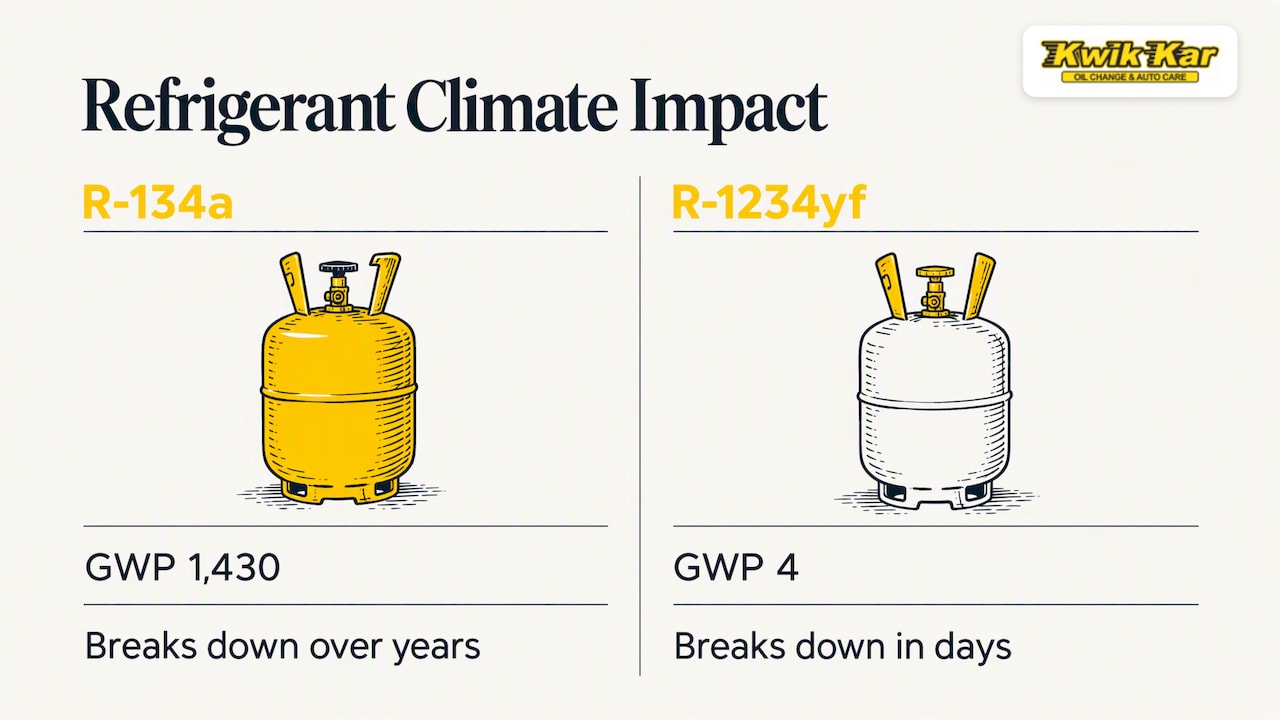
- R-134a is the older refrigerant (global warming potential of 1,430, non-flammable). R-1234yf is the newer one (GWP of 4, rated mildly flammable).
- They are not interchangeable. Each has its own service ports, and mixing them contaminates the system.
- Check the A/C label under the hood to see what your car uses. Do not guess from the model year, because manufacturers switched over several years.
- R-1234yf costs much more per pound, so recharges and repairs on newer cars usually cost more.
- If your A/C is weak, have it diagnosed before adding any refrigerant. Low refrigerant usually means a leak.
Table of Contents
- What is the difference between R-134a and R-1234yf?
- Why did carmakers switch to R-1234yf?
- Is R-1234yf as good at cooling as R-134a?
- Is R-1234yf dangerous because it is flammable?
- Can you use R-134a in an R-1234yf system, or the reverse?
- Which cars use R-1234yf?
- Why is R-1234yf so much more expensive?
- What this means for a Dallas driver
- Should you recharge the A/C yourself?
- Our perspective at Kwik Kar
- Get your A/C checked at Kwik Kar Spring Valley
- Frequently asked questions
- Sources
What is the difference between R-134a and R-1234yf?
Both are designed to do the same job: carry heat out of your cabin. The differences are in chemistry, environmental impact, safety classification and how they are serviced.
| Feature | R-134a | R-1234yf |
|---|---|---|
| Chemical family | HFC | HFO |
| Global warming potential | 1,430 | 4 |
| Atmospheric lifetime | About 12 years | About 11 days |
| Flammability class | A1, non-flammable | A2L, mildly flammable |
| Service fittings | Standard R-134a ports | Unique R-1234yf ports |
| Relative cost | Lower | Much higher |
| Typical vehicles | Older cars and many cars through the late 2010s | Newer cars, now the standard for new vehicles |
The global warming figures and lifetimes come from the EPA’s list of acceptable motor vehicle A/C substitutes, which puts R-1234yf at roughly a 99.7% reduction in warming potential compared with R-134a. Neither refrigerant harms the ozone layer. That was the problem with the older R-12 used in pre-1990s cars, as the EPA’s refrigerant overview explains.

Why did carmakers switch to R-1234yf?
The reason is climate impact. R-134a is a potent greenhouse gas when it leaks or is released at end of vehicle life. R-1234yf breaks down in the atmosphere in days rather than years, so a leak does far less long-term damage. For example, MACS described the 2017 Chevrolet Malibu as one of the vehicles moving to R-1234yf, with the GWP drop from 1,430 to 4 as the headline reason.
The switch did not happen on one date. Some brands moved early, others later, and some models changed partway through a model year. That is why the label matters more than the year.
Is R-1234yf as good at cooling as R-134a?
In a properly designed system, yes for practical purposes. One published comparison of the two in automotive A/C shows the two behave similarly, with small differences depending on the setup. Some lab studies that drop R-1234yf into a system built for R-134a find lower capacity. That is not how cars are built, though.
Automakers engineer R-1234yf systems around the gas. SAE reports that components such as internal heat exchangers help these systems match the cooling performance of R-134a systems. You should not expect your newer car to blow noticeably warmer air simply because it uses R-1234yf.
What matters more in Dallas heat is system condition: a clean condenser, a sealed system, a healthy compressor and the correct charge amount.
Is R-1234yf dangerous because it is flammable?
R-1234yf is classified ASHRAE A2L, meaning mildly flammable. R-134a is A1, non-flammable. The EPA’s rulemaking notes that R-1234yf only burns when its concentration in air falls within a narrow range, roughly 6.2% to 12.3% by volume, as the EPA final rule documents.
In practice, that is why the system design includes safeguards like unique fittings, pressure relief and leak management. For you as a driver, nothing changes day to day. The risk sits mostly with whoever opens the system, which is one more reason to leave A/C service to trained technicians. Both refrigerants can also displace air in enclosed, low spaces, so a garage with a leaking system should be ventilated.
Can you use R-134a in an R-1234yf system, or the reverse?
No. This is the most common mistake behind the “r134a or r1234yf” question, and it is worth being blunt about it.
- Different ports. The EPA requires unique service fittings for each refrigerant to prevent accidental mixing, and its guidance says an adapter may not be used to convert a fitting.
- Different equipment. Shops need approved recovery and recycling equipment for each refrigerant, per the EPA’s servicing requirements.
- Contamination. Mixed refrigerant cannot simply be topped off. It has to be removed and the system serviced properly.
- Warranty risk. Component makers warn that unauthorized substitution can void vehicle and component warranties.
This also answers a related question: no, your old R-134a gauges and can taps do not fit an R-1234yf system, and they should not. The fittings are intentionally different.
Which cars use R-1234yf?
Most new vehicles sold in the US today use R-1234yf. Many 2014 to 2020 models are in a gray zone, where one brand’s models may use either gas depending on model and build date. Older cars almost always use R-134a.
Here is how to be certain in about a minute:
- Open the hood and look for the A/C refrigerant label, usually on the radiator support, underside of the hood or near the strut tower.
- Read the refrigerant type (R-134a or R-1234yf) and the charge amount.
- Look at the service ports. R-1234yf ports are a different size and design than R-134a ports.
- If the label is missing or unreadable, check the owner’s manual or ask a shop to confirm.
The EPA also requires color-coded labels for each refrigerant, which is part of why the label is the reliable check.
Why is R-1234yf so much more expensive?
It is a newer, more complex molecule with a smaller supply base. MACS reported a 2016 analysis in which R-1234yf cost up to 39 times more than R-134a. Prices have changed since, so treat that as an indicator of the gap rather than today’s price list.
Two effects follow for you:
- Newer systems hold less refrigerant. Automakers have reduced charge volumes to limit cost, so your car may take noticeably less refrigerant by weight than an older one.
- Small leaks matter more. A leak that was a nuisance on an R-134a car can become an expensive top-off on an R-1234yf car, so finding the leak is the better money decision.
We do not publish a flat A/C price, because the cost depends on your vehicle, the refrigerant and what the diagnosis finds. You get an estimate before work begins.
What this means for a Dallas driver
North Texas summers put real strain on A/C. Stop-and-go traffic on Central Expressway, the Dallas North Tollway and I-635 keeps the condenser from getting the airflow it gets at highway speed, and long commutes mean the system runs for hours at a stretch. Heat does not change which refrigerant you need, but it exposes weak points fast: a worn compressor, a clogged condenser, a slow leak or a missing service port cap.
Some habits help whichever refrigerant you have:
- Have the A/C checked in spring, before the first 100-degree week, not after.
- Keep the condenser at the front of the car free of debris and bugs.
- Make sure the service port caps are on. They act as a primary seal, and MACS notes that missing caps are a common issue technicians see.
- If the air gets weaker over weeks, treat it as a leak until proven otherwise. Our guide to car A/C that is not blowing cold walks through the common causes.
Should you recharge the A/C yourself?
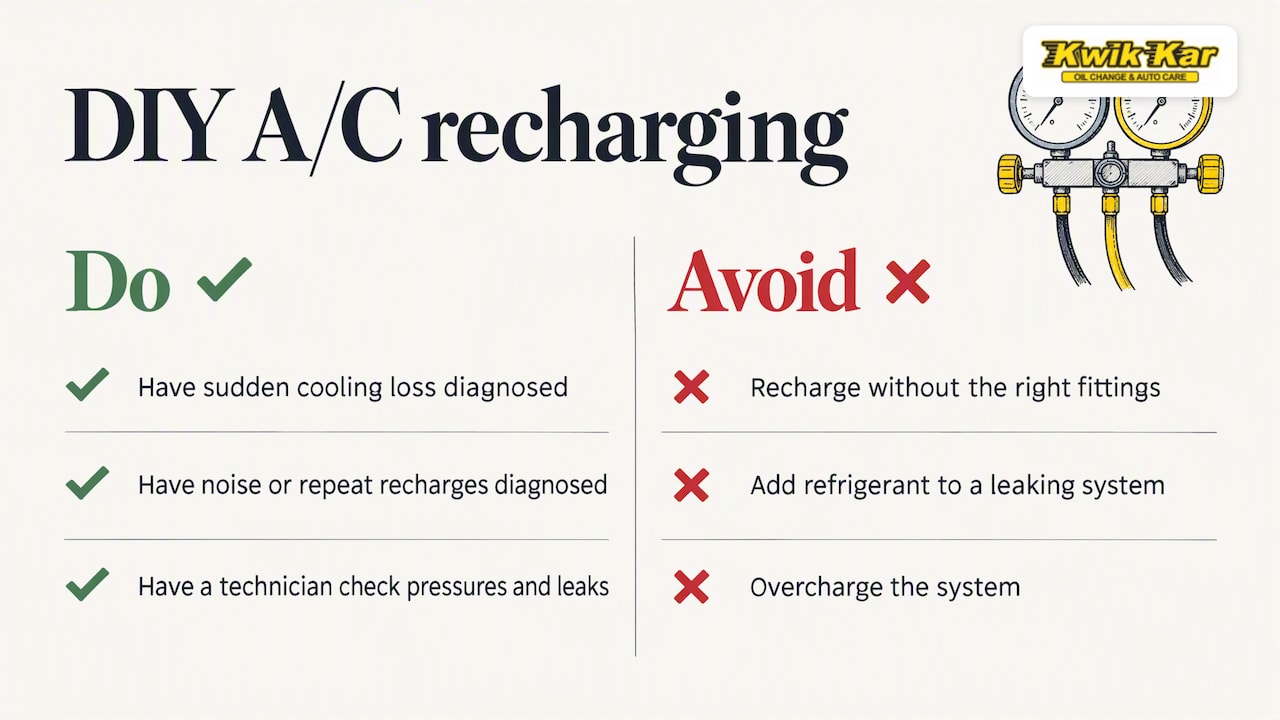
It depends on the refrigerant, and for most newer cars the answer is no. R-1234yf systems need the right fittings and equipment, and a recharge can that adds refrigerant to a system with a leak only delays the problem. Overcharging can also reduce cooling and stress the compressor. If your car uses R-134a and the system is only slightly low, a DIY kit is physically possible, but you will not know why it is low.
If the A/C stopped cooling suddenly, makes noise, or has been recharged more than once, have it diagnosed. A technician can check pressures, look for leaks and tell you whether the cause is refrigerant at all. Several different faults, from a failed compressor clutch to a blend door problem, can feel the same from the driver’s seat.
Our perspective at Kwik Kar
We see A/C questions every summer, and the pattern is consistent: drivers ask which refrigerant to buy when the better question is why the system lost it. Our approach is diagnosis first. Our ASE-certified technicians check the system, confirm the refrigerant type from the label and the ports, and we give you an estimate before any work starts. Our digital vehicle inspections include photos and video, so you can see what we see.
We would rather you spend money on the actual repair than on repeated top-offs. Matching the right refrigerant and the right equipment to your vehicle is part of doing that properly, whether the car is a domestic or an import.
— Kwik Kar
Get your A/C checked at Kwik Kar Spring Valley
If your A/C is weak or you are not sure which refrigerant your car uses, our air conditioning service and repair covers diagnosis, leak checks and repair for domestic and import vehicles. We are at 8280 Spring Valley Rd, Dallas, TX 75240, serving North Dallas, Far North Dallas, Addison, Richardson and Farmers Branch. Qualifying repairs may be covered by our 24-month/24,000-mile warranty, subject to its terms. You can schedule an appointment online, and you can see everything we do on our website.
Frequently asked questions
Is R-1234yf better than R-134a?
For the environment, yes: its global warming potential is 4 versus 1,430. For cooling in a system designed for it, performance is comparable. R-134a is cheaper and non-flammable, but it is being phased out of new vehicles. Neither is better in a system built for the other.
Can I use R-134a instead of R-1234yf to save money?
No. The fittings are different and an adapter is not allowed. Mixing refrigerants contaminates the system and can void warranties. A shop would have to recover the mixed refrigerant and service the system properly, which costs more than the savings.
Are R-134a and R-1234yf pressures the same?
Operating pressures are similar, but the similarity is not a reason to treat them as the same. Oil, seals, fittings and safety design differ. Use the gauges and equipment made for your vehicle’s refrigerant, or have a technician do it.
How do I know which refrigerant my car uses?
Read the A/C label under the hood and compare the service ports. Do not rely on model year alone, because manufacturers changed over gradually. If you cannot find the label, ask a shop to confirm before anything is added to the system.
Does Texas still require inspections that affect my A/C?
A/C is not part of any inspection. Most non-commercial vehicles in Texas no longer need a safety inspection as of January 1, 2025, per the Texas DPS. Vehicles registered in emissions counties, which includes Dallas County, still need emissions testing, and qualifying commercial vehicles remain subject to applicable safety inspection rules.
Sources
- EPA: Substitutes in MVAC passenger air conditioning
- EPA: Acceptable refrigerants and their impacts
- EPA: Listing of HFO-1234yf under SNAP, final rule
- EPA: Unique fittings and label colors
- EPA: Regulatory requirements for MVAC system servicing
- SAE: Q&A on R-1234yf refrigerants
- SAE: Comparative study of R134a, R1234yf and R407C on evaporator performance
- MACS: Chevrolet Malibu keeps you cool with R-1234yf
- Texas DPS: Vehicle safety inspection program changes