



The battery starts the engine, and the alternator keeps the car running and recharges the battery while you drive. If the car won’t crank, or cranks slowly or only clicks, the battery is the usual suspect. If the car starts (often after a jump) but dies again soon, or the lights dim while you drive, the alternator is more likely the problem. A simple voltage reading takes the guesswork out, and a full charging-system test confirms it.
This guide explains what each part does, how the symptoms differ, what the numbers on a multimeter mean, and the mistakes that lead drivers to replace the wrong part. We wrote it for everyday drivers in Dallas, from Spring Valley Road to Addison, Richardson and Farmers Branch, who want a straight answer before spending money.
TL;DR
- Battery trouble shows up at startup: slow cranking, clicking, or no crank at all.
- Alternator trouble shows up after startup: dimming or flickering lights, a battery warning light, whining noises, or a car that dies soon after a jump.
- A healthy battery reads about 12.6V with the engine off, and a working charging system reads roughly 13 to 14.5V with the engine running.
- A drive belt, loose or corroded cables, or the starter can mimic both failures, so test the whole system before replacing parts.
- If you are stuck or unsure, have the car tested professionally rather than driving until it dies.
Table of Contents
- What does each part actually do?
- Bad battery or bad alternator: the symptom comparison
- Is it the alternator or the battery? A step-by-step check
- Why does a car die after a jump-start?
- What else can look like a battery or alternator problem?
- Can you test it for free?
- When should you stop driving and get it tested?
- Our perspective: test the system, not just the part
- Battery and alternator service at Kwik Kar Spring Valley
- Texas inspection rules and your electrical system
- Keeping the charging system healthy
- FAQ
- Sources
What does each part actually do?
Think of the two as a team with different jobs. The battery stores electrical energy. It delivers the burst of power the starter motor needs to turn the engine over, and it powers the lights, dashboard and electronics when the engine is off.
The alternator is a generator driven by the engine’s belt. Once the engine is running, it supplies electricity to the whole car and sends the surplus back to the battery. The battery is not meant to run the car by itself for long. If the alternator stops charging, the car runs on stored battery power until that power is gone, and then it stalls.
That is why the two failures feel so similar. A dead alternator eventually produces a dead battery, and a weak battery can make a healthy alternator work harder than it should.
Bad battery or bad alternator: the symptom comparison
The most useful question is when the problem appears: before the engine starts, or after.
| What you notice | More likely the battery | More likely the alternator |
|---|---|---|
| Car won’t crank | Yes, especially with a clicking sound | Only if the battery is already drained by a charging fault |
| Slow, labored cranking | Yes, common in cold or old batteries | Possible if the battery has been undercharged |
| Starts with a jump, then runs fine for days | Yes, the battery just needed charge or is aging | Unlikely |
| Starts with a jump, then dies soon after | Less likely | Yes |
| Headlights dim or flicker while driving | Less likely | Yes |
| Battery or charging warning light on | Possible | Yes, often |
| Whining or grinding from the engine bay | No | Possible |
| Burning smell | No | Possible (belt or alternator) |
Signs of a bad battery
AutoZone’s guide lists the common bad battery symptoms as a car that won’t start, a clicking sound with no engine turnover, or very slow cranking, and it notes that low temperatures can also slow cranking. Other clues include a battery that is several years old, corrosion on the terminals, and a car that starts fine after a long drive but struggles after sitting.
In North Texas, summer heat is hard on batteries even though the failure often shows up later. A battery weakened by months of high under-hood temperatures may work through July and then fail on the first cool morning. If your battery is past the three-to-five-year range and the car is starting slowly, get it tested before it strands you.
Signs of a bad alternator
Alternator symptoms tend to appear while the engine is running. AutoZone’s testing guide lists dimming or flickering lights, a battery warning light, burning smells, and grinding or whining noises. HELLA’s technical guide adds that headlamp brightness that changes with engine RPM and bulbs burning out unusually quickly can point to the alternator, as can starting difficulty caused by a battery the alternator has left undercharged.
Fleet and truck owners see the dimming symptom often. If you manage vehicles with LED lighting, this overview of LED lights dimming on fleet vehicles covers yard checks that help separate wiring and voltage problems from lamp problems. For a deeper look at our own list of warning signs, see our guide on alternator going bad signs.
Is it the alternator or the battery? A step-by-step check
You do not need a shop to get a first read. You need a basic multimeter and ten minutes. If you are not comfortable working near a battery, skip to the professional option below.
- Look first. Check the terminals for white or blue-green corrosion and make sure the cable clamps are tight. A loose connection can imitate a dead battery or a dead alternator.
- Charge the battery fully. Haynes recommends fully charging the battery with an external charger and making sure the terminals are clean and tight before you troubleshoot the electrical system. Testing a half-dead battery gives misleading results.
- Measure with the engine off. A good battery should read about 12.6V. Much lower means it is discharged, aging or both.
- Measure with the engine running. AutoZone puts a working alternator at 13 to 14.5V at the battery. Haynes gives about 13.5V at idle and more than 14V with the engine revved. If the reading stays at battery level or drops, the alternator is not charging.
- Add load. HELLA’s procedure measures output with the engine running and electrical loads applied, such as headlights, blower and rear defroster. A charging system that holds voltage at idle but collapses under load is a weak alternator.
What the numbers tell you
| Reading | What it suggests |
|---|---|
| About 12.6V, engine off | Battery is charged and healthy |
| Well below 12.4V, engine off | Battery is discharged or failing |
| 13 to 14.5V, engine running | Charging system is working |
| Same as the resting battery voltage, engine running | Alternator is not charging |
| Noticeably above the normal range | Regulator problem, possible overcharging; have it checked |
Exact specifications vary by vehicle, so your manufacturer’s service information is the final word. Treat these ranges as a screening tool, not a verdict.
One test to never do
You may have heard of pulling a battery cable with the engine running to see if the car stays alive. Don’t. Car Talk warns that modern electronic voltage regulators can be damaged by this old trick, and recommends an output test instead. HELLA likewise says never to disconnect or short battery terminals while the engine is running, because voltage peaks can cause damage.
Why does a car die after a jump-start?
A jump-start supplies the power the engine needs to crank. Once the engine is running, the alternator is supposed to take over. If it can’t, the car is running on whatever reserve is left in the battery, and the jumper cables only delayed the problem. AutoZone notes that a car that starts after a jump but dies shortly afterward may have an alternator that isn’t functioning properly.
How long it will run depends on the battery’s condition, how many accessories you are using, and whether it is daytime or night. We can’t give you a reliable number of minutes or miles, and you should not trust anyone who does. Headlights, the A/C blower and the radio all pull power. In Dallas stop-and-go traffic on a summer afternoon, with the A/C running full, a failing alternator can leave you stalled in a lane quickly.
If the car starts after a jump and then runs fine for days, the battery was probably the problem. If it needs a jump again the next morning, the battery may be failing, or something may be draining it. We cover that in our guide to what causes a car battery to drain overnight.
What else can look like a battery or alternator problem?
This is where many drivers replace a good part. Several components create the same symptoms.
The starter
The starter motor is the third piece of the starting system. A bad starter often gives a single loud click, or a whirring sound with no engine turnover, while the lights and dashboard stay bright. A dead battery usually dims everything and may produce rapid clicking. Our guide on starter vs. alternator symptoms walks through the quick checks that separate them.
The drive belt and tensioner
The alternator is spun by the serpentine belt. A loose, glazed or broken belt, or a weak tensioner, means the alternator can’t turn properly even if the alternator itself is fine. A squealing sound on startup or when the A/C kicks on is a clue. HELLA advises checking the battery, electrical connections, belt and belt tensioner before replacing an alternator.
Cables, grounds and connections
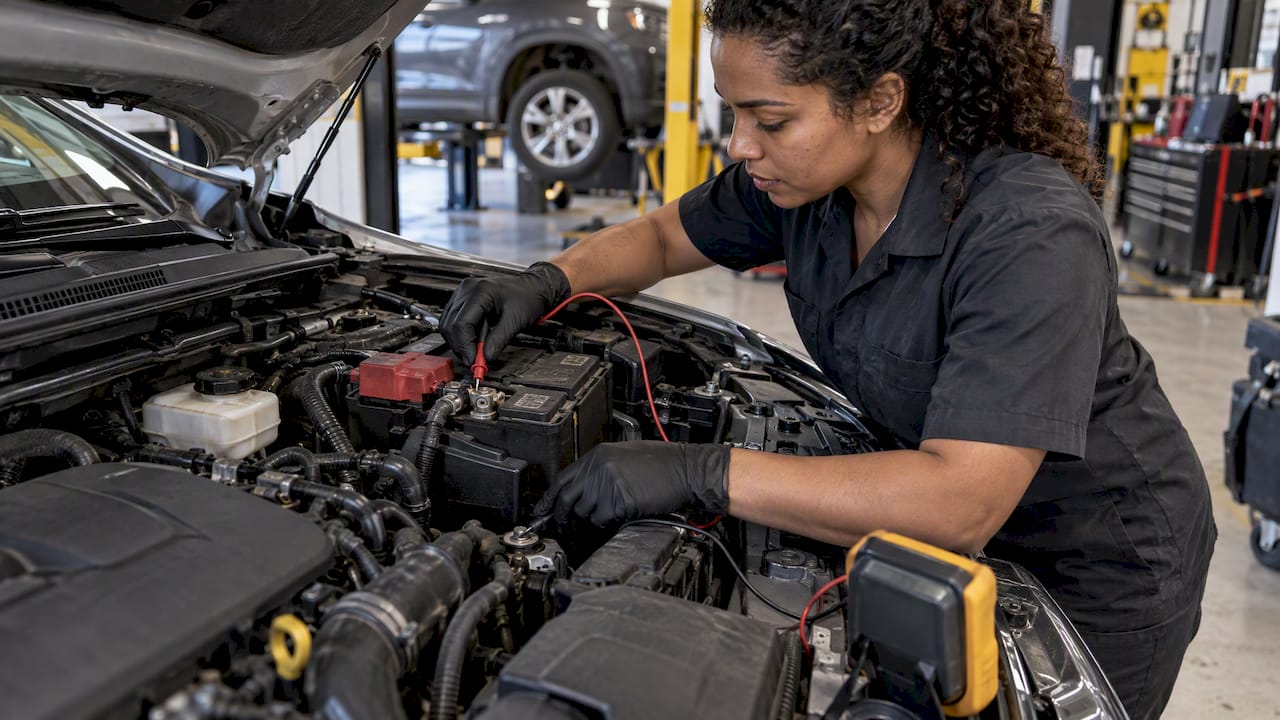
Corroded or loose cables add resistance. Current has to flow through them, and the car behaves as if the battery or alternator were weak. Technicians use a voltage drop test, which measures voltage across a connection while current flows and reveals excessive resistance in cables and connections. You cannot see that with your eyes.
Internal alternator faults
When the alternator itself is at fault, Haynes lists causes such as a loose or missing belt, broken electrical connections, internal shorts in the windings, mechanical faults or bad diodes. Some of those are repairable cheaply. Others mean a replacement alternator.
Heavy electrical add-ons
High-power aftermarket accessories, such as large subwoofers, can reduce the power available to recharge the battery and may call for an alternator upgrade. If your battery problems began after adding a sound system, lights or a winch, mention it to your technician.
Can you test it for free?
Often, yes. Haynes notes that a local auto parts store can usually bench-test an alternator’s output for free, which means you remove the part first. A bench test is only one piece of the picture, though. It does not catch a worn belt, a corroded cable or a battery that tests fine at rest but fails under load. A full charging-system test on the vehicle checks the battery, the cables, the belt and the alternator together, which is the approach HELLA’s guidance recommends: examine the complete system instead of replacing the alternator from symptoms alone.

When should you stop driving and get it tested?
Some situations are not worth gambling on.
- The battery light comes on while driving. The charging system may not be working. Turn off nonessential electrical loads and head to a safe place for testing, rather than continuing a long trip.
- Headlights dim at night or on the highway. Losing power at speed is a safety problem, not just an inconvenience.
- You needed a jump twice in a week. Something is wrong, either with the battery or with the charging system or a drain.
- The car stalls while moving. Power steering and brake assist feel different when the engine quits. Get the car towed or tested before driving again.
- You smell burning or hear grinding. Stop and have it inspected. A seized alternator can shred a belt that also drives other components.
If you are planning a long drive, such as a road trip out of Texas, test the battery and charging system beforehand. A failure at a small-town exit costs far more in time and stress than a quick test at home.
Our perspective: test the system, not just the part
We see the same pattern often. A driver replaces a battery, the car dies a week later, and the real cause was a worn belt, a corroded ground or a weak alternator that was slowly killing every battery installed. The reverse happens too: a driver pays for an alternator when the old battery was the weak link.
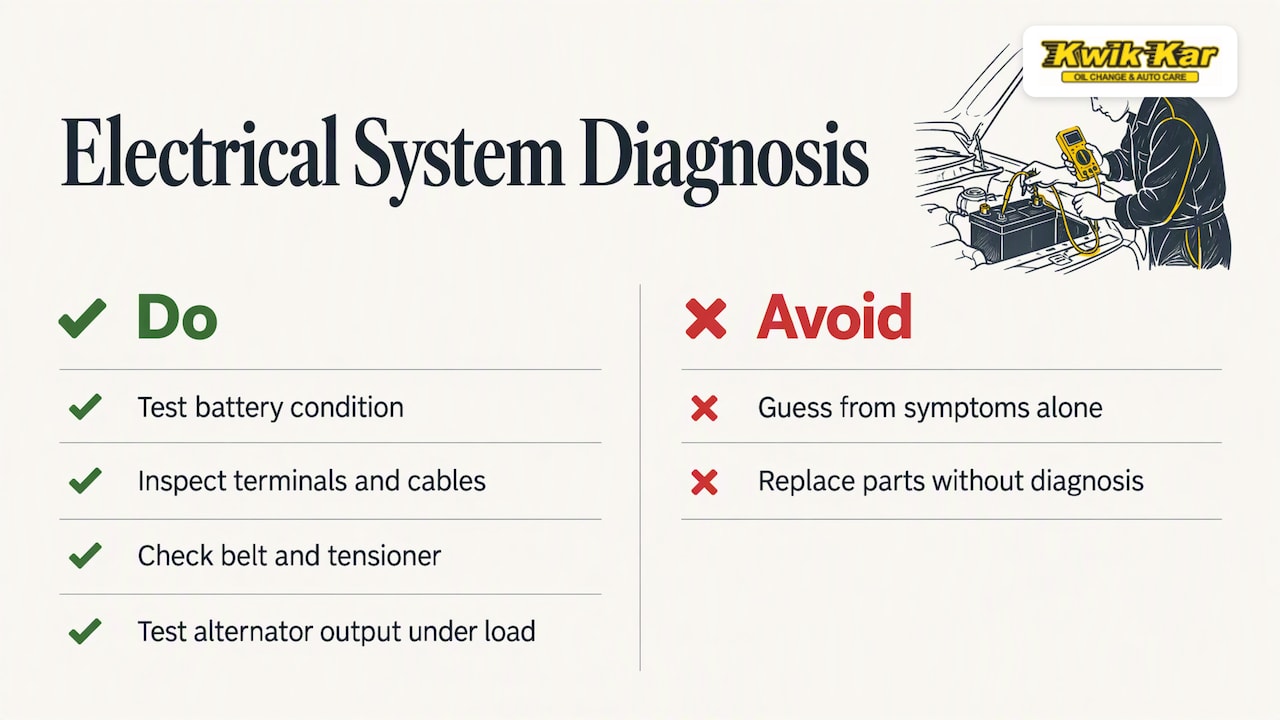
That is why we start with a diagnosis. Our ASE-certified technicians check the battery’s condition, the terminals and cables, the belt and tensioner, and the alternator’s output under load. We give you an estimate before any work begins, and our digital vehicle inspections can include photos and video, so you can see what we see. Our advice is simple: if you are guessing, test first. If you are not sure, have it diagnosed. Replacing parts from symptoms alone is the most expensive way to fix an electrical problem.
And when a repair qualifies, our 24-month/24,000-mile warranty applies, subject to its terms.
— Kwik Kar
Battery and alternator service at Kwik Kar Spring Valley
If your car is showing any of these symptoms, our team at 8280 Spring Valley Rd, Dallas, TX 75240 can test the battery, starter and charging system, and explain the results in plain language before you decide on a repair. See our alternator and starter repair page, or browse everything we do at kwikkarspringvalley.com. We serve drivers across North Dallas and Far North Dallas, including Addison, Richardson and Farmers Branch, and we handle domestic and import vehicles as well as fleet vehicles.
If your car is struggling to start, schedule an appointment and we will get it tested.
Texas inspection rules and your electrical system
A quick note, since drivers often ask. Under House Bill 3297, non-commercial vehicles in Texas no longer need a safety inspection before registration as of January 1, 2025, though a replacement fee still applies at registration. The Texas DPS also stresses that emissions tests are separate: vehicles registered in emissions counties still need them, and Dallas County is one of those counties. Qualifying commercial vehicles remain subject to applicable safety inspection requirements. A failing charging system can trigger warning lights and check engine codes, so sort it out before your emissions test, not after.
Keeping the charging system healthy
A few habits make a difference, and none require tools.
- Have the battery tested at each oil change once it is a few years old, especially before summer and before winter.
- Keep the terminals clean and tight.
- Replace worn belts on the interval your owner’s manual recommends.
- Avoid using the battery to power accessories with the engine off.
- Take frequent short trips? Short drives may not give the alternator time to fully recharge the battery, so an occasional longer highway drive helps.
- Follow your manufacturer’s guidance for the battery type your car requires, since some vehicles with start-stop systems need a specific battery.
FAQ
How do I know if it’s the alternator or the battery?
Check when the problem happens. If the car won’t crank, or cranks slowly or only clicks, suspect the battery. If it starts but dies, or the lights dim and the battery light comes on while driving, suspect the alternator. A multimeter reading of about 12.6V with the engine off and 13 to 14.5V running helps confirm which one it is.
How can I tell if my alternator is bad?
Watch for dimming or flickering lights, a battery or charging warning light, whining or grinding noises, a burning smell, and a car that dies soon after a jump-start. Headlights that brighten and dim with engine speed are another sign. Because a worn belt, loose cable or weak battery can look the same, have the full charging system tested before buying an alternator.
Can a bad alternator ruin a new battery?
Yes, it can. An alternator that undercharges leaves a battery drained, and deep discharge shortens battery life. An alternator that overcharges can also damage it. That is why a new battery should come with a charging-system test.
Can I drive with a bad alternator?
Only briefly, if at all. The car runs on battery reserve until it is used up, and then it stalls, which can happen in traffic or at night with the lights off. If the battery light is on, turn off nonessential electrical loads and get to a safe place or a shop right away.
Can the starter cause the same symptoms?
Yes. A failing starter can cause a car to click or not crank even when the battery is fine. The difference is that with a bad starter the lights and dashboard usually stay bright, while a dead battery dims them. A technician can test all three parts in one visit.
Sources
- Signs of a Bad Battery vs. Bad Alternator, AutoZone
- How to Test an Alternator with a Multimeter, AutoZone
- Troubleshooting Common Charging System Issues and Causes, Haynes
- Checking the alternator, HELLA
- Service work on the charging system, HELLA
- Best way to safely test an alternator, Car Talk
- Starting an Electrical System Diagnosis, Tomorrow’s Technician
- Vehicle Safety Inspection Program Changes Now in Effect, Texas DPS
- 6 Yard Checks to Fix LED Dimming on Fleets