


The most common ball joint symptoms are a clunk or knock from the front suspension over bumps, steering that feels loose or wanders, a shimmy in the steering wheel, and tire wear on the inner or outer edge. Any of these deserves a prompt inspection, because a badly worn ball joint can separate and let the wheel lose its position. If you drive around Spring Valley Road, North Dallas, Addison, Richardson or Farmers Branch and notice one of these signs, here is how to read it and what to do next.
TL;DR
- A faint, intermittent clunk from one corner of the car, often over bumps, dips or turns, is usually the first sign of ball joint wear.
- Loose or wandering steering, vibration through the wheel, and uneven tire wear point the same way, but each can also come from other parts.
- Tie rods, control arm bushings and wheel bearings can mimic a bad ball joint, so a hands-on inspection matters more than guessing from the noise.
- Treat suspected ball joint wear as urgent: severe wear can let the joint separate and cause loss of control.
- We can inspect your front end and explain what we find before any work begins.
Table of Contents
- What does a ball joint do?
- The main ball joint symptoms
- What else can be mistaken for a bad ball joint?
- Ball joint or tie rod: how can you tell?
- How is a bad ball joint diagnosed?
- Can you keep driving on a bad ball joint?
- What causes ball joints to wear out?
- Our perspective on ball joint symptoms
- Ball joint replacement: what to expect
- Book a front-end inspection at Kwik Kar Spring Valley
- How to describe your symptoms to a technician
- Keeping your front end healthy
- FAQ
- Sources
What does a ball joint do?
A ball joint is a pivot. It connects the steering knuckle (which holds your wheel) to the control arms, and it lets the wheel move up and down with the road while also turning left and right. Think of it as a hip joint for your front wheel: a ball and socket, packed with grease and sealed in a rubber boot.
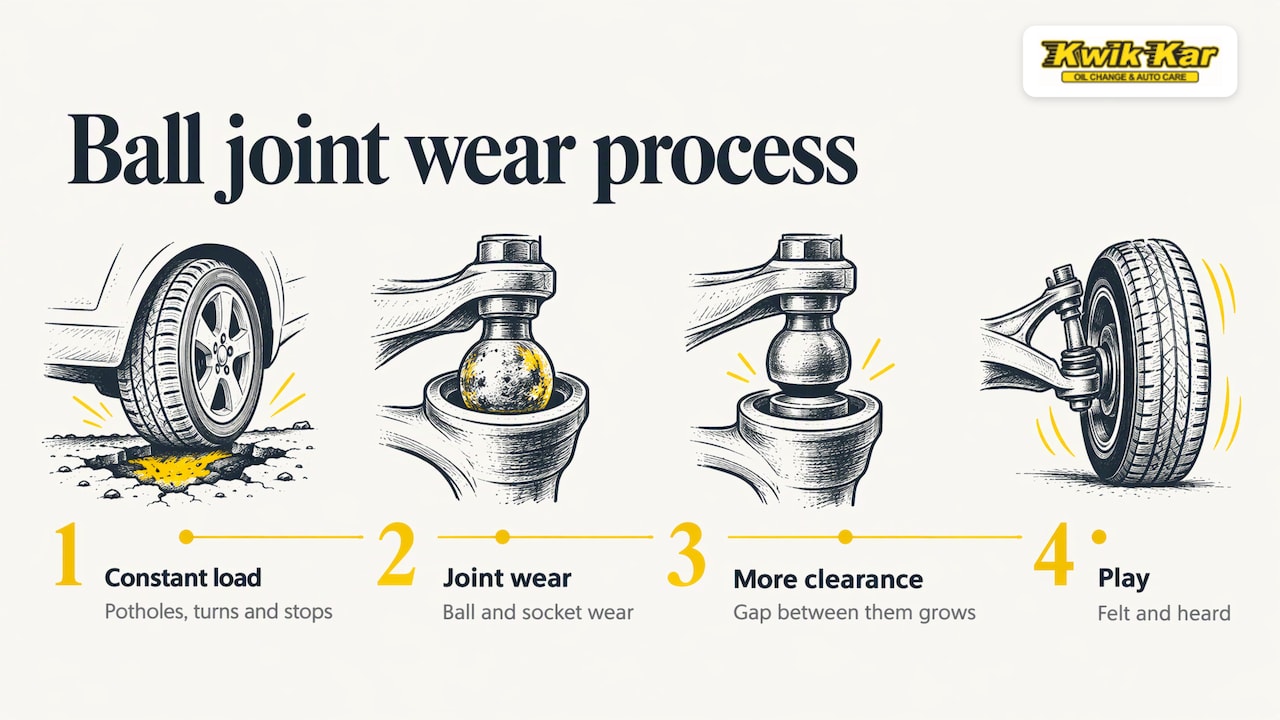
Because it handles both suspension motion and steering, a ball joint takes constant load. Every pothole, every turn and every stop transfers force through it. Over time the ball and socket wear, the clearance between them grows, and the joint develops play. That play is what you feel and hear.
The main ball joint symptoms
Clunking or knocking over bumps
This is the symptom most drivers notice first. MOOG Parts describes the earliest sign of a worn or loose ball joint as a faint, intermittent clunk from one corner of the vehicle. It can grow louder and more frequent over time, and it tends to show up over bumps, dips or while cornering.
If you are searching for why your car is clunking over bumps, a ball joint is a prime suspect, but not the only one. We cover the look-alikes below.
Loose, sloppy or wandering steering
When a joint has play, the wheel can shift slightly on its own instead of following your steering input. AutoZone lists loose or wandering steering as a classic sign. You may find yourself making small corrections on a straight stretch of highway, or feel the car drift left or right after hitting a bump. MOOG also notes that steering can feel sloppy or, in some cases, stiff.
Steering wheel vibration or shimmy
A worn ball joint can let the wheel oscillate at speed. Per MOOG Parts, worn joints can cause a front-end shimmy that you feel through the seat, the steering wheel or even the brake pedal. Vibration has many other causes, including unbalanced tires and warped rotors, so it is a clue rather than a verdict.
Uneven tire wear
When a ball joint lets the wheel tilt out of its intended angle, the tire no longer meets the road flat. AutoZone notes that wear concentrated on the inner or outer shoulder of the tire can point to a bad ball joint. If you want to understand the wider causes, our guide to what causes uneven tire wear walks through alignment, inflation and suspension.
A quick symptom reference
| What you notice | Where it shows up | Ball joint likelihood | Other possible causes |
|---|---|---|---|
| Clunk or knock over bumps | Front corner, often one side | High if sharp and metallic | Worn bushings, sway bar links, struts |
| Loose or wandering steering | Highway driving, lane changes | High | Tie rod ends, alignment, wheel bearings |
| Steering wheel shimmy | Mid to high speeds | Possible | Tire balance, warped rotors, bearings |
| Inner or outer tire edge wear | Front tires | Possible | Alignment, worn tie rods, low pressure |
| Pull to one side after bumps | Whole vehicle | Possible | Alignment, brake drag, tire problems |
What else can be mistaken for a bad ball joint?
This is the part that most articles skip, and it is where a careful inspection earns its keep. Vehicle Service Pros points out that suspension noises travel through the chassis, so the spot where you hear a sound is not always the spot where the problem sits. Their guidance is that a noise alone does not make a diagnosis; the vehicle should be road-tested and inspected step by step.
The usual look-alikes:
- Control arm bushings. These rubber sleeves cushion the control arm. When they crack or tear, you tend to get duller thuds, creaks or vibration over bumps, while a bad ball joint more often gives a sharper metallic click or pop during steering, according to A-Premium’s comparison.
- Tie rod ends. These are the steering links. Wear here also creates looseness and uneven tire wear. See our guide to the symptoms of a bad tie rod for how they feel.
- Wheel bearings. Vehicle Service Pros notes a growl or whine can indicate a worn bearing or tire rather than a joint. Our page on wheel bearing noise explains how those sounds change with speed and turning.
- Struts and sway bar links. These can rattle over small bumps and sound a lot like a ball joint to the untrained ear.
- CV axles. Clicking when turning can be a CV joint instead. Compare with our guide to CV axle symptoms.
If your noise is hard to place, our broader guide on a car making a loud noise can help narrow it down before you visit.
Ball joint or tie rod: how can you tell?
Shops use a simple wheel-rocking check with the front end safely lifted and supported. Grip the tire at 3 and 9 o’clock and push and pull. Play here points toward the steering linkage, meaning tie rod ends. Then grip at 12 and 6 o’clock and rock the wheel in and out. Play here can indicate ball joint wear. A brake and front end service article describes the same two-position shake as a way to check the tie rod ends and the side movement of the ball joint.
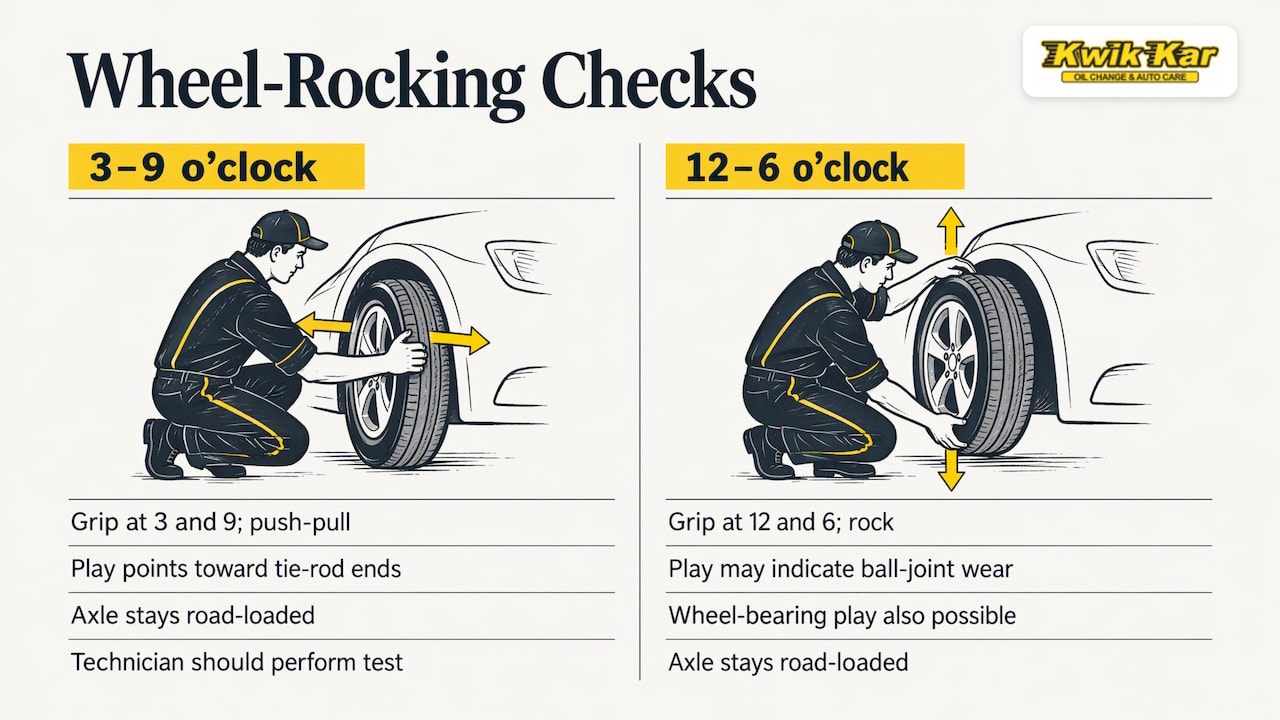
Two cautions apply. Wheel bearings can also show play in the 12 and 6 test, so the result alone does not name the part. And testing conditions matter: ZF Aftermarket advises that the axle should remain loaded as it would be on the road, and that an experienced technician should perform the test. Some designs read differently when the load is taken off the joint, which is one reason this is not a good driveway guess.
How is a bad ball joint diagnosed?
A proper inspection is more than a shake of the wheel. In general it includes:
- A road test or ride-along. The technician listens for the noise, feels the steering and notes when it happens: over bumps, in turns, braking or at speed.
- A visual check. The boot on each ball joint is examined for tears. A torn boot lets dirt and water in, and Hagerty explains that grit grinds into the socket and speeds up wear.
- A movement check. The wheel is moved vertically and the technician feels and listens for play. AutoZone notes that a dial indicator can help measure the wear.
- A look at the neighbors. Tie rods, bushings, bearings, struts and tires are checked together. The ASE study guide for automobile technicians frames steering pull, vibration and looseness as concerns that call for a systematic look at the related steering and suspension parts rather than assuming one part has failed.
At Kwik Kar Spring Valley, our ASE-certified technicians do this kind of inspection, and our digital vehicle inspections can document what they see with photos and video, so you can see the worn part or torn boot for yourself before you decide.
Can you keep driving on a bad ball joint?
The short answer is that you should not plan to. The risk is the failure mode. AutoZone warns that a ball joint can separate, which can leave the vehicle undrivable and risk an accident if the wheel is no longer held in position. MOOG Parts adds that severe wear can allow the stud to separate from its housing and cause an immediate loss of control.
How urgent is it? Delphi’s guidance on worn steering and suspension parts says a vehicle with symptoms of worn ball joints should be brought in for inspection immediately, and worn joints should be replaced. Use this as a practical rule:
- Faint, occasional clunk, steering still feels normal: book an inspection this week and avoid highway speeds and rough roads until then.
- Louder or more frequent clunking, noticeable steering looseness or wander: schedule the earliest available appointment and keep trips short and slow.
- Loud popping, significant wheel play, or the car pulls or wobbles suddenly: stop driving. Per A-Premium, a worn ball joint is a severe safety hazard, and loud popping or major wheel play is a signal to stop and have it inspected rather than keep going. Arrange a tow if needed.
What causes ball joints to wear out?
Ball joints do not fail on a schedule. Several things shorten their life:
- Mileage and normal wear. Every bump and turn cycles the joint.
- Torn boots and lost grease. Once the boot tears, grease escapes and dirt and water get in. The joint then wears from the inside.
- Rough roads and potholes. Hard impacts load the joint far beyond ordinary driving.
- Corrosion. In a 2021 recall report on one manufacturer’s trucks, NHTSA records show corrosion of the factory ball joint as a common cause in failure claims, and the remedy included upgraded control arms with stronger, less corrosion-susceptible joints. That is one vehicle family, but it shows that rust is a real way these parts fail.
- Heavy loads and larger tires. Extra weight or oversize wheels increase the force on the joint.
In North Texas, daily stop-and-go traffic on corridors like the Dallas North Tollway and I-635, plus summer heat that is hard on rubber boots and bushings, add up to a lot of suspension cycles. We do not have local failure statistics to quote, but regular front-end checks are a reasonable habit for anyone commuting long distances or driving older vehicles.
Our perspective on ball joint symptoms
We see the same pattern often: a driver notices a small clunk, assumes it is a loose item in the trunk or a rough road, and waits. By the time the steering feels loose, the joint has usually been wearing for a while and the tire on that corner may already be worn unevenly.
Our approach is to find the real source of the noise rather than replace the first part that seems likely. Because ball joints, tie rods, bushings and bearings can feel alike from the driver’s seat, we road-test, inspect the boots and joints, check for play, and look at the surrounding parts together. Our ASE-certified technicians do that work, and our digital vehicle inspections can show you photos and video of what they find.
We give you an estimate before work begins, so you can approve exactly what is needed. Where a repair qualifies, our 24-month/24,000-mile warranty may apply, subject to its terms. For a safety part like this, we think a clear explanation and a quick turnaround matter as much as the repair itself.
Kwik Kar
Ball joint replacement: what to expect
Once a joint is confirmed worn, replacement is the fix. On many vehicles the ball joint is pressed into the control arm or bolted in, and on some designs the whole control arm is replaced as an assembly. Which approach fits depends on your vehicle’s design, so follow the manufacturer’s guidance and your technician’s recommendation.
A few practical points worth knowing:
- Alignment usually follows. Replacing suspension parts changes the wheel angles, so an alignment is typically part of finishing the job. If you also feel a shake at highway speed, our guide on alignment vs. balancing explains the difference.
- Worn tires may need attention. If uneven wear is already advanced, the tires may not be worth keeping.
- Related parts may be worn too. An inspection that covers the full front end can save you a second trip.
- Ask for the estimate in writing before work starts. Any reputable shop should give you one.
Book a front-end inspection at Kwik Kar Spring Valley
If you are hearing a clunk, feeling looseness or seeing odd tire wear, we can inspect the suspension and steering at our shop at 8280 Spring Valley Rd, Dallas, TX 75240. We work on both domestic and import vehicles, and our full auto repair services include shocks and struts, tires, diagnostics and more. We serve drivers from Far North Dallas, Addison, Richardson and Farmers Branch who want a clear answer without guesswork.
We are family-owned, with nearly 30 years of local experience, and our work has earned recognition including RepairPal certification and CARFAX recognition. You can schedule an appointment online, or learn more at kwikkarspringvalley.com.
How to describe your symptoms to a technician
A good description speeds up the diagnosis. Before you come in, note:
- When it happens: over bumps, when turning, when braking, at certain speeds or only when the car is cold.
- Which side: a passenger listening while you drive slowly over a known bump can often pinpoint the side more accurately than you can from behind the wheel.
- What it sounds like: a sharp metallic pop, a dull thud, a creak or a whine.
- What it feels like: looseness, pull, vibration, or a change in how the car tracks on the highway.
- Recent events: a pothole hit, a curb strike, new tires, or a recent suspension repair.
This helps separate a ball joint from a bushing, bearing or tire problem without turning you into a technician.
Keeping your front end healthy
You cannot make a ball joint last forever, but you can avoid shortening its life:
- Have the front end inspected whenever tires are rotated or replaced, and any time you notice a new noise.
- Take early action on torn boots, which are often visible during an inspection, before dirt does damage.
- Avoid potholes and curbs where you safely can.
- Keep tires at the pressure listed on the driver’s door placard and follow your owner’s manual for service intervals.
- Address alignment and uneven wear promptly instead of letting a problem compound.
FAQ
What are the first signs of a bad ball joint?
Usually a faint, intermittent clunk or knock from one front corner, most noticeable over bumps, dips or turns. Steering may feel slightly loose or wander on the highway. Because other suspension parts cause similar noises, have it inspected rather than assuming.
Is a bad ball joint an emergency?
Treat it as urgent. Worn joints can separate and cause a loss of vehicle control, so an inspection should happen right away. If you hear loud popping or feel significant wheel play, stop driving and arrange a tow instead of continuing.
How do I know if I need ball joints or tie rods?
The symptoms overlap: both can cause looseness, clunking and uneven tire wear. Technicians check play at the 3 and 9 o’clock and 12 and 6 o’clock wheel positions, then inspect the parts directly. Wheel bearings can confuse that test, so a hands-on inspection is the reliable way to know.
Can a bad ball joint cause uneven tire wear?
Yes. A worn joint lets the wheel tilt away from its intended angle, so the tire wears on the inner or outer shoulder. Alignment, tie rods and tire pressure can cause the same pattern, so the tires and the suspension should be checked together.
Can a bad ball joint cause vibration in the steering wheel?
It can. Worn ball joints may create a front-end shimmy felt in the wheel, seat or brake pedal. Unbalanced tires, warped rotors and worn bearings also cause vibration, so the cause needs to be confirmed before parts are replaced.
Sources
- Symptoms of Bad Ball Joints, MOOG Parts
- Symptoms of a Bad Ball Joint, AutoZone
- Control Arm Bushing vs Ball Joint, A-Premium
- How to diagnose different suspension noise issues, Vehicle Service Pros
- Diagnosing Suspension Noises, Brake & Front End
- Correct diagnosis of faulty ball joints, ZF Aftermarket
- ASE Automobile Tests study guide
- Driving a car with worn steering and suspension parts, Delphi
- How It Fails: Shocks, bushings, and ball joints, Hagerty
- NHTSA Recall Report 21V-718