




If your car’s AC blows warm air alongside hissing, an oily residue, or a chemical smell, a refrigerant leak is the likely cause. The right next step is a certified technician who can diagnose the leak and recover the refrigerant safely, not a DIY recharge kit that only masks the problem for a few weeks.
TL;DR:
- A refrigerant leak often causes a combination of warm air, hissing sounds, oily residue, and chemical odors, which require professional diagnosis.
- Visual inspections and soap tests can identify leak signs without specialized tools, but complex leaks need certified technicians with EPA-approved equipment.
- Common leak points include aging O-rings, deteriorating hoses, punctured condensers, and damage from previous repairs, leading to varying repair costs.
- Running the AC on idle for a brief period can help identify leaks through hissing sounds, but refrigerant recovery and repairs must be handled by licensed technicians.
- DIY recharge kits are only short-term fixes and can cause further system damage; proper repairs with certified tools are required to ensure safety and system longevity.
Table of Contents
- Car AC Leak Symptoms: What to Watch For
- How Do You Confirm a Car AC Leak?
- What Usually Causes an AC Refrigerant Leak?
- What Happens at the Shop: Repair Options and Costs
- Can You Still Drive With a Car AC Leak?
- Kwik Kar Perspective: How We Diagnose AC Leaks
- Book an AC Diagnosis at Kwik Kar Spring Valley
- Sources
- FAQ
Car AC Leak Symptoms: What to Watch For
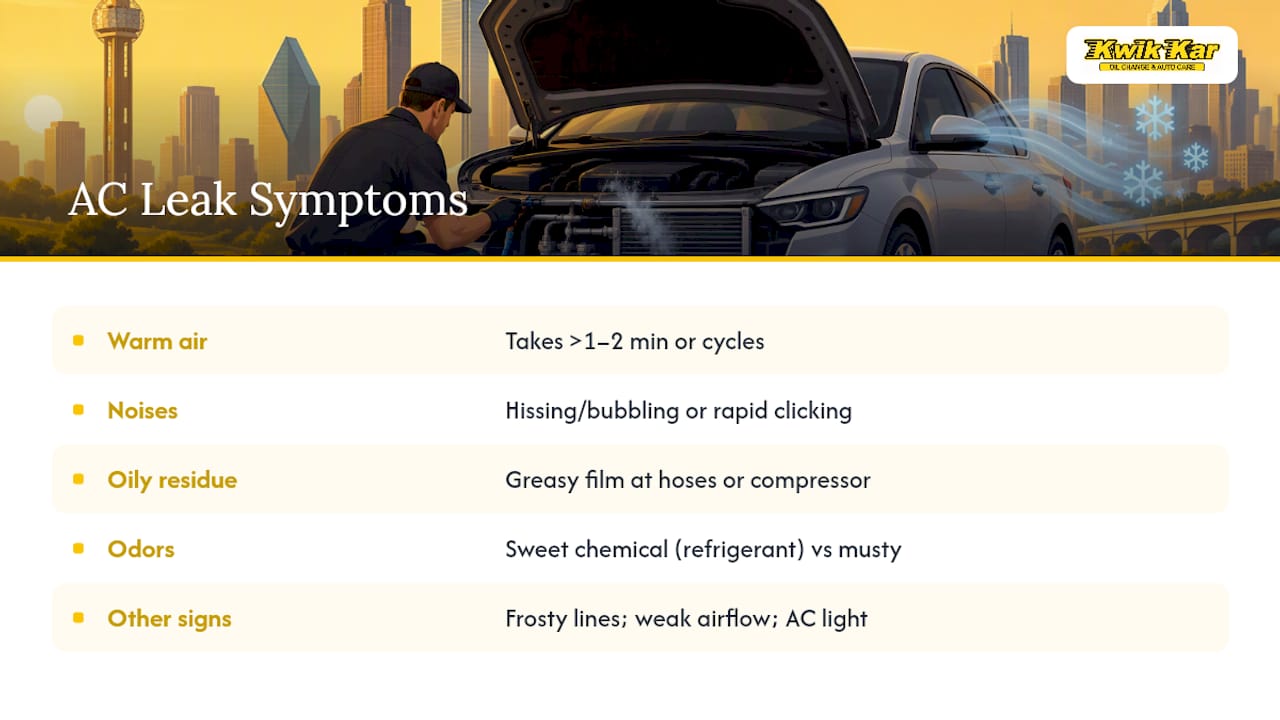
A refrigerant leak rarely announces itself with one clean signal. It usually shows up as a combination of warm air, strange sounds, and physical evidence you can spot during a quick look under the hood.
Warm or slow-to-cool air is the symptom almost every driver notices first. Turn the AC to max and watch the clock: a healthy system should feel noticeably cold within a minute or two of highway-speed airflow. If it takes longer, cycles between cool and warm, or never gets cold at idle but improves once you’re driving, refrigerant pressure is probably low.
Noises tell you a lot before you even touch the car. A hissing or bubbling sound near the firewall or under the dash often points to refrigerant escaping through a bad seal or fitting. Clicking or rapid on-off cycling from the compressor usually means the system’s low-pressure sensor is protecting the compressor from running dry.
Oily residue is one of the most reliable visual clues. Refrigerant oil leaves a greasy film around hose connections, the compressor, or the condenser at the front of the car. That’s different from the clear water that drips from your AC on a humid day. As the FTC’s auto repair guidance points out, greasy or oily residue near AC components, or oily spots under the vehicle, is a distinct sign worth photographing before your appointment.
Odors split into two categories. A sharp, slightly sweet chemical smell from the vents suggests refrigerant is escaping into the cabin airflow path. A musty, moldy smell is usually a clogged evaporator drain or cabin filter, not a refrigerant issue.
Other signs worth flagging: frost or ice forming on the AC lines under the hood, airflow that feels weaker than usual even when the temperature is right, or a dashboard AC indicator light. Corroborating reporting from Firestone Complete Auto Care lists oily residue, hissing, and chemical odor among the most commonly reported indicators of low refrigerant.
Pro Tip: Run the AC at idle for five minutes with the hood up (engine bay clear of loose clothing or hair) and listen near the firewall. A steady hiss that gets louder when you rev slightly often traces to a specific fitting rather than a slow, system-wide seep.
How Do You Confirm a Car AC Leak?
Some checks are safe to do in your driveway. Others require training, certification, and equipment you shouldn’t own unless you’re a working technician. Here’s the order that makes sense.
- Do a visual walk-around first. Pop the hood and look at the compressor, the condenser in front of the radiator, and every hose fitting for greasy buildup or dust caked in oil residue. Photograph anything suspicious. It’ll speed up the shop visit.
- Check vent temperature with a thermometer. Set the AC to max cold, high fan, recirculate on, and measure the center vent after five minutes of idle. Anything above the mid-40s Fahrenheit suggests a problem worth diagnosing.
- Try a soapy-water check on accessible fittings. A little dish soap and water on an exposed connection will bubble where refrigerant is escaping. This only works on fittings you can safely reach with the engine off.
- Look for frost. Ice on the low-pressure line near the compressor is a sign of abnormal pressure, often tied to a leak or a restriction.
- Stop there. Anything beyond visual and soap checks belongs to a shop with proper recovery equipment.
Over-the-counter recharge cans and stop-leak additives are tempting because they’re cheap and available at any parts store. They’re also a short-term patch at best. Sealants can clog expansion valves and contaminate recovery equipment, and an overcharged system can damage the compressor rather than fix anything.
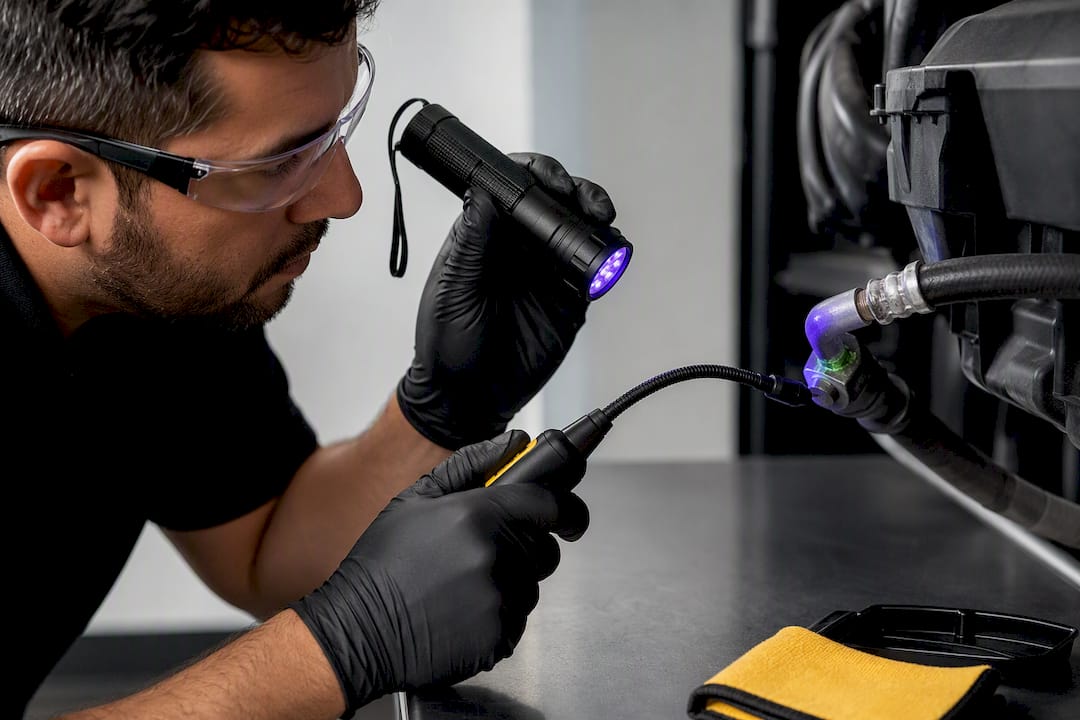
Shops rely on tools you won’t have at home: electronic leak detectors certified under SAE J1627, UV dye that glows under a blacklight at the leak point, and pressure or smoke tests that pinpoint problems invisible to the eye. Under EPA Section 609, only trained and certified technicians may recover and recharge refrigerant, and intentionally venting it during service is illegal. That’s not bureaucratic red tape. It’s the reason a shop visit beats a DIY can every time refrigerant is actually low.
What Usually Causes an AC Refrigerant Leak?
Most leaks trace back to a small number of failure points, and knowing them helps you understand what a technician finds and why some repairs cost more than others.
- Worn O-rings and rubber seals dry out and shrink with age, especially in Texas heat, creating tiny gaps at hose connections.
- Hose and fitting deterioration happens gradually from engine vibration, heat cycling, and road grime working into connection points.
- Condenser or evaporator punctures come from road debris kicked up at highway speed, or slow corrosion from years of exposure.
- Damage from a previous repair can introduce leaks if the wrong parts, contaminated refrigerant, or improper sealant were used.
- A slow leak left unaddressed eventually starves the compressor of lubricating oil carried in the refrigerant, which can turn a simple seal repair into a compressor replacement.
That last point is the one drivers underestimate most. A $20 O-ring problem, ignored for a year, can become a compressor failure that costs many times more.
What Happens at the Shop: Repair Options and Costs
A technician generally chooses from three approaches, and the EPA’s own guidance on recharging vehicle AC systems outlines all three: topping off the refrigerant, fully evacuating and recharging the system, or repairing and replacing the leaking component before recharging.
Topping off works when a leak is minor and slow, buying time without a full teardown. Evacuate-and-recharge is common when the leak isn’t obvious. Pulling the system down to a known pressure state lets a technician pressure-test it and often reveals a small leak that wasn’t visible before. Repair-and-replace is the real fix when a specific part, like a hose, O-ring, condenser, or compressor, is confirmed as the source.
Cost depends less on the part than on labor. As J.D. Power’s cost breakdown explains, a $5 O-ring is cheap, but reaching it often means depressurizing the entire AC system and disassembling components around it. That labor time is the real cost driver, not the part on the invoice.
Before any work starts, ask for:
- A written estimate listing parts and labor separately
- Confirmation of technician certification and recovery equipment on-site
- What happens if the diagnosis changes once the system is opened up
- Warranty terms on the completed repair
If you want a fuller breakdown of what shops charge for and why estimates vary, this guide to car AC repair pricing walks through it in more detail. And if the air just isn’t cold and you’re not sure a recharge is even the right fix, this piece on what it means when AC isn’t blowing cold helps separate refrigerant issues from electrical or mechanical ones.
Can You Still Drive With a Car AC Leak?
Short answer: yes, for a short trip to get it looked at, but don’t push it.
- Driving a few miles to a shop with warm AC air is generally fine and won’t cause immediate damage.
- Continuing to run the AC for weeks with low refrigerant risks compressor damage, since refrigerant carries the lubricating oil the compressor depends on.
- Never try to release refrigerant yourself. Recovery has to be handled by a certified technician under EPA rules.
- Stop driving and get the car towed if warm AC air is joined by engine overheating, a strong chemical smell inside the cabin, or fluid pooling under the vehicle. Those point to a bigger problem than the AC alone.
- If you’re managing a medical condition sensitive to heat, or it’s peak Texas summer, don’t wait out a slow leak. Get it diagnosed sooner rather than later.
Kwik Kar Perspective: How We Diagnose AC Leaks
Our ASE Certified Master technicians follow a set sequence: visual inspection, electronic leak detection paired with UV dye, refrigerant recovery and recycling, then repair and a full evacuate-and-recharge. Every job includes a digital inspection with photo and video documentation, so you see exactly what we found before we touch anything.
— Kwik Kar
Book an AC Diagnosis at Kwik Kar Spring Valley
Refrigerant work isn’t a driveway project, and it shouldn’t be. Federal rules under EPA Section 609 require a certified technician to handle recovery and recharge, which means the guy with a $30 recharge can from the auto parts store legally can’t do what a licensed shop can. We offer ASE Certified Master technicians, proper recovery equipment, and a written estimate before any work starts, so you know exactly what you’re paying for and why.

If your AC is blowing warm, hissing under the hood, or leaving oily spots on the driveway, our Air Conditioning Service & Repair team at Spring Valley Road can run a full diagnostic, show you the findings on photo and video, and give you a clear repair path before committing to anything. Families juggling summer road trips, commuters who need cold air for the Dallas heat, and fleet managers who can’t afford a vehicle down for guesswork all get the same transparent process. Schedule your AC inspection today and get back to cold air on your terms.
Sources
The regulatory and technical claims in this guide come from primary sources you can check yourself. The EPA’s guidance on recharging vehicle AC systems outlines the three repair paths and the role of electronic leak detectors. The EPA’s Section 609 regulation sets the certification and venting rules for technicians. J.D. Power’s cost guide explains why labor drives AC repair pricing more than parts. The FTC’s consumer auto repair guide covers what drivers can safely inspect themselves. For a broader look at diagnosing unusual vehicle smells before assuming it’s the AC, this diagnostic approach to car odors is a useful reference point.
- Options for Recharging Your Air Conditioner | US EPA
- How much does it cost to fix a car AC leak? | J.D. Power
- Auto repair basics | Consumer FTC
FAQ
Can You Drive a Car With an AC Leak?
Yes, for short trips to a repair shop, driving with an AC leak is generally safe. Extended driving with low refrigerant risks compressor damage, since refrigerant carries lubricating oil the compressor needs to run properly.
Is It Expensive to Fix an AC Leak in a Car?
Cost depends more on labor than parts. A worn O-ring itself is inexpensive, but as J.D. Power notes, reaching it often requires depressurizing and disassembling the AC system, which is what drives the bill up. We provide a written estimate before starting any work, so you know the cost breakdown upfront.
Can AutoZone Check for AC Leaks?
Auto parts stores can sometimes offer basic pressure checks, but they don’t have the certified recovery equipment or Section 609 training required to properly diagnose and repair refrigerant leaks. A shop with certified technicians and electronic leak detection equipment gives a more complete diagnosis.
Can I Fix a Car AC Leak Myself?
You can safely do visual inspections, vent temperature checks, and soapy-water tests on accessible fittings yourself. Actual refrigerant recovery, recharge, and component repair require EPA-certified technicians, since intentionally venting refrigerant is illegal and OTC recharge kits often cause more damage than they fix.
What Are the Most Common Signs of an AC Refrigerant Leak?
The most common signs are warm or slow-to-cool air, hissing or bubbling sounds, oily residue around AC components, and a chemical odor from the vents. Ice on the AC lines and reduced airflow are also frequent indicators worth checking.