

Catalytic converter replacement cost typically lands between $900 and $3,500 in the U.S., with most owners paying somewhere near $1,300 to $2,500 depending on the vehicle and part chosen. Parts usually make up the biggest share of that bill, not labor. Your final number depends heavily on your vehicle type and whether you live in a state that requires CARB-compliant parts.
TL;DR:
- The cost of replacing a catalytic converter in the U.S. generally ranges from $900 to $3,500, heavily influenced by vehicle type, converter count, and regional compliance requirements.
- OEM converters are the most expensive option, often exceeding $2,500, due to exact factory matching, while aftermarket direct-fit parts usually cost between $300 and $1,200.
- Labor costs run from $160 to $200 per hour, with total hours depending on access difficulty and whether the vehicle has multiple converters.
- Additional fees like diagnostics, oxygen sensor replacement, gaskets, and shop or environmental charges can add hundreds of dollars to the final bill.
Table of Contents
- What Does a Catalytic Converter Replacement Cost Break Down Into?
- Why Does the Price Vary So Much Between Vehicles?
- OEM vs. Aftermarket vs. Universal: Which Makes Sense for You?
- What Does Replacement Cost Look Like by Vehicle Type?
- What Hidden Fees Show Up on a Catalytic Converter Estimate?
- Is DIY Catalytic Converter Replacement Worth the Risk?
- How Do You Get an Accurate Catalytic Converter Quote?
- How Kwik Kar Oil Change & Auto Care Diagnoses and Quotes Converter Repairs
- When Is Full Replacement Actually the Right Call?
- Get a Straight Answer on Your Converter Repair Cost
- Sources
- FAQ
What Does a Catalytic Converter Replacement Cost Break Down Into?
Reading a repair estimate gets a lot easier once you know what each line item represents. The part itself is almost always the biggest expense, and the type you choose changes the math significantly.
- Universal converters: roughly $100 to $400, but they require custom pipe cutting and welding, and they’re not legal in every state for every application.
- Aftermarket direct-fit converters: typically $300 to $1,200, built to bolt into your exhaust without modification.
- OEM converters: often $800 to $2,500 or more, priced higher because they match factory specs exactly.
- Labor: most shops charge $160 to $200 per hour, with a straightforward single-converter swap running one to three hours.
On many vehicles, parts account for 70% to 93% of the total invoice, while labor dominates on trucks and SUVs where the converter sits in a hard-to-reach spot. That split is worth remembering when a shop quotes you a number that seems oddly labor-heavy or parts-heavy.
Why Does the Price Vary So Much Between Vehicles?
Two cars with the same problem can land thousands of dollars apart on the final invoice, and it usually comes down to a handful of specific variables.
- Vehicle type: trucks, performance cars, and hybrids often need larger or specially engineered converters that cost more to manufacture.
- Converter count: some vehicles, especially V6 and V8 engines, have two or more converters, doubling parts and labor.
- Precious metal pricing: platinum, palladium, and rhodium inside every converter tie the part’s cost directly to commodity markets, which is why hybrid and high-performance vehicles often carry heavier metal loads and higher price tags.
- Access difficulty: converters mounted near the transmission or buried under heat shields add labor hours regardless of part cost.
- Regional labor rates and CARB compliance: shops in California and other CARB states charge more for state-legal parts and often see higher hourly rates overall.
OEM vs. Aftermarket vs. Universal: Which Makes Sense for You?
The part you choose affects price, legal compliance, and how long the fix lasts. OEM converters run roughly 40% to 70% more than aftermarket equivalents, largely because they’re engineered to the exact specifications your manufacturer originally used.
- OEM: best fit, strongest warranty backing, but the most expensive option by a wide margin.
- Aftermarket direct-fit: a solid middle ground for most drivers, with good fitment and lower cost, as long as it’s rated for your emissions category.
- CARB-compliant aftermarket: required in California and several other states, and typically costs 30% to 60% more than a standard federal-spec part. Skipping this in a CARB state risks a failed smog check and other legal issues, as explained in detail in our technical guide on DPF deletes.
- Universal/weld-in: the cheapest part cost, but it demands skilled welding, doesn’t fit every application, and can create leaks if installed poorly.
If you’re unsure which category your car falls into, a shop can check your vehicle’s Engine Family Number against the CARB compatibility list before ordering, which saves you from paying twice.
What Does Replacement Cost Look Like by Vehicle Type?
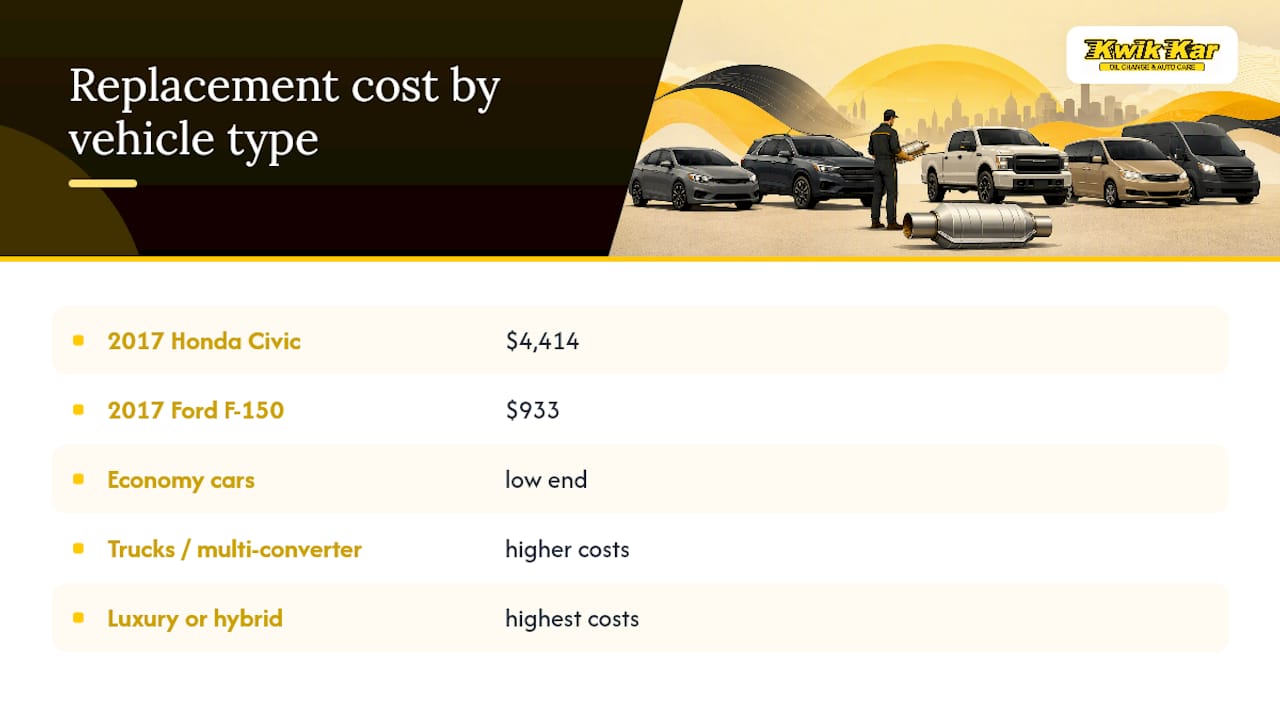
Real-world estimates show just how far apart two “average” repairs can land depending on the car. A ConsumerAffairs survey found a 2017 Honda Civic example totaling around $4,414, while a 2017 Ford F-150 example averaged closer to $933, illustrating how much the vehicle itself drives the outcome.
Economy cars sit at the low end because their single converters use less precious metal and install quickly. Trucks and multi-converter vehicles climb because of parts count and access time, and luxury or hybrid vehicles top the chart due to heavier metal loading and pricier OEM parts, a pattern that also shows up in RepairPal’s vehicle-specific estimator. Local labor rates and your state’s sales tax will nudge these figures up or down.
What Hidden Fees Show Up on a Catalytic Converter Estimate?
The converter itself is rarely the only line item on your invoice. A few recurring extras catch drivers off guard.
- Diagnostic fee: typically $50 to $150 to confirm the converter, not an oxygen sensor or exhaust leak, is the actual problem.
- O2 sensor replacement: $150 to $300 per sensor when sensors are damaged or simply old enough to swap alongside the converter.
- Gaskets, hardware, and welding: typically $20 to $200 depending on whether custom pipe work is needed.
- Shop and environmental fees, plus sales tax: often $15 to $50 in disposal or shop supply charges before tax is applied.
Ask for a fully itemized written estimate before any work starts. It’s the simplest way to catch a surprise fee before it lands on your final bill.
Is DIY Catalytic Converter Replacement Worth the Risk?
A universal converter and a weekend can save you real money on parts, since DIY-purchased components often run $150 to $500 cheaper than a shop’s marked-up part. But labor savings are smaller than they look once you account for the risk.
- Common DIY pitfalls: exhaust leaks from bad welds, a lingering check engine light, and failed emissions tests from incorrect part selection.
- CARB-state risk: installing a non-CARB part where compliance is required can fail your smog check and void manufacturer warranties.
- Torque and fitment errors: an improperly seated converter often means paying a shop to redo the job anyway, erasing your savings.
Pro Tip: If you’re DIY-capable, at minimum you’ll need a torque wrench, an OBD-II scanner to confirm the fault code before buying parts, penetrant oil for rusted bolts, and a lift or sturdy jack stands. Confirm CARB status for your state before you order anything.
How Do You Get an Accurate Catalytic Converter Quote?
A comparable, trustworthy estimate depends on giving the shop the right information and demanding the right details back.
- Provide your vehicle’s year, make, model, engine size, and the exact OBD-II code a scan tool pulled, so the shop diagnoses the real problem instead of guessing.
- Ask for a written estimate that separates part numbers, labor hours, hourly rate, taxes, and disposal fees, similar to how you’d read any detailed repair estimate breakdown.
- Confirm part sourcing: OEM, standard aftermarket, or CARB-compliant, and ask how long the warranty runs on both the part and the labor.
- Watch for red flags: a shop that won’t itemize costs, a total that’s dramatically lower than every other quote you got, or a converter recommendation with no diagnostic code to back it up.
How Kwik Kar Oil Change & Auto Care Diagnoses and Quotes Converter Repairs
A trustworthy quote starts with a real diagnosis, not a guess. Kwik Kar Oil Change & Auto Care’s ASE-certified technicians run full diagnostic checks before recommending a converter replacement, because a failing oxygen sensor can mimic the same check engine light and efficiency codes as a genuinely clogged converter.
- Transparent, itemized estimates presented before any work begins
- Backing from RepairPal and NAPA AutoCare, two names built on shop accountability
- Access to OEM and CARB-compliant parts sourced for your specific vehicle and state
- Warranty coverage on both parts and labor, plus rotating service coupons that lower total cost
When Is Full Replacement Actually the Right Call?
Replacement makes sense when you’ve failed a smog check, your converter was stolen, or internal damage (usually from years of unburned fuel or oil) has destroyed the honeycomb structure inside. In those cases, patching around the problem rarely holds up.
Sometimes the smarter move is different. If your car is older and the converter failure comes bundled with other expensive repairs, a comprehensive insurance claim (if theft-related) or simply selling the vehicle may beat sinking more money into it. Whatever you decide, get more than one written estimate and confirm your state’s compliance rules before you commit.
— Kwik Kar
Get a Straight Answer on Your Converter Repair Cost
Guesswork on a repair this expensive isn’t worth it, and that’s exactly where Kwik Kar Oil Change & Auto Care earns its keep. Rather than quoting a converter replacement off a code reader alone, our ASE-certified technicians confirm the actual fault first, source the correct OEM or CARB-compliant part for your specific vehicle and state, and hand you a written estimate before any work begins.
That process is backed by ASE and RepairPal certification, plus NAPA AutoCare recognition, so you’re not just trusting a shop’s word on the diagnosis. If your check engine light points to converter trouble, start with engine diagnostics to confirm what’s actually failing, then schedule your full auto repair service appointment and ask about current coupon offers that can bring your total down.
Sources
- How Much Does a Catalytic Converter Cost | AAA Automotive
- Cost to Replace a Catalytic Converter (ConsumerAffairs survey and mechanic quotes)
- RepairPal estimator — catalytic converter replacement cost
FAQ
Is It Worth Replacing a Catalytic Converter?
Yes, when the converter itself has failed internally, since driving with a clogged or damaged one hurts fuel economy, triggers check engine lights, and will fail an emissions test in most states.
How Much Should I Pay for Catalytic Converter Replacement?
Most U.S. drivers pay between $900 and $3,500 total, with the number depending heavily on vehicle type, converter count, and whether you’re in a CARB-compliance state.
Can I Drive a Car With a Bad Catalytic Converter?
You can drive short distances, but a failing converter can trigger reduced power, poor fuel economy, and eventually clog badly enough to stall the engine, plus it will fail state emissions testing.
How Much Does It Cost to Replace a Catalytic Converter on Bank 1?
A Bank 1 (single-side) converter replacement typically falls at the lower to middle end of the national range, often $450 to $2,000 depending on the vehicle, since only one converter and its related labor are involved rather than a full dual-bank replacement.