

For most daily drivers, ceramic pads are the better fit: they are quiet, clean and gentle on rotors. Semi-metallic pads earn their place when you tow, haul heavy loads, drive hard or want strong bite across a wide temperature range. Neither is better in every case. The right pad depends on your vehicle, how you drive and what the manufacturer specifies. Here is how the two compare, and how to decide for your car in Dallas traffic.
TL;DR
- Ceramic pads suit everyday commuting: low noise, fine light-colored dust and less rotor wear, usually at a higher price per set.
- Semi-metallic pads suit towing, heavy loads and performance use because the metal moves heat well, but they tend to be noisier and dustier.
- Start with what your vehicle manufacturer recommends, then adjust for how you actually drive.
- Pads and rotors wear as a system, so have both measured at every brake inspection.
- Brake symptoms can have several causes. A technician should confirm what you need before parts are chosen.
Table of Contents
- What is the difference between ceramic and semi-metallic brake pads?
- Which stops better, semi-metallic or ceramic?
- How do they compare on noise, dust and rotor wear?
- Ceramic vs. semi-metallic at a glance
- How much do they cost, and how long do they last?
- What works best for Dallas driving?
- OEM or aftermarket brake pads?
- Our perspective: match the pad to the driver
- Brake service in North Dallas, with a coupon
- When should you have your brakes checked?
- FAQ
- Sources
What is the difference between ceramic and semi-metallic brake pads?
The difference is the friction material. Consumer Reports describes semi-metallic pads as containing roughly 30% to 65% metal, while ceramic pads are built from ceramic fibers, nonferrous fillers and bonding agents, sometimes with small amounts of metal.
That recipe drives everything you notice from the driver’s seat. Metal conducts heat well, so semi-metallic formulations are common in performance, track and towing applications, according to ADVICS Aftermarket’s technical guidance. Ceramic formulations emphasize quieter operation, finer dust and lower rotor wear.
A quick note on terms. “Ceramic” here means the traditional ceramic pad sold for ordinary cars and trucks. It is not the same thing as carbon ceramic brake systems, which are a separate and much more expensive setup found on some high-end vehicles. If you are curious about that category, this overview of carbon ceramic brake costs shows how far apart the two are.
When you judge any pad, stopping ability is only one factor. Wagner Brake notes that heat absorption and dispersal, wear rate, noise and dust all matter alongside it.
Which stops better, semi-metallic or ceramic?
For normal street driving, both stop a vehicle well when they are correctly matched to it. Wagner says ceramic pads provide excellent stopping power and heat dispersal for most normal driving, while semi-metallic pads provide good stopping power and very efficient heat dispersal.
The gap shows up at the extremes:
- Heavy use and high heat. Towing, steep descents and repeated hard stops generate a lot of heat. Consumer Reports says upgraded or severe-duty pads are worth considering for towing, heavy loads, many passengers, hilly areas or daily steep descents. Semi-metallic formulations are a common choice for that kind of work.
- Cold starts. The Drive points out that semi-metallic pads can feel less effective when cold because they work best once somewhat warm.
- City stop-and-go. Ceramic pads are a good match for the low-speed, repeated braking that fills a typical commute, and they stay quiet while doing it.
The practical answer: if you drive a sedan, crossover or minivan to work and run errands, ceramic is usually the comfortable, low-maintenance pick. If your truck pulls a trailer every weekend, a semi-metallic or severe-duty pad deserves a serious look.
How do they compare on noise, dust and rotor wear?
This is where most drivers feel the difference day to day.
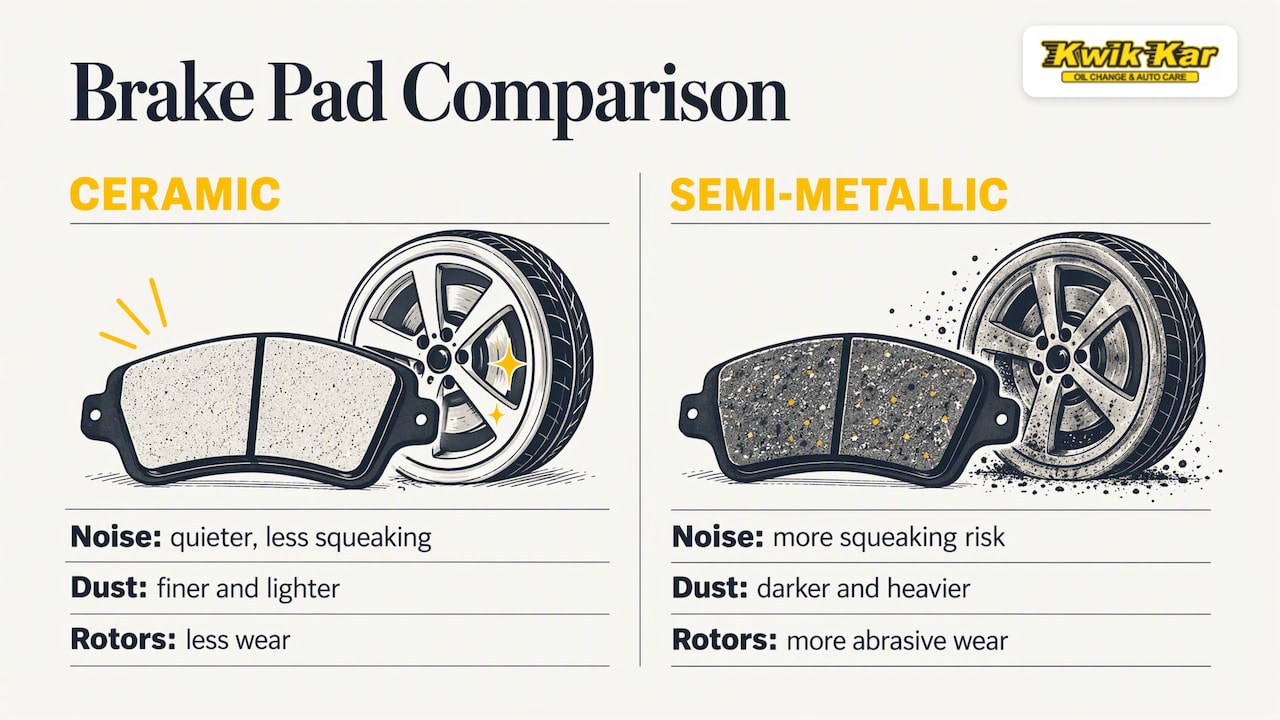
Consumer Reports says semi-metallic pads can be noisy and wear rotors faster, whereas ceramic pads are cleaner, quieter and offer excellent braking without wearing down rotors. So yes, semi-metallic pads are more likely to squeak or groan, especially when cold or damp, though noise also depends on hardware, shims, rotor condition and installation.
Squeaking is not always the pad material, though. A glazed pad, worn hardware or a rough rotor surface can all make noise. If a sound appears suddenly, have it looked at rather than guessing. Our guide to common car brake problems walks through the usual suspects.
Dust matters if you care about how your wheels look. Semi-metallic pads tend to leave darker, heavier dust. Ceramic dust is finer and lighter. When you want to clean wheels, a guide on removing brake dust safely covers dwell time and technique.
Rotor wear is the cost most people overlook. The metal content that gives semi-metallic pads their heat handling can also be abrasive. An academic review of brake pad wear reports that wear varies with material composition, braking conditions and temperature, and that metallic fibers can increase wear because of their abrasive nature.
Ceramic vs. semi-metallic at a glance
| Factor | Ceramic | Semi-metallic |
|---|---|---|
| Typical best use | Daily commuting, family vehicles | Towing, heavy loads, performance driving |
| Noise | Quiet | More likely to be noisy |
| Dust | Fine, light | Heavier, darker |
| Rotor wear | Gentler | Can be faster |
| Cold-weather feel | Consistent for everyday driving | Can feel weaker until warm |
| Heat handling | Excellent for normal driving | Very efficient across a wide range |
| Price per set | Usually higher | Usually lower |
Treat the table as a starting point. Individual pad lines within each category vary by manufacturer, and your vehicle’s own specification has the final say.
How much do they cost, and how long do they last?
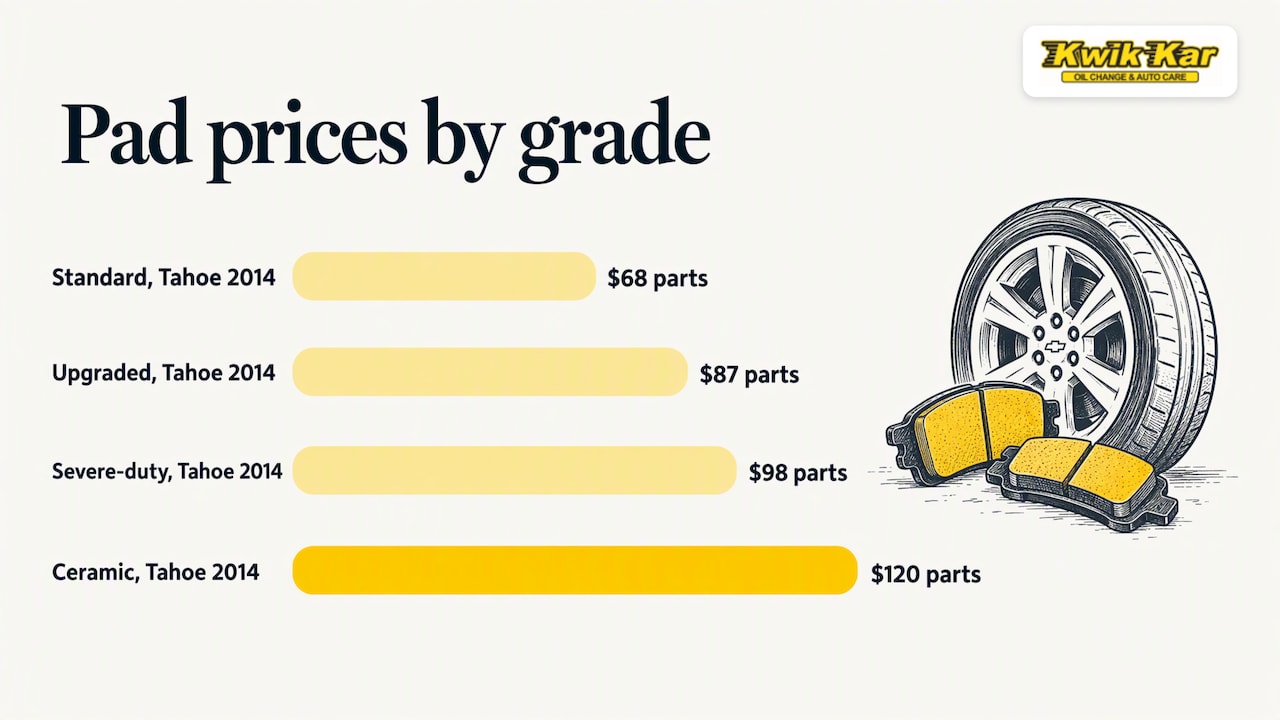
Ceramic pads usually cost more per set. Consumer Reports’ pad pricing for a late-model Chevrolet Tahoe, published in 2014, listed $68 for standard pads, $87 upgraded, $98 severe-duty and $120 ceramic. Those are old parts-only figures for one vehicle, so use them for the relationship between pad grades, not as today’s prices.
The bigger number is the full job. Consumer Reports’ 2026 maintenance guide puts the typical pads-and-rotors service interval at 25,000 to 50,000 miles and lists $500 to $950 for the operation. Your quote depends on the vehicle, the pad you choose, whether rotors are replaced and the labor involved. Our overview of common car repair cost factors explains what moves an estimate up or down.
On lifespan, Capital One’s brake pad guide says pad life can range from a couple of track days to about 70,000 miles, averaging around 45,000 miles. It depends on driving style, where you drive, how you use the vehicle and the pad material. That is why a single mileage promise for either type is not realistic. For more on what shortens or extends pad life, see our brake pad lifespan guide.
Think about total cost, not just the price on the box. A cheaper pad that wears rotors faster can cost more over two brake jobs. A pricier pad that suits your driving can save a rotor replacement.
What works best for Dallas driving?
North Dallas drivers put brakes through a few predictable situations. Commutes on the Dallas North Tollway, Central Expressway and I-635 mix highway speeds with sudden slowdowns, and surface streets around Spring Valley Road, Addison, Richardson and Farmers Branch bring traffic lights and short trips. Long Texas summers add heat on top.
That pattern points to some practical thinking:
- Mostly commuting and errands. Ceramic pads fit this well. They stay quiet in repeated stop-and-go braking and keep wheels cleaner.
- Towing a boat or trailer, or hauling loads. A semi-metallic or severe-duty pad is worth discussing, particularly if you head out on long highway trips.
- Mixed use. Many drivers fall here. Choose based on the heaviest regular demand you place on the vehicle, not the rare one.
- Winter mornings. Dallas has its cold snaps. If you run semi-metallic pads, expect them to feel best after the first few stops. Bridgestone, the tire maker, makes the same point in its guidance on cold weather, and the earlier cold-start note from The Drive applies too.
Brake heat also stresses the fluid. Heat and moisture break fluid down over time, so check our guide on the brake fluid change interval alongside any pad decision.
We will not quote local traffic or weather statistics here, because the choice does not hinge on them. It hinges on how you drive and what your vehicle’s manufacturer specifies.

OEM or aftermarket brake pads?
OEM pads match what the vehicle was built with. Aftermarket pads come from other manufacturers and can be equal, more basic or more specialized. Quality ranges widely.
Consumer Reports notes that replacement pads aren’t federally regulated, so it advises checking certification for your specific vehicle. It adds that certified standard pads should meet normal-driving needs, with upgraded or severe-duty pads worth considering for towing, heavy loads, many passengers or steep routes.
Wagner’s buying guide suggests comparing intended use, corrosion and dust tolerance, the technology you want, price and whether you want OE-level performance or premium features. It treats OE-style fit, form and function as its own criterion, which is a useful reminder: a pad labeled “premium” or “performance” is not automatically better for your daily driver.
A sensible approach is to start with the pad type your manufacturer specified, then change only if your use has changed, for example if you now tow. Always follow the vehicle manufacturer’s guidance for parts and service.
Our perspective: match the pad to the driver
We see the same pattern at our Spring Valley Road shop: drivers rarely ask for the “best” pad, they ask why their brakes are loud, dusty or wearing out too fast. Usually the pad was never matched to how they drive.
That is why we start with the vehicle’s specification and an honest conversation about your routine. Our ASE-certified technicians inspect pads, rotors, calipers and fluid together, and our digital vehicle inspections give you photo and video proof of what we find, so you can see wear before you approve work. We provide an estimate before work begins.
For most commuters we lean toward quiet, low-dust ceramic options where they suit the vehicle. For trucks that tow or carry heavy loads, we talk through semi-metallic or severe-duty choices. Either way, the goal is a brake job that fits your driving, not an upsell.
Kwik Kar
Brake service in North Dallas, with a coupon
If your pads are due, our team handles brake repair and service in Dallas for domestic and import vehicles at 8280 Spring Valley Rd, Dallas, TX 75240, serving North Dallas, Far North Dallas, Addison, Richardson and Farmers Branch. Look at our current $20 off brakes coupon for terms and eligibility. Qualifying repairs may be covered by our 24-month/24,000-mile warranty, subject to applicable terms.
You can see everything we offer at kwikkarspringvalley.com.
When should you have your brakes checked?
Don’t wait for a replacement interval alone. Book an inspection if you notice:
- A high-pitched squeal or a grinding sound when you press the pedal.
- A pedal that feels soft, low or spongy.
- A steering wheel or pedal that shakes while braking, which can point to rotor problems. See our guide on rotor warp for how that is diagnosed.
- The vehicle pulling to one side when you brake.
- A brake warning light on the dash.
These symptoms have several possible causes: pads, rotors, calipers, hardware, fluid or even tires and suspension. That is why professional diagnosis matters before you choose a pad type. You can also read our brake pad wear guide to learn what normal wear looks like.
Ready for a professional look? Schedule your brake service at Kwik Kar Spring Valley and we will walk you through what we find before any work begins.
FAQ
Are ceramic or semi-metallic brake pads better?
Neither wins in every situation. Ceramic pads are generally better for daily driving because they are quiet, clean and easier on rotors. Semi-metallic pads are generally better for towing, heavy loads and performance driving because they handle heat well. Follow your vehicle manufacturer’s recommendation first.
Do semi-metallic brake pads squeak?
They can. Consumer Reports says semi-metallic pads can be noisy, and they tend to make more noise than ceramic pads, especially when cold. Noise can also come from worn hardware, glazed pads or rough rotors, so a persistent squeal is worth an inspection.
Can I switch from semi-metallic to ceramic pads?
Often yes, but confirm it is appropriate for your vehicle and how you use it. If you tow or carry heavy loads, ceramic may not be the right choice. A technician can check your specification and your rotors, since pads and rotors should be matched and in good condition.
Do ceramic pads last longer?
They often wear more gently on rotors, but pad life depends on driving style, where you drive, vehicle use and the specific pad. Averages around 45,000 miles are cited for brake pads in general, with wide variation, so measure wear at each inspection rather than relying on a number.
Is OEM better than aftermarket for brake pads?
Not automatically. OEM pads match the original design, and quality aftermarket pads can meet or exceed it. Because replacement pads aren’t federally regulated, check certification for your specific vehicle and choose based on your driving.
Sources
- Brake Pads | Brake Service, Consumer Reports
- Consumer Reports’ Guide to Car Maintenance
- Ceramic vs. Semi-Metallic Brake Pads: How They Work, ADVICS Aftermarket
- What are the Best Car Brake Pads to Buy, Wagner Brake
- Brake Pad Buying Guide, Wagner Brake
- How To Pick the Right Brake Pads for Your Car, The Drive
- Brake Pads: How Long They Last, Capital One
- Motor Vehicle Brake Pad Wear: A Review, MDPI
- Carbon Ceramic Brakes Cost: Options, Replacement and Value
- Remove Brake Dust Safely with 2 to 5 Minute Dwell