



A P0171 code means your engine computer has found too much air and not enough fuel on engine Bank 1, and it has run out of room to correct the mix on its own. You can usually drive a short distance, but you should not ignore it, and in Dallas County it will keep you from passing your emissions inspection until it is fixed. The most common cause is a vacuum leak, not a bad part, so the smart first move is a proper diagnosis rather than swapping sensors.
TL;DR
- P0171 = System Too Lean (Bank 1). The engine is getting more air than the fuel it is being given can balance, and the check engine light comes on.
- Most common causes: vacuum leaks, a dirty or failing mass airflow (MAF) sensor, and fuel delivery problems such as clogged injectors or a weak fuel pump.
- Do not clear the code and hope. Clearing it erases freeze frame data the technician needs and resets the readiness monitors your emissions test checks.
- Texas impact: a check engine light is a failed emissions inspection in Dallas County, so a lean code needs to be repaired before you renew your registration.
- Next step: a scan of fuel trims plus a leak test finds the real cause. We do this at our Spring Valley Road shop in Dallas.
Table of Contents
- What the P0171 code actually means
- Symptoms you may notice
- Common causes of P0171, from most to least likely
- Why it is often not the part the code points to
- How a technician diagnoses P0171
- Can you drive with a P0171 code?
- What it means for your Texas emissions test
- Can you check it yourself first?
- Our perspective: fix the cause, not the code
- Book your P0171 diagnosis in Dallas
- Preventing lean codes down the road
- Frequently asked questions
- Sources
What the P0171 code actually means
Your engine runs best at a carefully controlled ratio of air to fuel. The engine computer (the PCM) watches that ratio through oxygen sensors in the exhaust and adjusts how much fuel the injectors deliver. When the exhaust shows extra oxygen, the computer reads it as a lean mixture and adds fuel to compensate.
A P0171 is set when the computer has detected more air than fuel, tried to add fuel, and reached its limit of adjustment, which then triggers the check engine light. That light is part of the OBD II standard, which applies to 1996 and newer gasoline passenger vehicles.
Two details are worth knowing:
- “Bank 1” is the side of the engine that holds cylinder number 1. On a four-cylinder engine there is only one bank, so the code covers the whole engine. On V6 and V8 engines, a matching P0174 means Bank 2 is lean as well. When both appear together, the cause is usually something shared by both banks, such as the MAF sensor, a leak in the common intake, or fuel pressure.
- “System too lean” describes the result, not the broken part. The code tells you the mixture is off. It does not tell you why.
That last point is where many drivers lose money. A code reader gives you a number. A diagnosis gives you a cause.
Symptoms you may notice
Some drivers see nothing but a check engine light. Others notice the car acting differently. Common signs of a lean condition include:
- A rough or unsteady idle, sometimes with a hunting RPM
- Hesitation or stumbling when you accelerate from a stop, common on Dallas stop-and-go commutes
- Worse fuel economy than usual
- A hissing or whistling sound from the engine bay, which often points to a vacuum leak
- Occasional stalling at idle
- A check engine light that comes and goes
If the light is flashing rather than steady, the engine is misfiring badly enough to risk damaging the catalytic converter. Reduce your speed and get the car checked right away.
Common causes of P0171, from most to least likely
The causes fall into three groups: unmetered air getting in, a sensor reading wrong, or not enough fuel arriving.
Vacuum leaks and unmetered air
This is the leading cause. Air that enters the intake after the MAF sensor has not been measured, so the computer does not know to add fuel for it. Technician references name vacuum leaks as a particularly frequent contributor to lean codes. Typical leak points include:
- Cracked or loose vacuum hoses, especially near junctions
- PCV hoses and elbows that have turned brittle with heat
- Intake manifold gaskets
- The brake booster hose
- Loose or split air intake tubing between the MAF sensor and the throttle body
Texas heat is hard on rubber and plastic. Hoses that look fine can crack when the engine is hot and shrink back when it cools, which is one reason a leak can seem to disappear and return.
A dirty or failing MAF sensor
The MAF sensor measures the air entering the engine. If it under-reports the air, the computer delivers too little fuel and the mixture runs lean. Sometimes the sensor only needs proper cleaning. Sometimes it has failed. A technician can tell the difference by checking the readings against what the engine should be pulling in.
Fuel delivery problems
If the engine is not getting enough fuel, the result is the same lean reading. Possible causes include:
- Clogged or restricted fuel injectors
- A weak fuel pump
- A clogged fuel filter on vehicles that have a serviceable one
- Low fuel pressure from a failing regulator
Exhaust leaks and sensor faults
A leak in the exhaust ahead of the upstream oxygen sensor can pull in outside air and make a healthy engine look lean. A worn oxygen sensor can also report poorly. These are less common, but they are the reason we confirm the problem before replacing parts.
Why it is often not the part the code points to
A common misconception is that a P0171 means a bad sensor. In practice it is often an unmetered air leak, with air entering downstream of the MAF sensor. Replacing an oxygen sensor or MAF sensor on a guess can leave you with a new part, the same light, and a larger bill.
This is also why we treat related codes carefully. If you are chasing a catalytic converter code on top of a lean code, the fuel control problem usually needs to be solved first. We cover that situation in our guide to verifying fuel control before replacing the converter.
How a technician diagnoses P0171
A good diagnosis follows a sequence, and each step narrows the field.
- Read the code and the freeze frame data. Freeze frame is a snapshot of the engine’s temperature, load and RPM at the moment the light came on. It helps the technician recreate the conditions needed to catch an intermittent leak.
- Look at the fuel trims. Short term and long term fuel trims show how hard the computer is working to add fuel. Reference material says that normal trims sit within about plus or minus 8, and readings of +10 or more on both mean the engine is running lean.
- Compare idle to 2,500 RPM. Technicians compare fuel correction at idle with correction at about 2,500 RPM. If the correction falls sharply at the higher speed, typically by 15% or more, that points to a vacuum leak rather than a fuel delivery problem. A leak matters most at idle, when the engine pulls the least air, and fades as airflow increases.
- Inspect by eye. Cracks or loose connections in PCV elbows, intake manifold gaskets and vacuum hoses are the first things to check.
- Pinpoint hidden leaks. When a visual check finds nothing, technicians use smoke testing or propane enrichment to find where the air is getting in, because internal gasket failures do not show up by eye.
- Test fuel delivery. If the leak tests are clean, fuel pressure and injector performance come next.
- Repair, then verify. After the repair, the fuel trims are checked again and the vehicle’s self-tests are allowed to complete.
Our engine diagnostic service follows this approach, and you get an estimate before any repair work begins. For a wider view of what the process looks like, see our engine light diagnostic guide for Dallas drivers.
Can you drive with a P0171 code?
For a short time, usually yes. The car often keeps running, which is why people postpone the repair. But a lean condition is not harmless. Technicians warn that over time it can bring poor fuel economy, hesitation, and even engine damage from excessive combustion temperatures.
Use this as a guide:
| Situation | What to do |
|---|---|
| Steady light, car drives normally | Book a diagnosis within the next few days and avoid hard acceleration or towing |
| Steady light with rough idle, hesitation or stalling | Get it checked as soon as you can, since stalling at an intersection is a safety risk |
| Flashing light | Slow down and have it inspected right away, because misfires can damage the catalytic converter |
| Light plus overheating or a burning smell | Pull over safely and have the car towed |
A stall on a busy road such as Central Expressway or LBJ Freeway is a different kind of problem than a stall in a driveway. If the engine is stumbling, do not wait for it to get worse.
What it means for your Texas emissions test
Dallas County is one of the 17 Texas counties that require an annual emissions inspection to renew vehicle registration, and an active check engine light will fail it. The same TxDMV calendar notes that safety inspections for noncommercial vehicles are no longer required as of 2025, but the emissions requirement in listed counties remains.
This matters for P0171 in two ways.
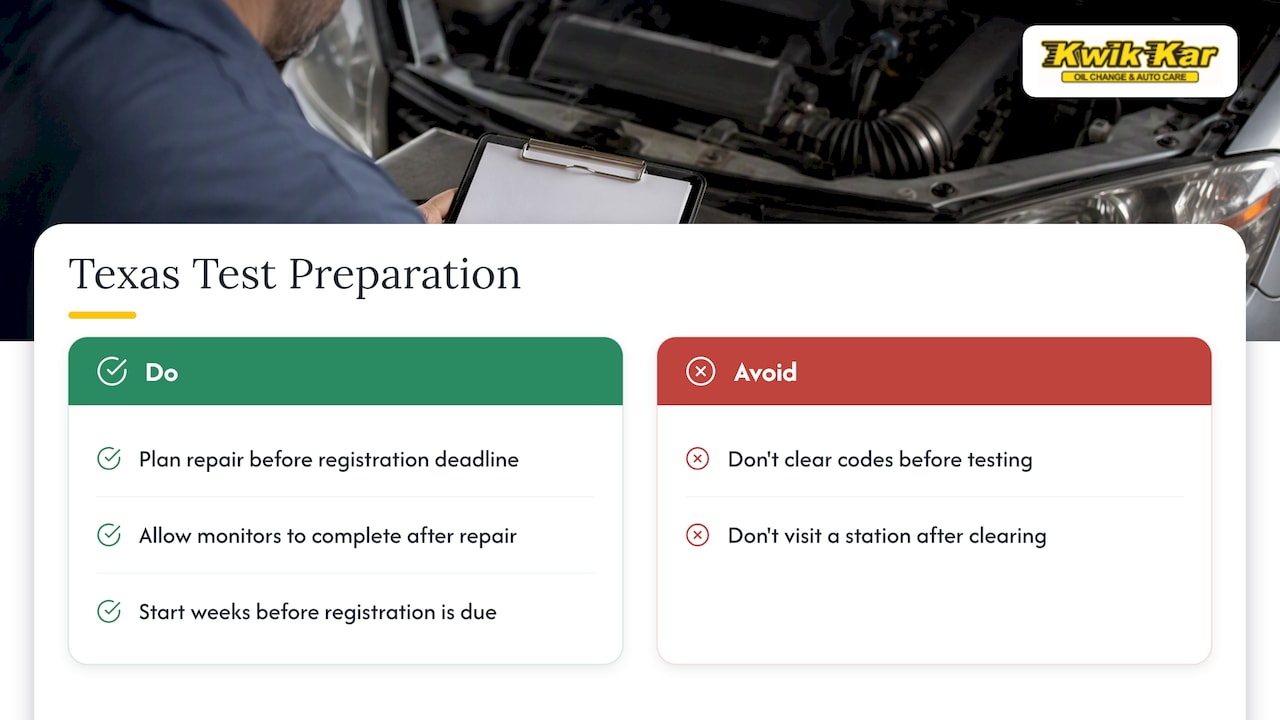
Do not clear the code right before the test. Clearing codes resets the car’s readiness monitors, the internal self-tests the inspection checks, to “not ready.” Those monitors need to complete after a real repair to confirm the problem is solved. Clearing the code and driving straight to a station tends to produce a failed test, plus you lose the freeze frame data we need.
Plan the repair before your registration deadline. Diagnosis, repair and a full drive cycle take time. Starting a few weeks before your registration is due leaves room if the cause takes more than one visit.
For more, see our guides to the Texas emissions test, what to do after a failed emission test, and Texas car inspection laws.
Can you check it yourself first?
A few simple checks are reasonable before you book, and they help you describe the problem accurately.
- Listen at idle with the hood open for a hiss.
- Look for cracked, split or disconnected hoses around the intake and the PCV system.
- Check that the air intake tube between the air filter box and the throttle body is tight.
- Make sure the gas cap is sealed. This matters more for evaporative codes than for lean codes, but a loose cap is worth ruling out for any check engine light.
- Write down when it happens: cold start, idle, highway speed, or after refueling.
We do not recommend pressing on with spraying flammable cleaners around a running engine to hunt for leaks. It is a fire risk, and professional smoke testing is safer and more accurate. Likewise, do not replace parts on a guess. A MAF sensor, oxygen sensor or fuel pump can each cost real money, and none of them is fixed by guessing.
Our perspective: fix the cause, not the code
We have been a family-owned shop serving this community for nearly 30 years, and lean codes are among the most misunderstood things drivers bring us. The usual pattern: a driver gets the code read for free, is told to replace a sensor, replaces it, and the light returns within a week.
Our approach is different, and it comes down to a few commitments:
- Diagnose before we recommend. Our ASE Certified Master technicians use advanced diagnostic tools to look at fuel trims, freeze frame data and live readings before anything is replaced.
- Show you the evidence. Our digital vehicle inspections include photo and video proof, so you can see what we see.
- Tell you the cost first. You get an estimate before work begins, and nothing is started without your approval.
- Stand behind the repair. Our work carries a 24-month/24,000-mile warranty.
A lean code is a good example of why this matters. The code is only a starting clue. The right repair might be a ten-minute hose fix or a more involved intake gasket job, and you should only pay for the one you need.
— Kwik Kar
Book your P0171 diagnosis in Dallas
If your check engine light is on and you suspect a lean code, we can find the cause at our Spring Valley Road location in Dallas. Our engine diagnostic service covers the scan, the fuel trim review and the leak testing, and you will hear the findings and the estimate before we do any repair. You can see everything else we handle on our full auto repair services page, including engine repair, electrical work, fuel injector service and state inspections. We service both domestic and import vehicles, and we also work with local fleets.
If you want to read more first, our guides on the check engine light in Dallas and the benefits of early vehicle diagnostics explain what to expect.
Preventing lean codes down the road
You cannot prevent every vacuum leak, but routine care lowers the odds.
- Keep up with oil changes. Old oil breaks down and contributes to crankcase ventilation (PCV) problems, which can cause leaks and rough running.
- Replace the engine air filter on schedule. A clogged filter strains the intake system and can also contaminate the MAF sensor.
- Have hoses checked at service visits. Cracked rubber is easy to spot during an inspection and cheap to replace before it sets a code.
- Do not ignore early symptoms. A slightly rough idle is often the first sign.
- Address any check engine light promptly. Small problems that go unfixed can become larger ones.
- Stay on schedule with preventive maintenance. Regular service gives a technician a chance to catch problems while they are still small.
For families with more than one vehicle and for fleet managers, a regular inspection schedule also keeps surprises off the calendar, especially ahead of registration renewals.
Frequently asked questions
How do I fix the P0171 engine code?
You fix the cause, not the code. That usually means finding and repairing a vacuum leak, cleaning or replacing a faulty MAF sensor, or correcting a fuel delivery problem. A technician identifies which by checking fuel trims and leak testing the intake. Once the repair is done, the code can be cleared and the car verified.
What is the most common cause of the P0171 code?
Vacuum leaks, meaning unmetered air entering the intake after the MAF sensor, are the most frequent cause. Cracked hoses, PCV components and intake manifold gaskets are typical culprits. A dirty MAF sensor and weak fuel delivery come next.
Can you drive your car with a P0171 code?
Usually for a short time, but you should not make a habit of it. A lean mixture can cause hesitation, stalling, poor fuel economy and, over time, engine damage from high combustion temperatures. If the light is flashing or the engine stalls, stop driving and get the car inspected.
How much does it cost to fix code P0171?
The cost depends entirely on the cause, from a simple hose repair to a gasket or fuel system job, so no single number fits every car. That is why we start with a diagnosis and give you an estimate before any work begins. Call or visit us with your vehicle details and we will explain your options.
Will a P0171 code fail a Texas emissions test?
Yes. In emissions counties such as Dallas County, an illuminated check engine light causes a failed inspection. Repair the cause, let the car complete its self-tests through normal driving, and then go for your inspection. Clearing the code beforehand will not help because the monitors will read as not ready.
Sources
- U.S. EPA: On-Board Diagnostic (OBD) regulations and requirements
- AA1Car: Ford TSB 04-17-4, system lean diagnostic trouble codes
- AA1Car: Engine vacuum leaks
- TxDMV: Single Sticker calendar 2026-27
- California Bureau of Automotive Repair: OBD readiness monitor regulations explained