




A professional combination patch and plug is the industry accepted way to permanently fix a punctured tire, while a plug alone is only a temporary emergency measure. If you’re driving on a plug right now, keep your speed under 50 mph and head straight to a shop for a full inspection, according to AAA.
TL;DR:
- The shop must remove the tire, inspect its inner liner, and apply a combination stem and patch before remounting and balancing it.
- Repair only tread punctures up to 1/4 inch (6 mm); replace tires with shoulder or sidewall damage, overlapping repairs, cracking, or bulges.
- A plug seals the puncture from outside but leaves the inner liner untreated, so hidden damage and moisture exposure remain unchecked until inspection.
- Some tires designed to run flat or carrying high speed ratings may be nonrepairable under manufacturer rules, even when damage meets size and location limits.
Table of Contents
- 1. What a tire plug is and when it’s used
- 2. What a tire patch is: the professional internal repair process
- 3. When each repair is appropriate and where the safety limits are
- 4. Industry standards and why professionals favor combination repairs
- 5. Professional repair vs DIY plug kits: what actually happens and what to do right now
- 6. Decision checklist: repair the tire or replace it?
- 7. Why a professional inspection matters more than the repair itself
- 8. Get your tire inspected and repaired the right way
- FAQ
- Sources
1. What a tire plug is and when it’s used
A tire plug is a sticky rubber or rope-like strip that gets pushed into a puncture from the outside of the tire, without removing the tire from the rim. You’ve probably seen the kit: a reamer tool to rough up the hole and an insertion tool to shove the plug through, usually coated in rubber cement. It plugs the hole from the outside in, which is exactly why roadside assistance crews and gas station attendants can do it in minutes.
That speed is the whole appeal. You don’t need a lift, a dismounted wheel, or specialized equipment, just the kit and a few minutes on the shoulder of the road. For a driver stranded with a slow leak, a plug gets you moving again.
The problem is what a plug doesn’t do. It seals the outer tread puncture, but it never touches the inner liner, the airtight rubber layer on the inside of the tire that keeps moisture away from the steel belts.
- A plug fills the puncture channel but leaves the inner liner unsealed.
- Moisture can seep in around the plug over time and reach the steel belts.
- No internal inspection happens during a plug-only repair, so hidden damage can go unnoticed.
That’s why a plug works fine to get you somewhere, but it’s not something we’d call a lasting fix.
2. What a tire patch is: the professional internal repair process
A patch is applied from the inside of the tire, which means the tire has to come off the rim first. That single step, dismounting the tire, is what separates a real repair from a quick fix, because it’s the only way a technician can see the full extent of the damage.
Here’s what the process looks like in a shop:
- The tire is dismounted from the wheel so the inside is fully visible.
- The technician inspects the inner liner for any hidden damage, cuts, or separation the puncture may have caused.
- The area around the puncture is buffed and cleaned to prepare the rubber surface.
- Vulcanizing cement or a chemical bonding agent is applied to the prepped area.
- The patch, or a combination patch-and-stem unit, is applied over the puncture and pressed or stitched down to remove air pockets and seat it fully.
Many shops now use a one-piece combination unit that includes a rubber stem to fill the puncture channel and a patch that seals over the inner liner in a single piece. Two-piece versions, a separate stem plus a patch, work the same way but are applied in two steps. Either way, the result fills the hole and seals the liner at once, which is the combination USTMA and other industry groups recognize as a genuine permanent repair when it’s done to spec, according to USTMA’s tire repair guidance.
3. When each repair is appropriate and where the safety limits are
Not every puncture qualifies for a plug, a patch, or any repair at all. The location and size of the damage decide that before anything else.
Repairs are only appropriate within the tread area, the flat, central part of the tire that touches the road. Damage on the shoulder or sidewall is never repairable, no matter how small, because those areas flex constantly and can’t support a patch or plug without risking a blowout.
The puncture also has to be small. USTMA guidance caps a repairable puncture at 1/4 inch, or 6 millimeters, in diameter. Anything larger means the tire needs to be replaced, not patched.
A few more rules decide whether a repair is safe to attempt:
- Repairable punctures sit only in the tread area, never on the shoulder or sidewall.
- The puncture diameter can’t exceed 1/4 inch (6 mm).
- Repairs can’t overlap each other, and most shops require a minimum spacing between separate punctures.
- The tire must come off the rim so the inside can be inspected before any permanent repair is applied, per the detailed puncture repair procedures USTMA publishes.
If a puncture falls outside any of these limits, the honest answer is a new tire, not a repair. Pushing a patch or plug into damage that’s too large, too close to another repair, or on the sidewall doesn’t fix the problem. It just delays a failure that happens at the worst possible time.
4. Industry standards and why professionals favor combination repairs
Tire repair isn’t guesswork, and it isn’t left up to individual preference either. USTMA, the organization that sets puncture repair procedures for the tire industry, is specific about what counts as acceptable.
That standard exists because the two failure points, an open puncture channel and an unsealed inner liner, cause different problems. An unfilled channel lets air escape and moisture collect inside the tire. An unsealed inner liner leaves the steel belts exposed to that moisture, which leads to corrosion and, eventually, tread and belt separation. A properly applied combination repair addresses both points at once, according to USTMA’s tire care and safety guidance.
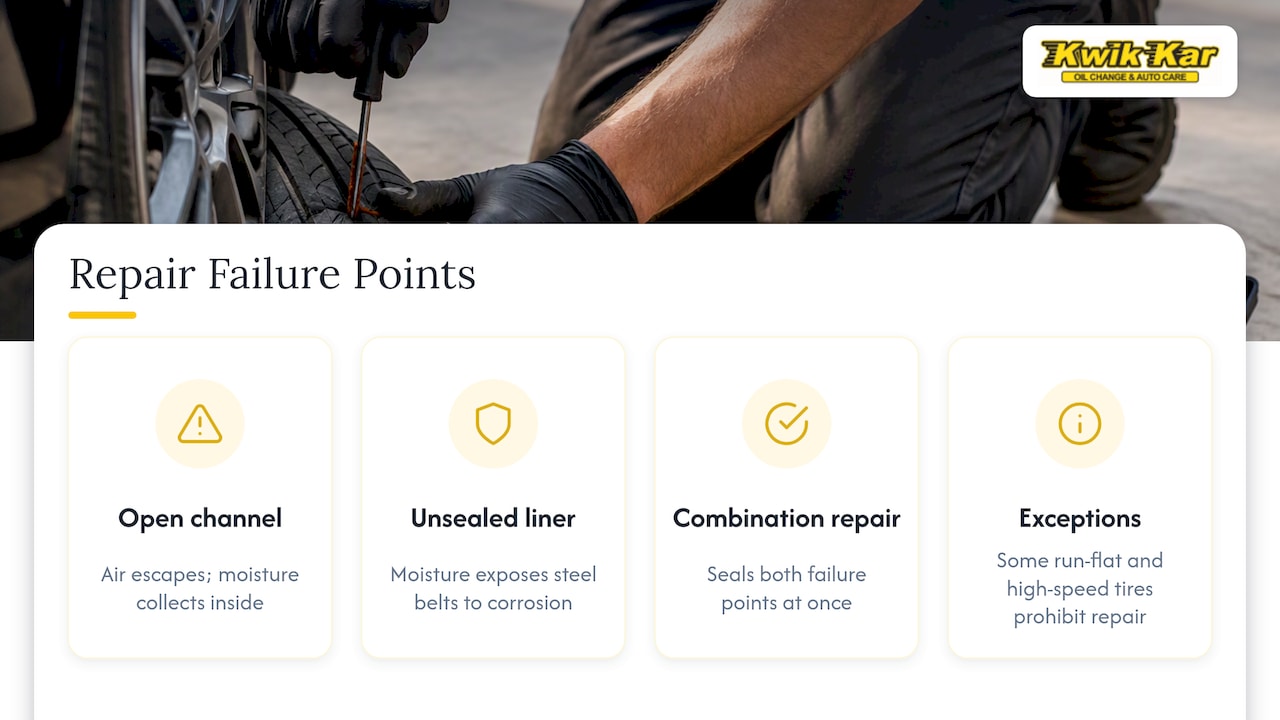
Not every tire qualifies even when the puncture fits the size and location rules. Some run-flat tires and certain high-speed-rated tires carry manufacturer policies that prohibit repair altogether, regardless of how small the puncture is. A shop should check the sidewall markings or the manufacturer’s bulletins before repairing any tire that falls into those categories.
5. Professional repair vs DIY plug kits: what actually happens and what to do right now
A shop-performed combination repair and a roadside DIY plug kit solve two different problems. The DIY kit gets you off the shoulder of a highway. The shop repair is what makes the tire trustworthy again.
Here’s the workflow a shop follows for a permanent repair:
- Inspect the tire while it’s still on the vehicle to check tread depth, location, and size of the damage.
- Dismount the tire fully from the wheel.
- Inspect the inner liner for hidden damage the puncture may have caused.
- Apply the combination plug-and-patch repair, buffing, cementing, and seating it according to procedure.
- Remount the tire, rebalance the wheel assembly, and perform a final check for leaks or improper seating.
Pro Tip: If you’re currently driving on a plugged tire, keep speeds under 50 mph and drive directly to a shop rather than running errands first.
A DIY plug is acceptable only as a stopgap to reach a professional, never as the end of the repair. If you find a puncture, here’s what to do immediately: pull over safely, check the tire pressure with a gauge if you have one, note where the object entered the tread, and avoid highway speeds until a technician has inspected it.
6. Decision checklist: repair the tire or replace it?
Deciding between a repair and a replacement comes down to a short set of facts you can check before you even call a shop.
- Where is the damage: tread area only, or does it touch the shoulder or sidewall?
- How big is the puncture: at or under 1/4 inch (6 mm), or larger?
- How many punctures are there, and are they spaced far enough apart to avoid overlapping repairs?
- How old is the tire, and is there any visible cracking, bulging, or uneven wear nearby?
- Does the tire manufacturer allow repairs on this model, especially for run-flat or high-speed-rated tires?
| Checklist item | Repairable | Not repairable |
|---|---|---|
| Damage location | Tread area | Shoulder or sidewall |
| Puncture size | Up to 1/4 inch (6 mm) | Larger than 1/4 inch |
| Spacing between punctures | No overlap, adequate spacing | Overlapping or too close together |
| Tire condition | No cracking, bulging, or excessive age | Visible damage or manufacturer restriction |
If every item checks out, ask the shop to dismount the tire, inspect the inner liner, and apply a combination plug-and-patch repair rather than a plug alone. If anything fails the checklist, replacement is the safer call. When you talk to a technician, ask directly whether they’ll remove the tire from the rim to inspect it, what warranty covers the repair, and whether they’ll rebalance the wheel afterward. Those three questions tell you quickly whether you’re getting a real repair or a quick patch job.
7. Why a professional inspection matters more than the repair itself
The repair method matters, but the inspection behind it matters more. We ensure that every repairable tire is dismounted, the inner liner inspected, and findings documented before any patch or plug goes in. This transparent approach, along with warranty coverage on qualifying repairs, means you know what you’re paying for and what’s covered if something goes wrong later.
— Kwik Kar
8. Get your tire inspected and repaired the right way
If you’re not sure whether your tire can be repaired or needs to be replaced, we’ll check it for you, no guessing required. Our technicians dismount the tire, inspect the inner liner, and provide a clear assessment with a transparent estimate before any work starts.

- Dismount-and-inspect process on every repairable tire, not a quick plug-only fix.
- Transparent estimates before work begins, so you know the cost upfront.
- Fast turnaround for commuters, families, and local fleets who need their vehicle back on the road.
Schedule a tire inspection or repair with our Spring Valley Road team today and get a clear answer on whether your tire can be safely repaired or needs replacing.
FAQ
How long can you drive on a tire with a plug?
A plug is meant to get you to a repair shop, not to serve as a long-term fix. Keep speeds under 50 mph and drive directly to a professional for a full inspection and permanent repair, according to AAA.
Are tire plugs a permanent fix?
No, a plug alone is a temporary, emergency repair, not a permanent one. A proper permanent repair requires a combination patch and plug applied from inside the tire after it’s removed from the rim, per USTMA’s repair standards.
At what point should you not plug a tire?
A tire shouldn’t be plugged, or repaired at all, if the damage is on the shoulder or sidewall, if the puncture exceeds 1/4 inch (6 mm), or if it overlaps another repair. USTMA guidance also notes that some run-flat or high-speed-rated tires carry manufacturer policies that prohibit repair even within those limits, as detailed in USTMA’s puncture repair procedures.
Can I plug my tire with a nail in it?
If the nail is in the tread area and the hole is 1/4 inch (6 mm) or smaller, a plug can serve as a temporary measure to get you to a shop. Once there, the nail should come out and the tire should be dismounted for a proper combination patch-and-plug repair rather than left with the plug alone, following AAA’s repair guidance.