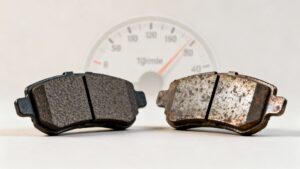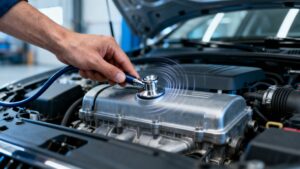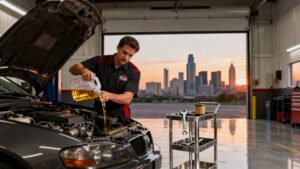

The fastest way to verify mechanic repair quality is to run five checks before you drive off the lot: confirm a signed, itemized invoice; inspect or receive an explanation for replaced parts; take a short test drive; scan for OBD-II codes; and get the warranty in writing. Doing all five takes less than 20 minutes and gives you documented proof the job was done right.
Quick verification checklist for pickup day:
- Signed, itemized invoice — every part number, labor hour, and charge listed separately
- Replaced parts or core-charge explanation — see the old part or get a written reason it was returned to the supplier
- Test drive — confirm the original symptom is gone and no new noises appeared
- OBD-II scan — no pending or active fault codes after the repair
- Written warranty — a commonly recommended minimum coverage period on parts and labor
TL;DR trust signals to demand from any shop: ASE certification on the technician doing your work, RepairPal or NAPA AutoCare recognition, a written estimate signed before work starts, and a warranty documented on the final invoice. The Better Business Bureau (BBB) complaint record for the shop is worth a 30-second check before you book.
Surveys consistently show that a large share of U.S. drivers fear unnecessary services from auto shops. Objective verification steps, not online reviews alone, are your best protection.
Table of Contents
- Where should you start when looking for a reputable shop?
- How to evaluate a shop before you approve any work
- What to ask your mechanic and how to document it
- How to read and verify your repair estimate and final invoice
- Red flags that a shop’s work or billing may be dishonest
- Practical post-repair checks to confirm the work held
- What reputable shops actually do: a model verification process
- What to expect: typical timelines and cost ranges for major services
- When to get a second opinion and how to dispute poor work
- Key Takeaways
- The transparency side of the repair counter
- Kwik Kar Oil Change & Auto Care: certified, transparent, and ready to verify
- Useful sources and verification resources
- FAQ
Where should you start when looking for a reputable shop?
Personal referrals still outperform any algorithm. Ask friends who drive the same make or model, check with coworkers whose vehicles you’ve seen well-maintained, and look in neighborhood community groups where people name specific technicians rather than just shops. A recommendation tied to a specific car problem is far more useful than a five-star average.
Once you have a short list, layer in national verification tools. The Better Business Bureau lets you check years in business, complaint counts, and how disputes were resolved. RepairPal’s certified shop directory flags shops that meet its standards for fair pricing, technician credentials, and warranty coverage. NAPA AutoCare centers must meet training and facility requirements to carry that designation. ASE badges should be visible at the counter or on the shop’s website, and you can confirm individual technician credentials directly through ASE’s online lookup.
What the research says: Professional markers like clear warranty language, visible technician certifications, and consistent facility practices are more reliable indicators of quality than online reviews alone. Reviews help you spot patterns, but a shop with 200 reviews and no posted ASE credentials is a weaker signal than one with 40 reviews and documented technician certifications.
State consumer protection offices add another layer. Your state Attorney General’s consumer protection page often lists complaint records and licensing requirements for auto repair shops. Cross-referencing a shop’s BBB record with your state AG’s database takes five minutes and can surface patterns that review sites miss.
Online reviews are most useful when you focus on recent, detailed accounts that describe specific repairs, not just star ratings. A cluster of complaints about billing surprises or refused written estimates is a pattern worth taking seriously. For a deeper look at choosing a reliable auto shop, the criteria below will sharpen your decision.
How to evaluate a shop before you approve any work
What a good written estimate looks like
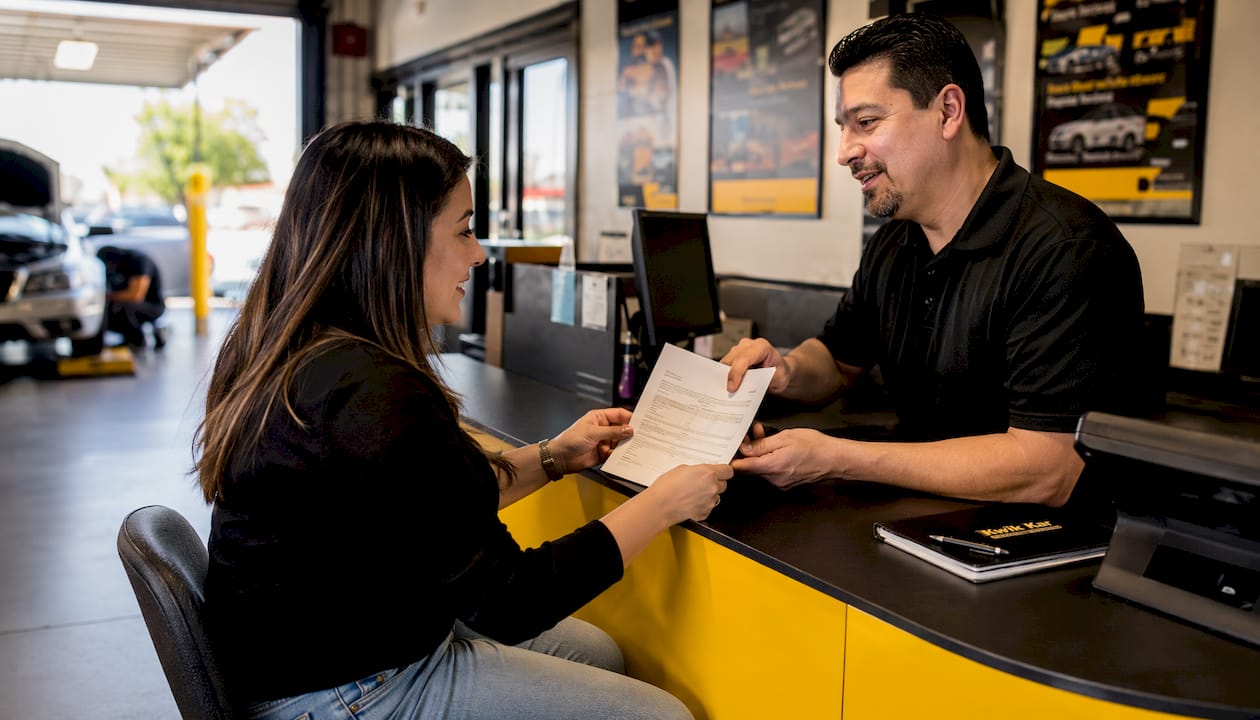
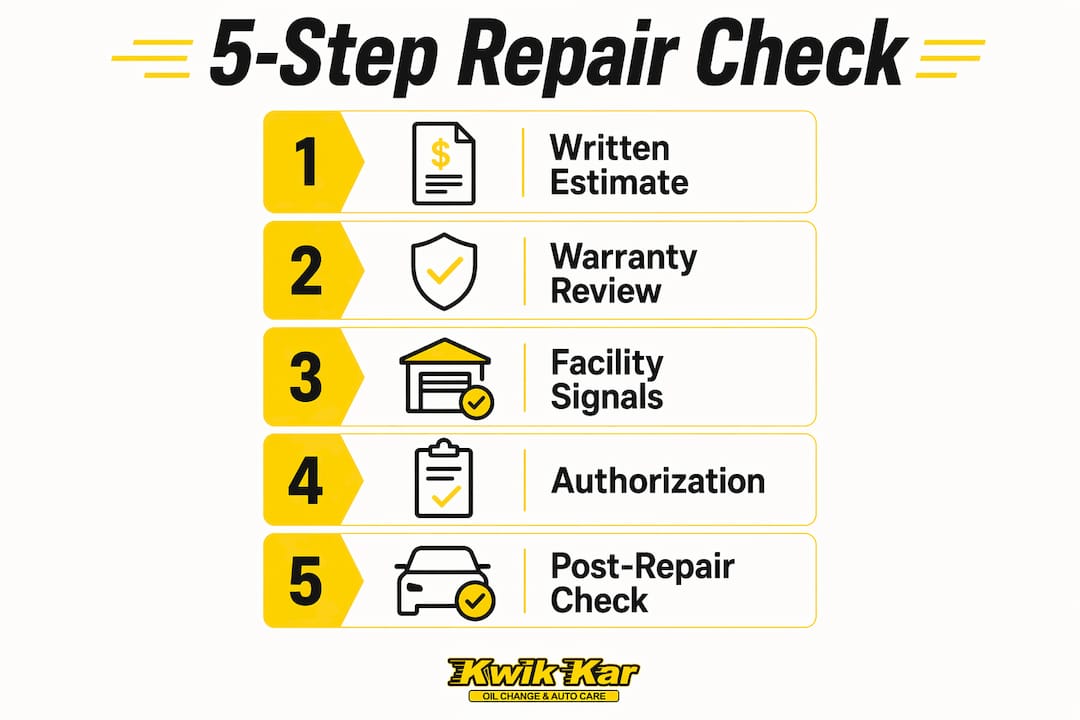
A written, itemized estimate is your legal and practical foundation. Many U.S. jurisdictions require shops to provide one before work begins, and it should break out every part by name and number, labor hours, expected completion time, and a dollar threshold above which the shop must call you for authorization. If a shop hands you a single-line total, that is not an estimate.
Warranty standards worth insisting on
Consumer Reports identifies 12 months/12,000 miles as a practical benchmark for repair warranties. Read the warranty language carefully: it should cover both parts and labor, name the specific repair, and state the process for returning if the problem recurs. A verbal guarantee means nothing if it is not on the invoice.
Facility and staff signals
ASE certification is a baseline, not a guarantee. Because ASE tests are category-specific (electrical, transmission, brakes, etc.), confirm that the technician assigned to your car holds credentials relevant to the system being repaired. Shops that post technician bios with current certification categories give you that information without having to ask. Cleanliness, organized tooling, and a front desk that explains repairs in plain language are consistent indicators of professional process.
| Evaluation signal | What it usually indicates |
|---|---|
| ASE certification (current, category-matched) | Technician passed standardized testing for that system |
| RepairPal or NAPA AutoCare recognition | Shop meets third-party standards for pricing, warranty, and process |
| Written, itemized estimate before work | Consumer-protection compliance and billing transparency |
| 12-month/12,000-mile warranty in writing | Shop stands behind parts and labor |
| Posted technician bios and training records | Ongoing education, not just a one-time credential |
| Clean, organized facility | Consistent operational standards |
Pro Tip: Book a low-stakes oil change at any new shop before committing to a major repair. You’ll see how they communicate, whether they return your car in the same condition, and whether they hand you a written summary without being asked. That trial run tells you more than any review.
What to ask your mechanic and how to document it
Preparation before you drop off the car shapes every interaction that follows. Bring a written list of symptoms with dates (when the noise started, what dashboard lights appeared, how often it happens), plus any previous repair invoices for the same system. That context helps the technician diagnose accurately and gives you a paper trail if the same issue recurs.
Key questions to ask before authorizing work:
- “Do you have experience with [my make and model], specifically with [the system being repaired]?”
- “What diagnostic steps will you run, and will I see the results?”
- “What brand of parts will you use — OEM, OE-equivalent, or aftermarket — and why?”
- “Can I see the failed part before it’s disposed of or returned for a core charge?”
- “If you find additional problems, what is the dollar limit before you call me for approval?”
- “Will the warranty cover both parts and labor, and can I see that in writing on the invoice?”
Ask for signed, timestamped authorization for any work beyond the original scope. A shop that calls you, describes the additional problem clearly, quotes the cost in writing, and waits for your approval before proceeding is operating correctly. One that proceeds without calling is not. Keep screenshots or emails of any text-based approvals alongside the paper invoice.
How to read and verify your repair estimate and final invoice
The written estimate is your comparison baseline. When you pick up the car, set the final invoice next to the original estimate and check them line by line. State consumer-protection guidance recommends keeping both documents and requesting old parts when possible, because those two items together give you the evidence needed to dispute any charge.
What to check on the final invoice:
- Part numbers on the invoice match the parts actually installed (you can cross-reference with the old part or a quick online lookup)
- Labor hours billed align with the complexity of the task (a brake pad swap on a standard sedan should not bill eight hours)
- Any charges above the authorized estimate carry a signed approval with a timestamp
- Tax and disposal fees are itemized, not buried in a lump sum
- The warranty terms appear on the invoice itself, not just on a separate handout
For parts you cannot physically inspect, ask for the core-charge explanation in writing. Some replaced parts (alternators, brake calipers, starters) carry a core charge and are returned to the supplier for credit. A professional shop documents this rather than simply refusing to show the old part. If the shop cannot produce the part and has no written core-charge explanation, that is a billing red flag. Understanding why estimates vary by shop helps you spot inflated labor or unnecessary parts before you sign.
An OBD-II scan before and after the repair is the most objective check available. If the shop ran diagnostics, ask for a printed readout of the fault codes found and the codes cleared. Comparing pre- and post-repair codes confirms the targeted system was actually addressed.
Red flags that a shop’s work or billing may be dishonest
A single red flag warrants a question. Multiple flags together warrant pausing payment and seeking a second opinion before you leave the lot.
Service and billing red flags:
- Refusal to provide a written, itemized estimate before work begins
- Inability to show replaced parts with no core-charge explanation offered
- Final invoice significantly higher than the estimate with no signed authorization for the difference
- Labor hours that look inflated relative to the task (compare against flat-rate labor guides available online)
- Parts listed on the invoice by vague descriptions rather than part numbers
- No warranty offered in writing, only a verbal assurance
Behavioral red flags:
- Aggressive upsells on unrelated systems with no time allowed for a second opinion
- Evasive or vague answers when you ask about diagnostic steps or technician credentials
- No ASE certification visible or verifiable, and no explanation when you ask
- Odd noises or new symptoms that were not present when you dropped off the car
- Pressure to authorize additional work immediately, framed as a safety emergency
If you encounter three or more of these signals, contact your state Attorney General’s consumer protection office and get a second opinion from an independent shop before paying for disputed charges.
Practical post-repair checks to confirm the work held
At pickup
Walk around the car before driving away. Check that panels, covers, or components related to the repair are properly reinstalled. Ask the service advisor for the post-repair test drive results in writing, or request to accompany a technician on a short drive if the shop allows it. Run an OBD-II scan or ask the shop to show you a cleared-code readout. Confirm you have the old parts or a written core-charge explanation in hand.
Short drive checklist
On your first drive, listen for any noise that was not present before the repair. Confirm the original symptom is gone. Check that all dashboard warning lights are off. Test related systems: if brakes were serviced, test them at low speed in a safe area; if an HVAC repair was done, run the system through all settings. These post-service checks take less than ten minutes and catch most problems before you are miles from the shop.
Follow-up over 24–72 hours
Re-check fluid levels relevant to the repair. Look under the car for any new drips or leaks. Confirm warning lights remain off after a full drive cycle. Note any new symptoms that appear and write them down with the date and mileage.
Pro Tip: Document post-repair problems with dated photos and a short video of any noise or warning light. A timestamped photo of a fluid leak under your car, taken 48 hours after a seal replacement, is far stronger evidence for a warranty claim than a verbal description weeks later.
What reputable shops actually do: a model verification process
A high-quality shop follows a documented workflow on every job. Before touching the car, a service advisor performs a pre-service inspection and records the vehicle’s condition. The technician assigned to the job holds current ASE credentials in the relevant category, and the shop can show you that documentation on request.
Once the diagnostic is complete, the shop provides a written, itemized estimate with a clear authorization threshold. No additional work proceeds without a phone call and your signed approval. After the repair, the technician runs a post-repair test and documents the results. You receive the old parts or a written core-charge explanation, a signed invoice with warranty terms, and a clear point of contact if the problem recurs.
Why certifications matter for modern vehicles: ASE re-tests technicians on a recurring cycle, which means a current ASE credential reflects knowledge of contemporary vehicle systems, not just what a technician learned a decade ago. For vehicles with advanced driver-assistance systems, hybrid powertrains, or complex electronics, that recency matters. Shops recognized by RepairPal and NAPA AutoCare have also met third-party standards for pricing fairness and warranty coverage, adding an independent layer of accountability beyond the shop’s own claims.
ASE and RepairPal certified shops signal that a third party has reviewed the shop’s credentials and process standards, not just the shop’s own marketing. Understanding what certified technician status means for your repair helps you ask the right questions at drop-off.
What to expect: typical timelines and cost ranges for major services
Knowing standard timelines helps you spot unrealistic promises or unnecessary delays. The table below reflects general U.S. industry ranges; your specific vehicle, parts availability, and shop workload will affect actual times.
| Service | Typical time | Notes |
|---|---|---|
| Diagnostic scan only | 1–2 hours | More for complex electrical or intermittent faults |
| Brake pad and rotor replacement (one axle) | 1.5–3 hours | Both axles add proportional time |
| Transmission fluid service | 1–2 hours | Full rebuild: 3–5 days |
| Engine oil and filter change | 30 minutes | Longer for synthetic drain-and-fill on some models |
| Timing belt/chain replacement | 4 hours | Varies significantly by engine layout |
| A/C recharge and leak check | 1–3 hours | Leak repair adds time |
Labor billing follows either actual hours or a flat-rate guide (such as Mitchell or AllData). Flat-rate billing means you pay the book time for a job regardless of how long it actually takes. Ask which method the shop uses before authorizing work, because a flat-rate shop billing 3.0 hours for a job the guide lists at 1.5 hours is a billing discrepancy worth questioning.
Cost ranges vary by parts choice. OEM parts carry a premium but match factory specifications; OE-equivalent parts from reputable suppliers are a reasonable middle ground; budget aftermarket parts may cost less upfront but can affect warranty coverage. Any turnaround promise should appear in writing on the estimate, and if the shop needs more time, they should call you with a revised completion time before the original deadline passes.
When to get a second opinion and how to dispute poor work
A second opinion is worth requesting when the original symptom persists after the repair, when the invoice includes items you did not authorize, or when the shop refuses to show replaced parts or offers no core-charge documentation.
Step-by-step dispute process:
- Talk to the shop manager first. Describe the specific discrepancy in writing (email is best) and state the outcome you want. Many disputes resolve at this stage.
- Gather your evidence. Collect the original estimate, the final invoice, any signed authorizations, photos of the vehicle, old parts if you have them, and OBD-II readouts.
- Get a written second opinion. Take the car to an independent shop, provide the first invoice, and ask for a written assessment of the work performed. A second mechanic’s written report is your strongest independent evidence.
- File a BBB complaint. The BBB complaint process is free and creates a documented record; many shops respond to avoid a public complaint on their profile.
- Contact your state Attorney General. State consumer-protection offices can investigate shops for unauthorized charges and misleading conduct. The FTC’s auto repair guidance recommends saving all invoices and written communications to support a dispute.
- Consider small-claims court. For disputes under your state’s small-claims limit (typically $5,000–$10,000), small-claims court is a practical last resort. Bring every document listed above.
What to save and for how long: Keep the original estimate, final invoice, all signed authorizations, photos, OBD-II printouts, and any text or email communications for at least as long as your warranty period, plus six months. If you filed a complaint, keep records until the case closes.
Key Takeaways
A repair you can verify is a repair you can trust: demand a signed, itemized invoice, visible or explained replaced parts, a post-repair OBD-II clear, and a written warranty before you drive away.
| Point | Details |
|---|---|
| Written estimate is your baseline | Demand a signed, itemized estimate before work starts; compare it line by line to the final invoice. |
| 12-month/12,000-mile warranty benchmark | Insist on this minimum in writing on the invoice, covering both parts and labor. |
| OBD-II scan confirms the fix | A post-repair scan with no active or pending codes is the most objective proof the targeted system was addressed. |
| ASE credentials should match the job | Verify the technician’s current certification covers the specific system being repaired, not just general automotive work. |
| Kwik Kar Oil Change & Auto Care meets the checklist | ASE-certified technicians, itemized estimates, RepairPal and NAPA AutoCare recognition, and written warranty coverage on every repair. |
The transparency side of the repair counter
From where we stand at Kwik Kar Oil Change & Auto Care, the verification steps in this article are not obstacles. They are exactly what a shop with nothing to hide should welcome. Written estimates protect both sides of the transaction. Returning old parts or documenting core charges removes any ambiguity about what was replaced. Post-repair test drives catch problems before you leave the lot, which is far less costly than a callback.
The shops that resist these steps are usually the ones with something to hide. Technician training is not a one-time event; modern vehicles with advanced electronics and driver-assistance systems require ongoing education, and a shop that cannot show you current credentials is telling you something about its commitment to quality. Transparency is not a policy we adopted because customers asked for it. It is the only way to do this work correctly.
Kwik Kar Oil Change & Auto Care: certified, transparent, and ready to verify
Kwik Kar Oil Change & Auto Care in Dallas, TX checks every box on the verification checklist above. ASE-certified master technicians handle both domestic and import vehicles, RepairPal and NAPA AutoCare recognition confirms third-party accountability, and every job starts with a written, itemized estimate and ends with documented warranty coverage.
Whether you need a post-repair diagnostic scan, a full brake or transmission service, or a trial oil change to evaluate the shop before a major repair, the team at Kwik Kar Oil Change & Auto Care provides the documentation, credentials, and communication you should expect from any certified shop. You can also take $30 off a maintenance service with a free inspection coupon to start with a low-risk visit. Book your appointment or review the full list of auto repair services to get started.
Useful sources and verification resources
- FTC Auto Repair Basics — Federal guidance on written estimates, warranties, and dispute documentation; the authoritative starting point for U.S. consumer rights in auto repair.
- Better Business Bureau (BBB) — Check complaint history, years in business, and dispute resolution records for any shop before you book.
- ASE (National Institute for Automotive Service Excellence) — Verify individual technician certifications by category and confirm current credential status.
- RepairPal — Find certified shops, compare fair-price estimates by repair type and ZIP code, and confirm shop certification status.
- Texas Attorney General: Car Repair Tips — State-level consumer protection guidance on estimates, old parts, and dispute steps (Texas readers; check your own state AG for local rules).
- California BAR Auto Repair Consumer Guide — Detailed state-level rules on written estimates and consumer rights; useful model for understanding what other states often require.
- Kwik Kar: ASE & RepairPal Certified — Details on Kwik Kar Oil Change & Auto Care’s certifications and what they mean for your repair.
- Kwik Kar: How to Find a Trustworthy Auto Mechanic — Practical vetting criteria and local referral guidance.
- Collision Auto Glass: Choosing the Best Auto Glass Shop — Partner resource for readers evaluating windshield or glass repair quality alongside mechanical work.
FAQ
How do you know if a mechanic shop is good?
Look for current ASE certifications, a written estimate before work starts, a 12-month/12,000-mile warranty in writing, and a clean, organized facility. AARP’s shop assessment criteria also recommend checking BBB records and asking whether technicians communicate clearly in plain language.
What are the red flags of a bad mechanic?
The clearest red flags are refusal to provide a written estimate, inability to show replaced parts without a core-charge explanation, a final bill significantly higher than the estimate without signed authorization, and no warranty offered in writing. Aggressive upsells with no time for a second opinion are also a consistent warning sign.
How do you verify mechanic repair quality after the job is done?
Run an OBD-II scan to confirm no active fault codes remain, inspect the repair area visually, confirm you received old parts or a written core-charge explanation, and take a short test drive to verify the original symptom is resolved. Follow up over 24–72 hours by checking for fluid leaks and new warning lights.
How do you know if a repair shop is legitimate?
Confirm ASE certification for the technician assigned to your vehicle, check the shop’s BBB profile for complaint history, look for RepairPal or NAPA AutoCare recognition, and verify that the shop provides a signed, itemized estimate before touching your car. Shops that meet all four criteria are operating to recognized U.S. industry standards.
What is the 30/60/90 rule for cars?
The 30/60/90 rule refers to common preventive maintenance intervals that vary, typically covering fluid changes, filter replacements, spark plugs, and belt inspections. Your owner’s manual is the authoritative source for your specific vehicle’s schedule, since modern cars vary significantly from this general guideline.