



Most U.S. drivers pay between $400 and $900 for water pump replacement on a mainstream car, with labor typically covering 60% to 70% of that bill. Timing-belt-driven pumps and luxury vehicles generally have higher replacement costs. Before you book anything, get a written diagnostic estimate that breaks out parts and labor separately, so you know exactly what you’re paying for and why.
TL;DR:
- Water pump replacement costs vary from $300 for simple external jobs to over $1,500 for European luxury vehicles with tight engine bays.
- Labor costs dominate the expense, especially for timing-belt-driven pumps that require disassembly of engine components, often extending repair time to a full day.
- Estimates should specify whether the pump is externally driven or timing-belt driven, as this detail explains most price differences and affects repair complexity.
- Replacing the water pump alongside the timing belt is highly recommended to avoid split labor costs and future disassembly.
- Always obtain a detailed, written estimate that itemizes parts, labor, warranties, and clearly states whether the pump is OE, OE-equivalent, or economy-tier to avoid overpaying.
Table of Contents
- How Much Does Water Pump Replacement Cost in the U.S.?
- What Changes the Price? Six Main Cost Drivers
- What Should a Water Pump Estimate Include?
- What Happens During a Water Pump Replacement?
- Is the Standard Cost Advice on Water Pumps Actually Useful?
- Get a Written Water Pump Estimate From Kwik Kar
- Sources
- FAQ
How Much Does Water Pump Replacement Cost in the U.S.?
Water pump replacement typically runs from a low of around $300 for a straightforward, externally mounted pump to $1,200 or more when the pump lives behind the timing cover. RepairPal puts the national average between $885 and $1,134, with parts running $524 to $604 and labor at $361 to $530. Other estimators land a bit lower: AutOwner aggregates a broader range of $310 to $1,100, averaging around $641, once you factor in cheaper economy-car jobs alongside pricier import work.
Where your car falls in that range depends heavily on class and engine layout:
- Economy cars (Civic, Corolla, Sentra): often $300 to $600, since the pump sits externally and access is simple.
- Mid-range sedans and crossovers (Camry, Accord, CR-V): usually $400 to $800.
- Trucks and SUVs (F-150, Silverado, Tahoe): commonly $450 to $900, depending on engine size and accessory clearance.
- Luxury and European imports (BMW, Audi, Mercedes): frequently $800 to $1,500-plus, per Fixxr’s 2026 estimate breakdown, largely due to tighter engine bays and pricier OE parts.
The part itself is often the smaller line item; to maintain your vehicle’s exterior protection, consider how to keep your ceramic coating in top condition. Many modern water pumps cost just $150 to $300, according to AutoZone, but labor to access, remove, and reinstall the pump, plus refill and bleed the cooling system, makes up the bulk of your invoice. Regional labor rates matter too. A shop in a major metro area may charge more per hour than one in a smaller town, even for identical work.
What Changes the Price? Six Main Cost Drivers
Two identical-looking estimates for the same car can differ by hundreds of dollars, and it almost always comes down to one of these six factors.
- Pump location and drive method. An externally driven water pump, mounted on the front of the engine and turned by a serpentine belt, is usually a one- to two-hour job. A timing-belt-driven or timing-chain-driven pump sits behind covers that require disassembling the front of the engine, which can push labor to four hours or more.
- Parts tier. Economy aftermarket pumps cost less upfront but may carry shorter warranties. OE (original equipment) and OE-equivalent parts cost more but tend to match factory tolerances and last longer.
- Bundled services. If your pump is timing-belt driven, most shops recommend replacing the timing belt at the same time, since the labor to reach both components overlaps almost entirely. Adding the pump to a timing-belt job adds modest parts cost but very little extra labor, compared to paying for two separate teardowns later.
- Access and engine layout. Transverse-mounted engines in tight compact-car bays can take longer to work in than a roomy truck engine bay, even when the pump itself is externally mounted.
- Local labor rates. Shop hourly rates vary by region and can shift your total by $50 to $150 even when the parts cost is identical.
- Existing damage. If the engine has been running hot, you may also need a new thermostat, radiator hoses, or a full coolant flush, adding $50 to $200. In more serious overheating cases, a warped cylinder head or blown head gasket can add $1,000 to $2,500 to the job.
Pro Tip: Ask your shop whether your engine’s water pump is externally driven or timing-belt driven before you accept an estimate. That single detail explains most of the price gap between a $400 quote and a $900 quote for what looks like the same repair.
What Should a Water Pump Estimate Include?
A transparent written estimate should itemize labor hours, the specific part and brand being installed, warranty terms on both parts and labor, applicable taxes and shop fees, and any core charge if your old pump is exchanged. If a shop won’t put these details in writing before starting work, that’s worth treating as a warning sign.
When you call around or review a quote, ask:
- Is my water pump externally driven or timing-belt driven?
- What brand or tier of replacement pump are you installing, economy, OE-equivalent, or OE?
- How many labor hours are budgeted for this job?
- What warranty comes with the parts and the labor separately?
- What’s the expected turnaround time to get my car back?
Watch for estimates that bundle “parts and labor” into one number with no breakdown, quotes that seem far below every other shop you called (often a sign of a lower-tier part or a shorter warranty), and any shop that won’t commit to a labor-hour figure in writing. Two estimates only compare fairly when they list the same part tier, the same scope of work, and the same warranty length side by side. Reviewing your options against general auto repair pricing factors can help you spot when a number looks off.
What Happens During a Water Pump Replacement?
The technician starts by confirming the diagnosis (checking for coolant leaks, a failing bearing, or a worn impeller) and agreeing on the scope of work with you before touching the car. From there, the standard sequence is: drain the coolant, remove whatever’s blocking access (belts, pulleys, sometimes the timing cover), pull the old pump and gasket, install the new pump with a fresh gasket or sealant, refill the cooling system, and bleed out trapped air.
Before your car leaves the bay, a shop should pressure-test the cooling system to confirm there are no leaks and run a road test to check that temperatures stay stable under load.
- Simple externally driven pump jobs: often same-day, sometimes just a few hours.
- Timing-belt-driven pump jobs: frequently a full day or into the next day, especially if a timing belt or thermostat is replaced at the same time.
- Jobs complicated by prior overheating damage: can extend to multiple days if head-gasket or radiator work is needed.
Pro Tip: Ask the shop to show you the old pump once it’s out. A cracked impeller, a seized bearing, or a failed seal confirms the diagnosis was correct and gives you peace of mind that you weren’t sold an unnecessary repair.
Is the Standard Cost Advice on Water Pumps Actually Useful?
Most cost guides hand you a number and stop there, which misses the point. The real skill isn’t finding the lowest quote. It’s knowing enough about your specific engine to tell whether a quote makes sense.
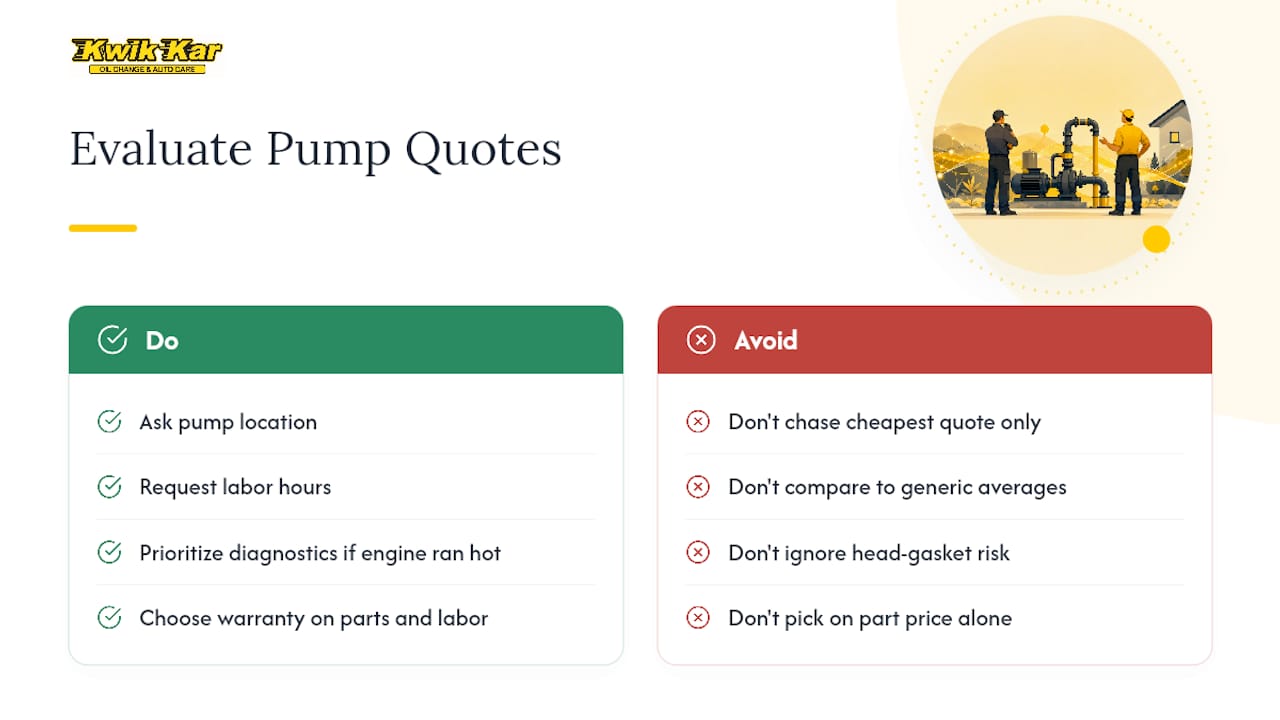
A $1,200 estimate on a timing-belt-driven European sedan isn’t a red flag. A $1,200 estimate on a Corolla with an external pump absolutely is. That distinction only comes from asking about pump location and labor hours, not from comparing your quote to a generic online average.
We’d also push back on the instinct to chase the cheapest number. Labor makes up the majority of this repair, so the part price difference between economy and OE tiers is often small relative to the total bill. Paying slightly more for a documented warranty on both parts and labor protects you far more than saving $40 on a pump. If your engine has already run hot, prioritize the diagnostic conversation over the price conversation. A pump replacement that ignores head-gasket damage underneath it isn’t a bargain. It’s a second repair waiting to happen.
— Kwik Kar
Get a Written Water Pump Estimate From Kwik Kar
Kwik Kar Oil Change & Auto Care gives you what most of the estimates you’ll find online can’t: an actual technician looking at your actual engine before you commit to a number. Our ASE Certified Master technicians use modern diagnostic tools to confirm whether your pump is externally driven or timing-belt driven, then hand you a written estimate that breaks out labor hours, part brand, and warranty terms before any work begins.

We’re recognized by both RepairPal and NAPA AutoCare, and most water pump jobs turn around fast, often same-day for externally mounted pumps. Ask us about current coupons when you call. If your check engine light or temperature gauge has you second-guessing your cooling system, our engine diagnostic service can confirm what’s actually wrong before you spend a dollar. Ready to see your options? Visit our full auto repair services page to request a written estimate or book your appointment today.
Sources
- Does My Car Need a New Water Pump? – Kelley Blue Book
- Water Pump Replacement Cost Estimate – RepairPal
- How Much Does a Water Pump Replacement Cost in 2026? · Fixxr
- Water Pump Replacement Cost: $310 – $1,100 (2026) | AutOwner
- Symptoms & Signs of a Bad Water Pump – AutoZone
FAQ
How much does water pump replacement cost on average?
Most mainstream cars run $400 to $900, with an overall U.S. average landing around $600 to $650 once labor, parts, and taxes are included, according to AutOwner’s estimator data.
Why is labor so much more expensive than the pump itself?
The part often costs just $150 to $300, but reaching it, especially on timing-belt-driven engines, plus draining and refilling the cooling system, takes real shop time, which is why labor typically covers 60% to 70% of the total bill.
Should I replace the timing belt at the same time as the water pump?
Yes, if your engine’s pump is timing-belt driven, most shops recommend doing both together since the labor overlap makes it far cheaper than paying for two separate teardowns later.
What are the warning signs I need a water pump replacement soon?
Watch for coolant puddles under the front of the engine, a high-pitched squealing or grinding noise, and a rising temperature gauge. Catching these early, before the engine overheats, typically keeps the repair in the standard cost range instead of adding head-gasket damage.
Does Kwik Kar offer written estimates before starting work?
Yes, Kwik Kar Oil Change & Auto Care provides a written estimate detailing labor hours, part brand, and warranty coverage before any repair begins, so you know the full cost upfront.