




Balancing fixes vibration caused by uneven wheel weight; alignment fixes steering pull and uneven edge wear caused by bad suspension angles. If your car shakes at highway speed, book a wheel balancing service. If it drifts to one side or your tread wears unevenly on one edge, book a wheel alignment service. After a new tire install or a pothole hit, plan on getting both services checked at once.
TL;DR:
- If your car vibrates at highway speed, balancing alone typically resolves the issue, especially if the vibration fades or appears only at certain speeds.
- Drifting to one side or uneven edge wear indicates misalignment, which corrects suspension angles like camber, caster, and toe.
- New tires, hitting potholes, or suspension repairs almost always require both balancing and alignment checks to prevent uneven wear and shaking.
- Balancing usually costs $15 to $50 per tire and takes 15 to 30 minutes, while alignment ranges from $75 to $150 and takes 30 to 60 minutes.
- Accurate diagnosis involves checking symptoms like speed-dependent vibration, pulling, tread wear patterns, and asking shops for visual printouts of prior and post-work measurements.
Table of Contents
- Alignment vs Balancing at a Glance
- What Tire Balancing Actually Corrects
- What Wheel Alignment Actually Corrects
- How to Tell Which Service You Need
- When You Need Both Services at Once
- What Actually Happens in the Bay
- What to Expect on Price
- Questions to Ask Before You Approve the Work
- Kwik Kar’s Take on Getting the Diagnosis Right
- Book Your Alignment or Balance Check in Dallas
- Sources
- FAQ
Alignment vs Balancing at a Glance
Here’s the short version, side by side, so you know what to ask for before you even pick up the phone.
| Service | What it fixes | Main symptom | Typical time | Typical US cost | Check frequency |
|---|---|---|---|---|---|
| Wheel balancing | Uneven weight in the tire/wheel assembly | Vibration or shake at speed | 15 to 30 minutes for a set of four | $15 to $50 per tire | Every new tire mount and when vibration returns |
| Wheel alignment | Suspension angles (camber, caster, toe) | Pulling, drifting, uneven edge wear | 30 to 60 minutes | $75 to $150 for a four wheel alignment | Annually, or after suspension work/impacts |
A few decision rules cut through most of the confusion:
- If the shake only shows up at certain speeds (say, 55 to 65 mph) and the steering wheel feels normal otherwise, balancing alone usually solves it.
- If the car pulls to one side on a flat, empty road, or your tires show wear only on the inner or outer edge, alignment is the fix.
- If you just installed new tires, hit a deep pothole, or had suspension parts replaced, request both. One without the other often leaves the original complaint half solved.
What Tire Balancing Actually Corrects
Every tire and wheel assembly has small variations in weight distribution, even brand new ones straight off the rack. Wheel balancing corrects that uneven weight by adding small counterweights to the rim until the assembly spins true. Technicians sort this into two types: static imbalance, where the weight is off on a single plane, and dynamic imbalance, where the weight is uneven side to side, which causes a wobble rather than just a bounce.
A standard spin balancer spins the wheel and measures where the heavy spot sits, then a technician clips or sticks weights opposite that point. For stubborn vibration on performance or heavy-duty wheels, shops sometimes reach for a road-force balancer, which presses a roller against the tire to simulate road load and catch problems a standard spin test misses.
Watch for these signs of imbalance:
- Vibration that appears at highway speed and fades at lower speeds
- A shimmy felt in the steering wheel, seat, or floor
- Cupped or scalloped tread patterns from the tire bouncing against the road
Pro Tip: If your new tires start vibrating within the first few hundred miles, don’t assume they’re defective. A lost or shifted weight is far more common, and it’s a quick fix.
What Wheel Alignment Actually Corrects
Alignment has nothing to do with weight. It adjusts three suspension angles so your tires meet the road the way the manufacturer designed them to. Camber is the inward or outward tilt of the tire when you look at it from the front; too much negative camber wears the inner edge fast. Caster is the forward or backward tilt of the steering axis, which affects straight-line stability and steering feel. Toe is whether the tires point slightly inward or outward relative to each other, and it’s the angle most responsible for a car that drifts even with your hands off the wheel.
Shops correct these angles on a computer-guided alignment rack using sensors or lasers mounted on each wheel, then adjust tie rods, control arms, or camber bolts to bring every angle back within factory spec. A good shop hands you a printout showing before-and-after numbers.
Symptoms that point to misalignment:
- The car pulls or drifts to one side on a flat road
- The steering wheel sits off center when driving straight
- Tread wears unevenly on the inner or outer shoulder rather than across the whole tire
How to Tell Which Service You Need
Run through this quick checklist before you call the shop, and you’ll walk in already knowing what to ask for.
- Notice when the vibration happens. If it’s speed dependent (worse at 60 mph, gone at 30), that points to balance.
- Check for pulling. Find an empty, flat stretch of road, let go of the wheel briefly, and see if the car drifts one direction. That points to alignment.
- Look at the tread. Cupped or wavy wear patterns suggest imbalance; wear concentrated on one edge suggests misalignment.
- If you notice both a vibration and a pull, or you can’t isolate the symptom, ask for a full inspection covering both.
Pro Tip: Run your palm across the tread instead of just looking at it. Cupping and edge wear are often easier to feel than to see, especially on darker tread rubber.
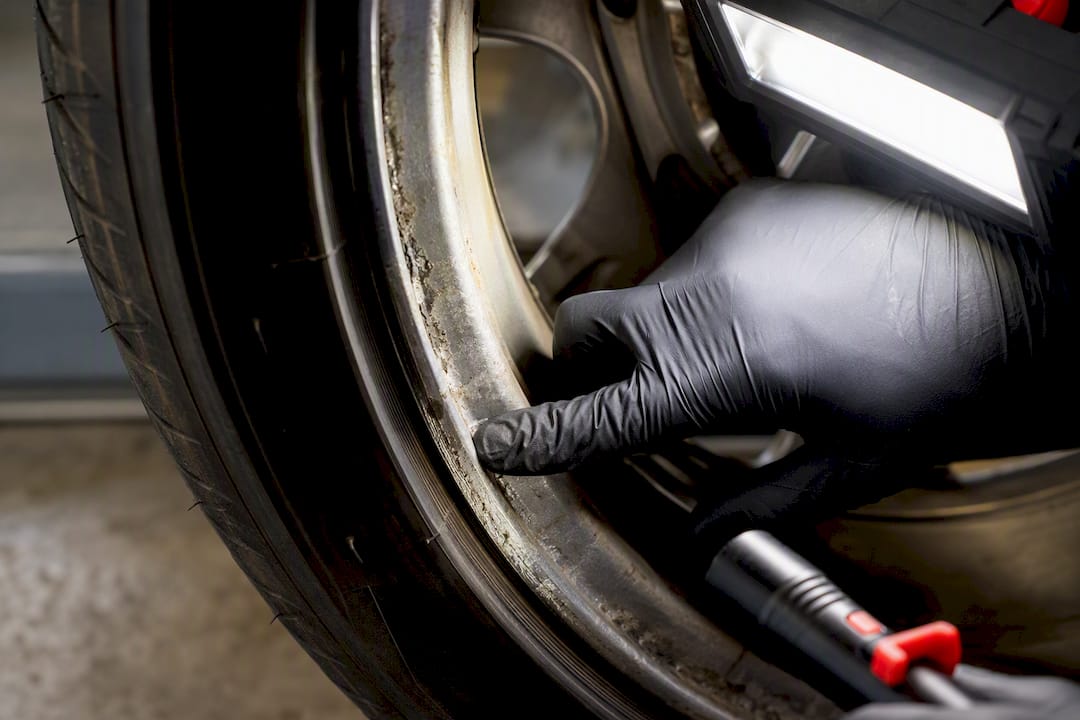
Any sudden, severe vibration, a loud thump after hitting something, or a steering wheel that suddenly feels loose are red flags; doing a clean ceramic coated wheels visual inspection can help spot damage or corrosion early. Get to a shop the same day rather than waiting for a scheduled service.
When You Need Both Services at Once
Certain triggers almost always call for a balance-and-alignment combo rather than one or the other:
- New tire installs. Every new tire should be balanced at mounting, and many shops recommend checking alignment at the same visit so the fresh rubber doesn’t start wearing unevenly on day one.
- Suspension repairs. Replacing struts, control arms, or tie rods changes the geometry underneath your car, which almost always throws off alignment.
- Potholes and curb strikes. A hard impact can knock a wheel weight loose and tweak a suspension angle in the same moment.
- Tire repairs or remounts. Pulling a tire off the rim to patch it disturbs the balance, even if the wheel itself wasn’t touched.
Outside of those triggers, an annual alignment check plus a balance check at each tire rotation covers most drivers, especially if you spend a lot of time on Dallas-area highways where potholes and expansion joints are a fact of life.
What Actually Happens in the Bay
A balancing job is straightforward: the wheel comes off, goes on the spin balancer, gets measured, and gets small weights added until it spins smooth. Simple jobs run 15 to 30 minutes for a full set of four.
An alignment takes longer because the car has to be positioned precisely on the rack, sensors clamped to each wheel, and multiple angles measured and adjusted one at a time. Expect 30 to 60 minutes for a standard job, longer if a technician finds worn tie rod ends or bushings that need replacing before the angles will even hold.
- Balancing equipment: spin balancer for routine checks, road-force balancer for stubborn vibration
- Alignment equipment: computer rack with sensors or lasers, plus hand tools for adjusting camber, caster, and toe
- Ask for the printout either way. It’s your proof the work was actually done and done correctly.
What to Expect on Price
Balancing is typically billed per tire, with common ranges of $15 to $50 per tire depending on the shop and whether road-force balancing is needed. A four-wheel alignment commonly runs $75 to $150, though the number climbs if a technician has to replace a worn part before the angles will hold spec.
A few things push the price up on either service:
- Specialty or oversized wheels that require extra setup time
- Worn suspension components discovered during the alignment check
- Diagnostic time if the symptom isn’t obvious from a quick test drive
Many shops bundle balancing into a new tire purchase, which is worth asking about directly. If you’re shopping for a new set, check whether balancing is already included in the price or billed separately, and ask what the warranty covers if vibration shows up again a few weeks later.
Questions to Ask Before You Approve the Work
A shop that’s confident in its diagnosis will answer these without hesitation:
- Can I see the alignment printout showing before and after numbers?
- Will you use standard dynamic balancing or road-force balancing, and why?
- What weight material are you using, and where will it be placed on the wheel?
- How long will the job take, and what’s covered if the symptom comes back?
If a shop can’t answer clearly, or skips the printout entirely, that’s worth a second opinion before you pay for work you can’t verify.
Kwik Kar’s Take on Getting the Diagnosis Right
Our ASE-certified technicians run a symptom-first check before recommending either service, and you get a transparent estimate before any work starts. If your car shakes, pulls, or the tread looks uneven, bring it in and we’ll pinpoint the cause fast.
— Kwik Kar
Book Your Alignment or Balance Check in Dallas
Guessing which service your car needs wastes a trip and sometimes money. Kwik Kar Oil Change & Auto Care on Spring Valley Road gives Dallas drivers a straight answer: our ASE-certified technicians diagnose the actual symptom first, then walk you through a transparent estimate before anything gets touched.

Whether you’re dealing with highway vibration, a car that won’t drive straight, or you just picked up a new set of tires, our team checks balance and alignment together so you’re not paying for a repeat visit later. If uneven wear has you wondering what else might be going on with your suspension, our guide on what causes uneven tire wear breaks down the patterns worth watching. And if you’re due for new rubber anyway, our tires and alignment guide covers how rotation intervals fit into the bigger maintenance picture.
Ready for a diagnostic check? Schedule your alignment or balance service at our Spring Valley Road location, or ask about current tire bundle offers when you call.
Sources
- Wheel alignment & balancing explained – Michelin USA
- Tire alignment vs. balance — Family Handyman
- Wheel balance vs. alignment: what’s the difference and why it matters | AAA Automotive
FAQ
How do I know if I need a balance or alignment?
Vibration that changes with speed usually points to imbalance, while pulling to one side or uneven edge wear on the tread points to misalignment. If you notice both, ask the shop to check both at the same visit.
Should you do balance or alignment first?
There’s no strict order requirement, but most shops balance the tires first, then align, since a wobbling wheel can make alignment readings less reliable. If you’re only dealing with one symptom, you only need the matching service.
Can I do balancing without alignment?
Yes, balancing and alignment are separate procedures that address different problems, so you can get one without the other. Just know that a balanced tire on a misaligned car will still wear unevenly over time.
Which is more expensive, wheel alignment or balancing?
Alignment typically costs more overall, with four-wheel jobs commonly running $75 to $150 compared to $15 to $50 per tire for balancing. The gap comes down to alignment requiring more setup time and precision equipment.