



If your car clicks when you turn the key but the engine won’t crank, the cause is most often a weak or discharged battery, or loose or corroded battery connections. Rapid clicking usually points to the battery side of the system. A single, loud click usually points to the starter or its solenoid. Either way, a few safe checks can tell you which one you’re dealing with before you call for help or buy a part.
This guide walks you through what each kind of click means, what you can check in a parking lot or driveway, how a jump-start fits in, and the point where guessing gets expensive and a proper test is the smarter decision.
TL;DR
- Rapid clicking usually means the battery is too weak to turn the starter. Check the terminals and try a jump-start.
- One loud click, then silence usually points to the starter or solenoid, though a badly discharged battery can also produce it.
- Clean, tight battery terminals and good ground connections matter as much as the battery itself.
- If a charged battery or a jump-start doesn’t fix it, stop swapping parts and get the starting and charging system tested.
- We test batteries, starters and alternators at our Spring Valley Road shop in Dallas.
Table of Contents
- What does the clicking sound actually mean?
- What can you safely check yourself?
- Why do shops test voltage drop before replacing a starter?
- Battery, starter or alternator: how to tell them apart
- When should you stop troubleshooting and call a shop?
- Perspective: what we see in the bay
- Need a battery, starter or alternator checked in Dallas?
- Prevention: keeping the click from coming back
- FAQ
- Sources
What does the clicking sound actually mean?
When you turn the key or press the start button, the battery sends current to a relay, called the solenoid, on or near the starter. The solenoid does two jobs: it pushes the starter gear into the engine’s flywheel and it closes a heavy switch that lets large current flow to the starter motor. The click you hear is that solenoid (or a relay) working, or trying to.
If there isn’t enough power behind it, the solenoid grabs, drops out, grabs again, and you get a chatter. If the power is there but the starter motor or its contacts fail, you get one click and nothing.
AutoZone’s guide says clicking during a no-start is almost always an electrical issue, with rapid clicking usually pointing to a weak or dead battery and a single heavy click typically indicating a faulty starter motor or a badly discharged battery. That overlap is why the sound is a clue, not a verdict.
Rapid clicking: the battery side
A fast tick-tick-tick-tick means the solenoid keeps engaging and dropping out because voltage collapses the moment the starter asks for current. Common causes:
- A weak or discharged battery. Hagerty’s troubleshooting guide calls a weak or dead battery by far the most common reason a starter doesn’t spin the engine, or spins it too slowly.
- Corroded or loose battery clamps that let the battery read fine but can’t pass the current.
- A bad ground connection between the battery, engine and body.
- An alternator that hasn’t been charging, so the battery was undercharged before you parked.
The last one matters. If you’ve jump-started the same car twice in a month, the battery may not be the root problem. Our guide to starter and alternator symptoms covers the quick tests that separate the two.
A single click: the starter side
One firm click followed by silence usually means the solenoid is getting the signal but the starter motor isn’t turning. That can be a failed solenoid, worn starter contacts, a bad connection at the starter, or a problem in the control circuit that sends the signal. HELLA’s U.S. technical guide lists several starter failure points: electrical connections, the engaging solenoid, the starter motor itself, and the pinion and freewheel parts. A starter that clacks without engaging is among the symptoms it describes.
A badly discharged battery can still give a single click, because one solenoid pull takes little current compared with turning the engine. So a single click doesn’t automatically condemn the starter.
Quick comparison
| What you hear | Lights and dash | Most likely cause | First thing to check |
|---|---|---|---|
| Fast, repeated clicking | Dim or flicker when you try to start | Weak or discharged battery | Battery voltage, terminals |
| Fast clicking, lights fine | Bright | Corroded clamp or poor ground | Terminals, ground straps |
| One loud click, then nothing | Normal or slightly dim | Starter or solenoid, or a very low battery | Battery charge, then starter circuit |
| No click, no crank, lights on | Normal | Starter relay, switch, or control circuit | Professional diagnosis |
| Engine cranks normally but won’t fire | Normal | Fuel or spark problem | Professional diagnosis |
That last row is worth noting. ALLDATA’s no-start guide says slow cranking points toward a low battery, cables, the starter or a mechanical problem, while normal cranking points more toward fuel or spark. Clicking with no cranking is a different problem from an engine that spins but won’t catch.
What can you safely check yourself?
You don’t need tools beyond a basic set, and none of these steps involve working under the car. Wear eye protection when you’re near a battery, keep metal tools away from both terminals at once, and stop if anything looks cracked, swollen or leaking.
- Notice the dash and headlights. If the lights dim sharply or go out when you turn the key, the battery or its connections are the prime suspect. If they stay bright and you get one click, the starter side moves up the list.
- Look at the terminals. White, blue or green crust around the posts, or a clamp you can twist by hand, is enough to cause rapid clicking. AutoZone recommends inspecting the terminals, checking cable tightness, and cleaning corrosion with a battery-terminal brush and a baking-soda-and-water solution, then retesting.
- Check the ground. Hagerty advises cleaning corroded posts and clamps and checking the negative cable’s connections to the engine block and chassis before you decide to buy a battery.
- Measure battery voltage if you have a multimeter. Hagerty gives about 12.6 volts as a full charge and says below 12 volts is essentially discharged for starting purposes. Bosch’s starting-systems guide says a fully charged battery reads 12.6 volts at rest and that at least 12.4 volts is needed for a proper test, and that battery connections and ground straps must be clean and tight.
- Retry after cleaning. If the engine now cranks, the problem was the connection, not the battery. Have the battery load-tested anyway so you know how much life it has left.
Our own walkthrough on checking car battery health goes deeper on what a battery test shows.
Does a jump-start make sense?
Yes, when the symptoms point to the battery. If the battery tests weak, or you can’t test it on the spot, a jump-start is a reasonable next step. Follow the instructions in your owner’s manual for the correct connection order and any warnings for your model, since some vehicles have dedicated jump points and hybrids have their own rules.
What the result tells you:
- It starts right away. The battery was the weak link, or the connections were. Don’t just drive on. Find out why it was low: an old battery, a charging problem, or something draining it overnight.
- It starts, then dies again soon after. Suspect the alternator, which isn’t recharging the battery.
- It still just clicks. If the battery is truly charged and the jump didn’t help, the starter and its circuit are the next priority.
If you’re curious about the overnight-drain scenario, we cover it in what causes a car battery to drain overnight.
Why do shops test voltage drop before replacing a starter?
Parts swapping is how a $0 problem becomes a $400 one. A loose cable or a corroded ground can mimic a failed starter almost perfectly, because the starter is simply not receiving the current it needs.
The professional method is to test the circuit under load. Delco Remy’s diagnostic procedure starts by charging and load-testing the battery, then checks voltage drop across the starter cables, and treats click-with-no-crank as a control-circuit category. Its guidance is that total voltage drop in the starter circuit should stay below 0.5 volts while cranking, and that an excessive drop can cause both click and no-click complaints.
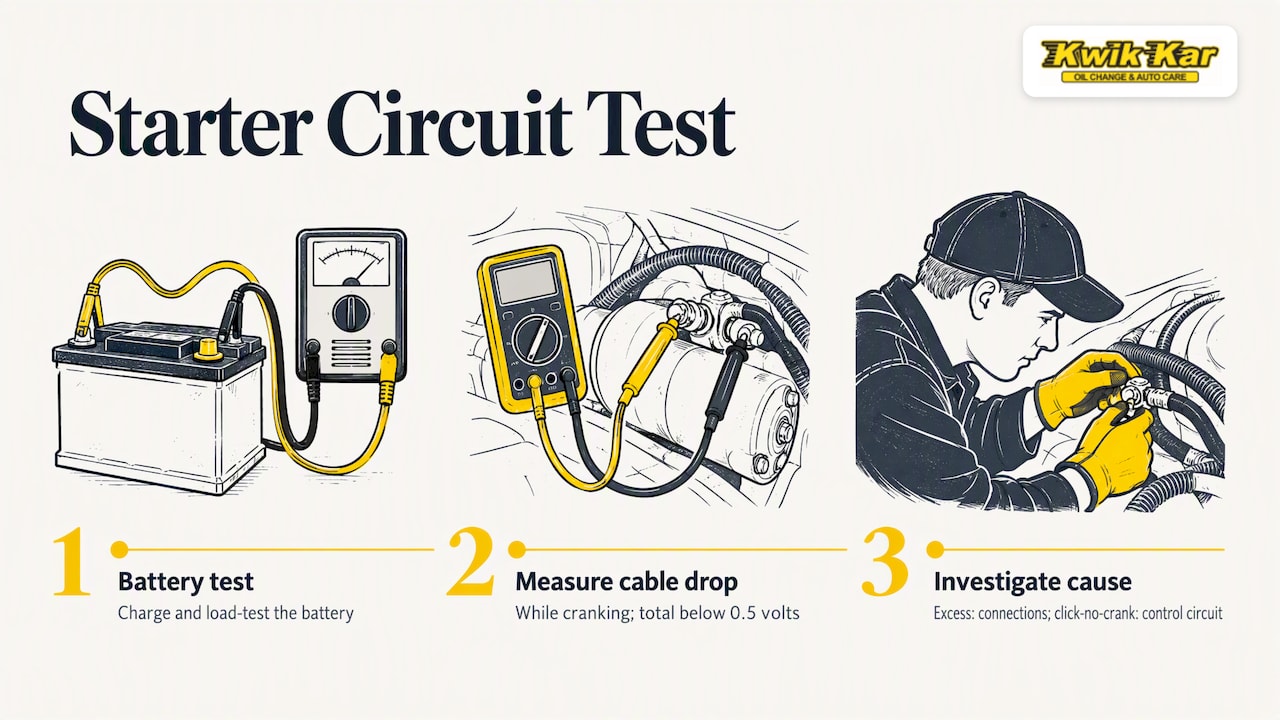
Voltage drop is simple in principle: measure how much voltage is lost along a cable or connection while current flows. A small resistance you can’t see or feel can steal enough voltage to stop a starter. If you want to understand the idea in more depth, this explanation of finding small ground resistance with a voltage drop test shows how a fraction of an ohm in a ground path can cause trouble, and the same logic applies to starter cables.
Battery, starter or alternator: how to tell them apart
These three parts work as one system, and each one can make the others look bad.
- Battery: stores the energy. It’s the most common culprit when you hear rapid clicking, especially on an older battery. Heat is hard on batteries, and North Texas summers make a battery that’s already near the end of its life more likely to quit without warning.
- Starter: converts that energy into cranking. A failing starter tends to give a single click, intermittent no-starts that sometimes fix themselves, or a grinding sound.
- Alternator: recharges the battery while you drive. It rarely causes the click itself, but a weak alternator leaves the battery undercharged, so the click shows up the next morning. Warning signs include a battery light on the dash, dim headlights while driving, and a battery that keeps dying. See our list of alternator warning signs.
AutoZone’s starter guide notes that dashboard lights with no cranking can indicate a bad starter, but that a failing battery can produce similar slow-cranking symptoms. That’s the reason we test before we recommend.
A simple decision path
- Rapid clicking and dim lights: clean the terminals, then charge or jump the battery.
- Starts after a jump and runs fine for days: have the battery load-tested, and replace it if it fails.
- Starts after a jump but dies again, or the battery light comes on: have the charging system tested.
- Single click, battery known to be good, jump doesn’t help: have the starter and its circuit tested.
- Cranks but won’t start: that’s a fuel, spark or sensor question, not a clicking problem.
When should you stop troubleshooting and call a shop?
Stop and have a technician diagnose it when any of these apply:
- Cleaning the terminals and jump-starting didn’t change the symptom.
- The battery tests fine, or you can’t tell, and the car still clicks.
- You’ve had more than one no-start in a short period. Repeated failures point to a cause that a single jump won’t fix.
- You see a swollen battery case, a rotten-egg smell, leaking fluid, or melted cable insulation. Don’t keep trying to start the car.
- You smell burning or see smoke around the engine bay.
- The car is in an unsafe spot, such as a highway shoulder or a tight parking structure, and tow assistance is the safer move.
- You’re about to buy a starter or alternator based on a guess. A starter can be a labor-heavy job on some vehicles, and a wrong guess costs you both the part and the time.
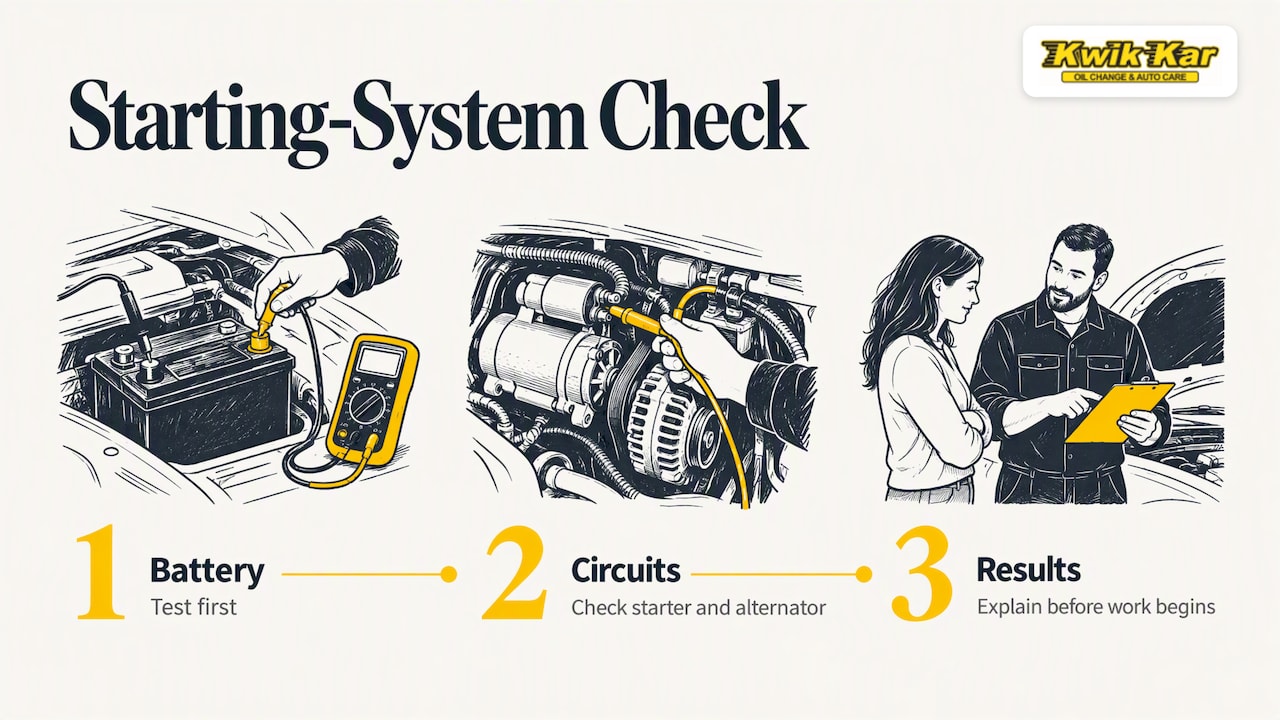
We’d rather spend ten minutes proving what’s wrong than have you pay for a part that wasn’t the problem. A proper start-and-charge test covers the battery’s condition, the charging output, the cable and ground voltage drops, and the starter draw.
Perspective: what we see in the bay
Most clicking no-starts that come through our Spring Valley Road shop turn out to be simpler than the driver feared, and a few turn out to be more involved than a jump-start suggested. What separates them is testing, not the sound alone.
Our approach is to test first, explain what we found, and give you an estimate before any work begins. Our digital vehicle inspections include photos and video, so you can see the corroded clamp, the cracked case or the worn cable for yourself. Our technicians are ASE certified, and that matters most on electrical complaints where the symptom and the cause don’t always match.
Dallas stop-and-go traffic and short hops don’t give a battery much time to recover after each start, and summer heat shortens battery life. We don’t put a number on that, because it varies by battery and driving. But if your battery is several years old and you’ve started to notice slow starts, replacing it on your own schedule beats replacing it on a tow truck’s schedule.
— Kwik Kar
Need a battery, starter or alternator checked in Dallas?
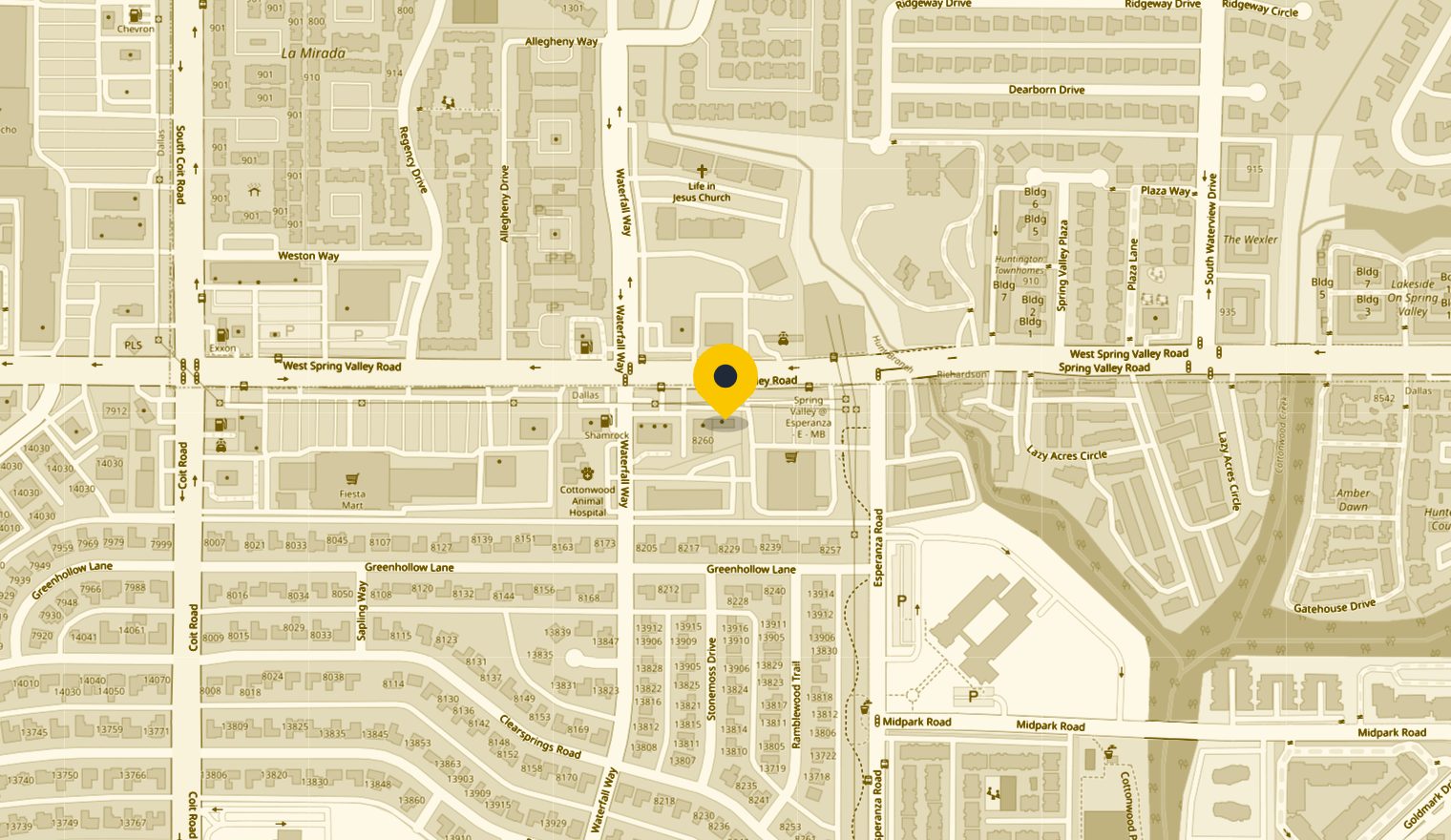
If your car clicked and you’ve got it running, or you’ve had it towed, we can test the whole starting and charging system at 8280 Spring Valley Rd, Dallas, TX 75240, serving drivers across North Dallas, Far North Dallas, Addison, Richardson and Farmers Branch. We test the battery first, then the starter and alternator circuits, and we explain the results before any work starts. If a battery is the answer, see our battery replacement service. If the starter or alternator is at fault, our alternator and starter repair page has the details.
Some qualifying repairs carry our 24-month/24,000-mile warranty, subject to the applicable terms. Ask us which coverage applies to your job when you book. You can also find current coupons, including battery offers, on our website at kwikkarspringvalley.com.
Ready to find out what’s behind the click? Schedule an appointment at Kwik Kar Spring Valley and we’ll test it properly.
Prevention: keeping the click from coming back
Most no-starts give a little warning first. A few habits help:
- Pay attention to slow cranking. If the engine takes longer to turn over than it used to, the battery or a connection is already struggling.
- Keep terminals clean and tight. A quick look when you check the oil takes seconds.
- Test the battery before summer and before winter. A battery that’s marginal in a mild month often fails in the first real temperature swing.
- Don’t ignore the battery light. It usually means the charging system isn’t doing its job, and the battery is running on borrowed time.
- Limit short-trip dependence. If most of your driving is a few minutes at a time, an occasional longer drive helps the alternator top the battery up.
- Follow your owner’s manual for service intervals and battery specifications, particularly if your vehicle uses an AGM or EFB battery, since the replacement type matters.
FAQ
Does clicking mean a dead battery or a bad alternator?
Rapid clicking most often means a weak or discharged battery. The alternator can be the underlying reason if it hasn’t been recharging the battery, which is why a car that keeps going flat needs its charging system tested, not just a new battery. A single click is more often a starter or solenoid issue.
How can I tell if it’s the starter or the battery?
Look at the lights and listen. Dimming lights and fast clicking suggest the battery or a connection. Bright lights and one click suggest the starter side. If you can measure voltage, about 12.6 volts at rest means a charged battery, and a jump-start that fixes the problem confirms a battery issue.
Can I force-start a car with a bad starter?
We don’t recommend tricks such as tapping the starter or bridging terminals. They can damage wiring, trigger a car that’s in gear, or cause injury, and they only work briefly if at all. If the starter is failing, have the car tested and repaired, and get a tow if it won’t start where it sits.
Why won’t my car start with power but no clicking at all?
If the lights and radio work but you hear nothing when you turn the key, the problem may be in the starter relay, the ignition switch, the neutral safety switch or the control circuit. That’s a diagnostic job because several parts can cause it. Check that the car is in Park or Neutral, and then have it tested.
Is it safe to keep trying to start a clicking car?
A few attempts are fine, but repeated cranking attempts can overheat the starter and drain what’s left in the battery. If it doesn’t start after a couple of tries and a jump-start, stop and have it diagnosed.
Sources
- AutoZone: Car Won’t Start, Clicking Noises
- AutoZone: Signs of a Bad Starter
- Hagerty Media: Troubleshooting a Car That Won’t Start
- Bosch Auto Parts: Starting Systems
- Delco Remy: Tech Tip, Diagnosing Starter Cranking Problems
- HELLA: Checking the starter
- ALLDATA: A quick-start guide to no-start diagnostics