


If your brake pedal goes to the floor, treat it as a brake failure warning: stop driving the vehicle as soon as you can do so safely and have it inspected before it goes back on the road. The usual culprits are a brake fluid leak, air in the lines, or a master cylinder that is leaking internally. All three mean the hydraulic system is no longer building the pressure your brakes need, and none of them is a fix to try in a parking lot between errands.
This guide covers what to do in the moment, what causes a pedal to sink or feel soft, what a technician checks, and how to keep it from happening again. It is written for everyday drivers in Dallas and the surrounding area, not for mechanics.
TL;DR
- A pedal that sinks to the floor, slowly sinks at a stop, or feels soft means the hydraulic brake system is losing pressure. Do not keep driving on it.
- The three most common causes are a fluid leak, air or moisture in the fluid, and a worn master cylinder.
- If the pedal fails while you are moving, grip the wheel, pump the pedal, find a safe place to slow down, and use lower gears and then the parking brake gradually.
- Pedal vibration is a different problem, usually a warped rotor or out-of-round drum.
- Have the car towed or driven carefully to a shop for a proper diagnosis. Our brake repair service in Dallas handles this at 8280 Spring Valley Rd.
Table of Contents
- What should you do if the brake pedal goes to the floor while driving?
- Why is my brake pedal going to the floor?
- Symptoms: sinking, soft, spongy, or vibrating?
- Can you drive with a brake pedal that sinks?
- How a technician diagnoses a sinking brake pedal
- What repairs might fix it?
- How often should brake fluid be changed?
- Our perspective: why a soft pedal deserves a full inspection
- Get your brakes checked in Dallas
- What about Texas inspections and brake problems?
- FAQ
- Sources
What should you do if the brake pedal goes to the floor while driving?
Stay calm, keep both hands on the wheel, and get the car off the road. Michelin’s guidance for U.S. drivers is to hold the steering wheel firmly, pump the brake pedal rapidly, and look for a safe way off the road, such as a side street, a parking lot, an uphill slope, or a safe barrier.
Here is the order that makes sense for most passenger vehicles:
- Pump the pedal quickly. In a conventional hydraulic system, rapid pumping can build up some temporary pressure, which may be just enough to slow the car.
- Turn on your hazard lights and signal your intentions to drivers around you.
- Shift down through the gears. Engine braking helps you shed speed. In an automatic, use the manual or low-gear selector if your car has one.
- Apply the parking brake gradually if pumping does not bring you down to a safe speed. Michelin notes that applying it slowly helps avoid locking the rear wheels, so do not yank it.
- Leave the engine running if you can. Michelin advises that the engine should be turned off only as a last resort, because it also removes power steering and makes the car much harder to steer.
On a Dallas highway such as North Central Expressway, the Dallas North Tollway, or LBJ Freeway, the hardest part is often traffic around you. Move to the shoulder early, steer smoothly, and avoid sudden lane changes while you bleed off speed.
Once you have stopped, do not try to drive again. Call for a tow or roadside assistance. Brakes are a safety system, and a pedal that failed once can fail again at the next red light.
Why is my brake pedal going to the floor?
Your brakes work by hydraulics. When you press the pedal, the master cylinder pushes brake fluid through steel lines and rubber hoses to the calipers or wheel cylinders, which press the pads or shoes against the rotors or drums. Fluid does not compress, so the pedal feels firm. Anything that lets fluid escape, or lets a compressible gas into the lines, breaks that chain.
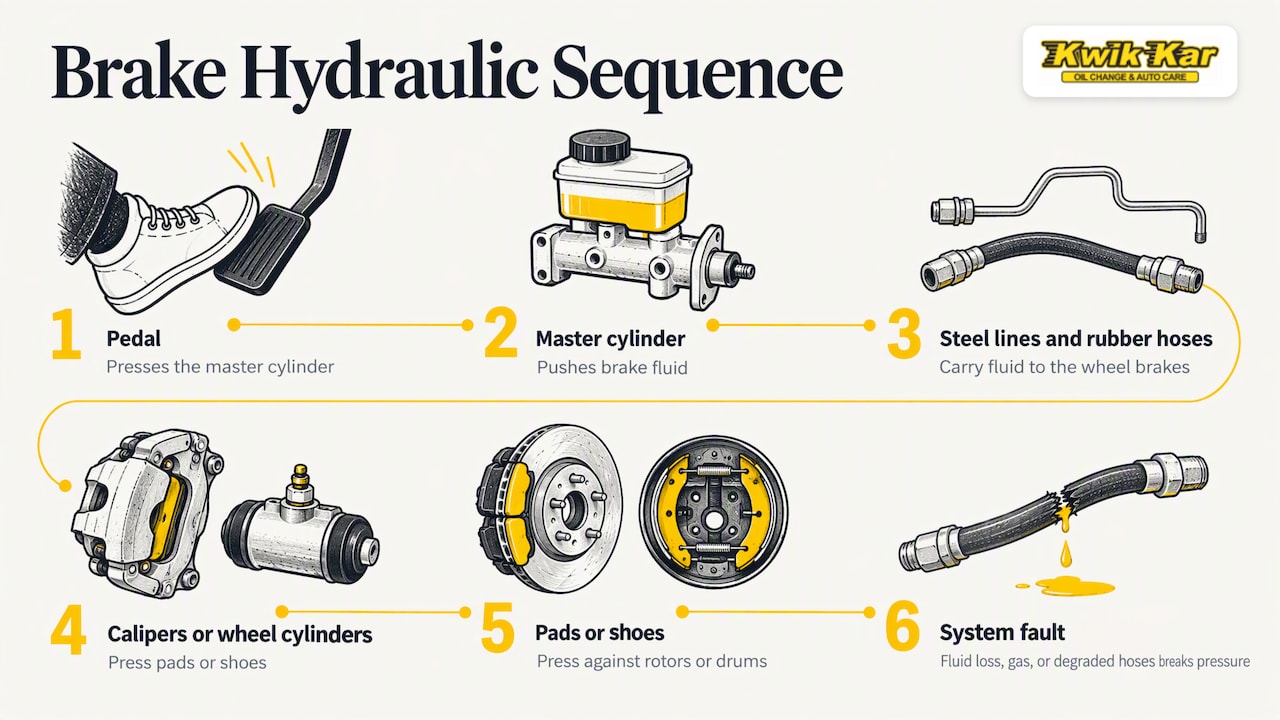
PowerStop’s technical explanation is that air or gas in the hydraulic system, fluid loss, or degraded hoses prevent pressure from being transmitted normally, which is why the fault itself has to be found and repaired, not just the pedal feel.
A brake fluid leak
This is the most common cause. Fluid can escape from a brake line, a rubber hose, a caliper, a wheel cylinder, or a fitting. As the level drops, the pedal travels farther each time, then eventually hits the floor. A leak may leave damp spots near a wheel, a puddle under the car, or fluid that seems to disappear from the reservoir with no obvious drip.
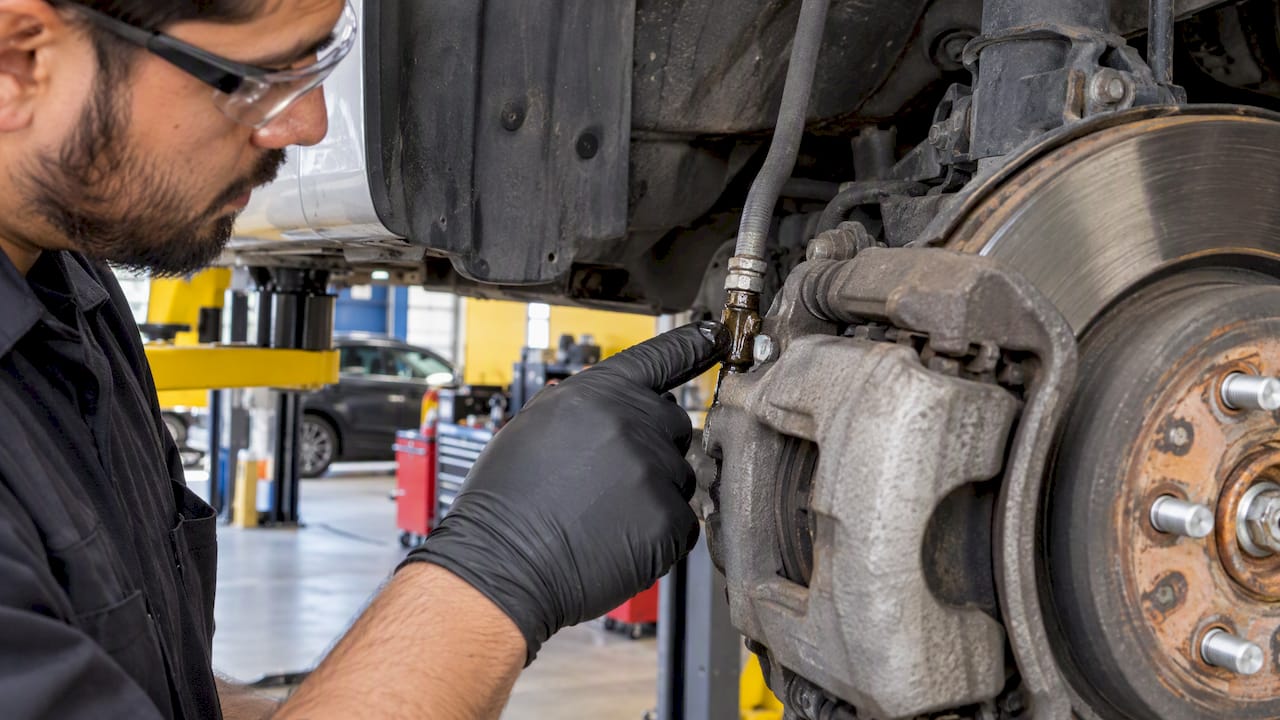
A low-fluid warning is worth taking seriously. Bumper’s guidance is that an illuminated brake warning light needs immediate attention, and that if the fluid is low, you should not drive until the cause is identified and fixed. Topping off the reservoir only hides the symptom, because the fluid went somewhere.
Air or moisture in the system
Air in the lines makes a pedal feel spongy, and a modern automotive technology textbook lists air in the brake system as a cause of a spongy pedal. Air can get in after a repair that was not bled properly, through a leaking fitting, or when the reservoir runs very low.
Moisture is the slower version of the same problem. Brake fluid absorbs water from the air over time. Kelley Blue Book notes that brake fluid attracts water and should generally be changed every year or two, because water can cause corrosion and spongy brakes. Wet fluid also boils at a lower temperature, which matters in stop-and-go traffic and long downhill stretches when the brakes get hot, and overheated fluid can form vapor that compresses like air.
A failing master cylinder
Inside the master cylinder, rubber seals keep the two brake circuits pressurized. When those seals wear, fluid slips past them internally. There may be no drip anywhere, but the pedal slowly sinks while you hold it at a stoplight. A forum-style way of putting it that mechanics often repeat: a sinking pedal comes down to a fluid leak, air in the system, or an internally leaking master cylinder. That is a useful shorthand, but confirming which one it is takes testing, not guessing.
Worn or swollen brake hoses
Rubber hoses age. PowerStop lists worn or swollen brake hoses among the causes of a soft pedal, alongside leaks, air, contaminated or overheated fluid, and improperly bled components. A hose can balloon under pressure without leaking a drop, which absorbs pedal travel and makes the pedal feel mushy.
Other causes worth knowing
- A recent brake job. If the pedal feels low right after new pads or rotors, the pistons may need to be pumped back out, or the system may need to be bled again. Either way, go back to the shop that did the work.
- Severely worn pads or shoes. When friction material is nearly gone, the pedal sits lower because the pistons have farther to travel. See our guide to how brake pad wear shows up.
- Power assist problems. A failed brake booster can make the pedal feel hard or odd, not always soft. Our overview of what a brake booster does explains the difference.
- ABS hydraulic unit faults. On some vehicles, a leak or fault inside the ABS unit can lose pressure. If your ABS light is on too, read about what an ABS light means.
Symptoms: sinking, soft, spongy, or vibrating?
The way the pedal behaves points toward a cause, though it never replaces a proper inspection.
| What you feel | Likely direction | What to do |
|---|---|---|
| Pedal goes straight to the floor, no resistance | Major fluid loss or a failed circuit | Stop driving. Tow it. |
| Pedal slowly sinks while you hold it at a light | Internal master cylinder leak or an external leak | Do not drive. Have it inspected. |
| Pedal feels soft or spongy but holds | Air or moisture in the fluid, swollen hose | Schedule an inspection promptly |
| Pedal pumps up after a couple of presses | Air in the lines, or pads and shoes far out of adjustment | Do not drive. Diagnose first. |
| Pedal pulses or shakes under braking | Warped rotor or out-of-round drum | Have the brakes inspected soon |
| Hard pedal, car barely slows | Power assist problem | Stop driving. Diagnose. |
What about pedal vibration?
Vibration is a separate complaint from a sinking pedal. The same textbook ties pedal vibration usually to an out-of-round brake drum or warped disc. In everyday terms, the rotor surface is no longer true, so the pads grab unevenly and you feel it through the pedal and sometimes the steering wheel. Our pages on front-end shake when braking and the rotor warp test cover it in detail. A sticking caliper can also cause uneven wear and heat, which is covered in our caliper diagnosis guide.
The Florida Department of Highway Safety and Motor Vehicles makes a point that applies anywhere: pulling, shaking, or noise when braking should be repaired immediately, because waiting can increase both damage and cost.
Can you drive with a brake pedal that sinks?
No. Even if the pedal comes back after a few pumps, the system is telling you it cannot hold pressure reliably. Driving to a shop a few miles away is a gamble at highway speeds or in heavy traffic, and a bad one in a car full of kids or on a busy road like Preston Road or Coit Road.
If the pedal is only a little soft and the car stops normally, a short, slow, careful trip straight to a shop may be reasonable for some drivers, but a tow is the safer call. When in doubt, or if the pedal ever touches the floor, tow it.
How a technician diagnoses a sinking brake pedal
A good diagnosis starts simply and narrows down. Because several different faults produce the same pedal feel, the goal is to find which one you have before replacing parts. Here is what that process generally includes:
- Check the fluid. Level, color, and condition in the reservoir. Dark, murky fluid suggests moisture or contamination. A low level suggests a leak somewhere.
- Inspect the whole system visually. Lines, hoses, calipers, wheel cylinders, and fittings, plus the area around the master cylinder and booster for wetness. Our digital vehicle inspections let us document what we find with photos and video, so you can see the problem yourself.
- Test the pedal. Hold steady pressure and watch whether it sinks. A sinking pedal with no external leak points toward the master cylinder.
- Isolate the problem. Professionals may use blocking plugs or pinch off hoses to find which brake circuit holds a leak, and may use a pressure gauge on the master cylinder outlet to separate an internal pressure loss from an external leak.
- Bleed the system properly if air is the issue. Procedures vary by vehicle, and PowerStop notes that some newer ABS systems require a scan tool for bleeding. Manufacturer service bulletins sometimes call for specialized steps. One 2015 GM bulletin for certain Chevrolet models, for example, directs technicians to do repeated automated bleeding followed by a gravity bleed to remove trapped air.
AutoZone’s own advice for people who cannot find or fix a spongy pedal is to have a professional mechanic inspect it, because brakes are a safety system. We agree, and we would go further: a pedal that reaches the floor is not a weekend-project symptom.
What repairs might fix it?
The repair depends entirely on the finding. Common outcomes include:
- Replacing a leaking brake line, hose, caliper, or wheel cylinder, then bleeding the system
- Replacing a master cylinder with internal seal wear
- Replacing worn or swollen hoses
- Flushing contaminated or old fluid and bleeding out air
- Replacing worn pads, shoes, rotors, or drums, and checking for related wear
- Addressing the booster or ABS unit when those are the source
We do not quote repairs from a symptom description. The cost of a brake job depends on the vehicle and what is actually failing, so we provide an estimate before work begins, after the inspection. If you are curious about one common service in the mix, our article on brake fluid flush costs explains what drivers typically pay.
How often should brake fluid be changed?
Check your owner’s manual first, because the manufacturer’s interval and fluid specification are what count. As a general rule, Kelley Blue Book’s guidance is every year or two, and many manufacturers specify a similar window, while some stretch it further. Our brake fluid change interval guide walks through how to decide for your vehicle.
North Texas conditions make this worth a look. Long summer stretches of heat, stop-and-go traffic on the tollways, and highway commutes all put heat into the brakes, and heat is hard on fluid that has already absorbed moisture. We are not citing any local statistics here, only the plain mechanics: hotter brakes and wetter fluid are a bad combination.
When you inspect your own car, a clean wheel makes a leak easier to spot. Washing off buildup first, for instance by following these steps to remove brake dust safely, lets you see whether a wet spot near the caliper is fresh fluid or just grime. Do not spray cleaners into the brake system, and never open the bleeder yourself without training.
Our perspective: why a soft pedal deserves a full inspection
We see the same pattern often. A driver notices the pedal feels a little lower than it used to, tells themselves it is nothing, and drives on for weeks. Brake problems rarely stay small, because the thing that caused the soft pedal, whether a weeping hose, old fluid, or a tired master cylinder, keeps getting worse.
That is why we start with a complete inspection instead of a parts guess. Our ASE-certified technicians use advanced diagnostic tools, and our digital vehicle inspections give you photos and video of what they find, so you are looking at the evidence before you decide anything. You get an estimate before work begins.
We work on both domestic and import vehicles, and we follow the manufacturer’s guidance for fluid type, service intervals, and bleeding procedures. Qualifying repairs are covered by our 24-month/24,000-mile warranty, subject to applicable terms. Ask us about it when you book.
We are a family-owned shop with nearly 30 years in the community, and we would rather you ask about a pedal that feels a little off than wait until it fails at the worst time.
Kwik Kar
Get your brakes checked in Dallas
If your pedal sinks, feels soft, or has ever touched the floor, we can inspect the whole brake system at our shop at 8280 Spring Valley Rd, Dallas, TX 75240. We serve drivers across Spring Valley Road, North Dallas, Far North Dallas, Addison, Richardson, and Farmers Branch, and our technicians work on domestic and import vehicles. See everything we do on our full auto repair services page.
If you are planning a brake job, check our brakes coupon page for current offers and terms. If you are not sure the car is safe to drive, arrange a tow first, then schedule an appointment so we can look at it as soon as possible. For a broader overview of what else can go wrong, see our list of common car brake problems.
What about Texas inspections and brake problems?
Since January 1, 2025, Texas no longer requires a safety inspection for most non-commercial vehicles. The Department of Public Safety confirms that House Bill 3297 abolished the safety inspection program for non-commercial vehicles, and that those vehicles are still subject to a $7.50 inspection program replacement fee paid at registration. Emissions testing is a separate requirement and still applies to vehicles registered in emissions counties, which includes Dallas County. Qualifying commercial vehicles remain subject to applicable safety inspection requirements.
The practical point for you: no inspection requirement means no one else checks your brakes for you. A soft pedal will not be caught at a sticker visit, so it is on you to notice it and act on it.
FAQ
Why does my brake pedal sink slowly when I stop at a light?
A pedal that sinks under steady pressure usually means fluid is going somewhere. It may be leaking externally, or slipping past worn seals inside the master cylinder. Either way the system is not holding pressure, so it needs professional diagnosis before you drive further.
Why does my brake pedal go to the floor after new brakes?
A low pedal after a brake job can come from air left in the lines, pistons that have not been seated, or a problem with the master cylinder or booster. It should not be ignored. Return to the shop that did the work and have it checked right away.
How do I get the pressure back in my brakes?
In an emergency, rapid pumping of the pedal may build temporary pressure in a conventional system, which can help you stop safely. It is not a repair. The actual fix is finding the leak, air, or failed part and correcting it, which a technician should do.
How long does brake fluid last?
Brake fluid absorbs moisture over time, and general guidance is to replace it every year or two. Your owner’s manual gives the interval for your vehicle. Replacing it on schedule helps prevent corrosion and a spongy pedal.
How do I know if my brakes are bad?
Watch for a soft or sinking pedal, pulling to one side, shaking, grinding or squealing noises, or a brake warning light. Any of these means the brakes should be inspected soon, and a pedal that reaches the floor means stop driving.
Sources
- Brake Problems – Safe Driving Tips, Michelin USA
- Driving Emergencies: If Your Brakes Stop Working, Michelin
- How To Diagnose a Spongy or Soft Brake Pedal, PowerStop
- What to Do If Your Brakes Fail, Bumper
- Brake System Diagnosis and Repair, Modern Automotive Technology
- Why Do My Brakes Feel Spongy? Kelley Blue Book
- Maintaining a Road-Ready Vehicle, Florida Department of Highway Safety and Motor Vehicles
- California Highway Patrol brake inspection guidance
- How to Fix Brakes That Go to the Floor, AutoZone
- What Are Spongy Brakes and How to Fix It, AutoZone
- NHTSA service bulletin, 2015 GM brake bleeding
- Vehicle Safety Inspection Program Changes Now in Effect, Texas DPS
- Remove Brake Dust Safely, Diamondbrite