

To verify a repair invoice, check three things first: vehicle identifiers (VIN, odometer reading, and date), the itemized parts and labor math, and written authorization and warranty terms. If any of those three checks fail, ask the shop for clarification before you pay. The FTC’s consumer guidance recommends getting a completed repair order that lists every repair, all parts, costs, and the vehicle’s odometer reading. Florida statute 559.911 goes further, requiring shops to document odometer readings, itemized labor and parts, used or rebuilt part disclosures, and a written warranty statement on every invoice.
Three immediate checks on any repair invoice:
- Vehicle identifiers: Confirm the VIN, odometer reading (in and out), date, and shop registration number match your vehicle and visit.
- Itemized math: Verify that (labor hours × hourly rate) + parts total + fees + tax = the invoice total. Every line should add up.
- Authorization and warranty: Confirm you authorized every line item and that warranty terms (time and mileage) appear in writing.
Table of Contents
- What should a valid U.S. auto repair invoice include?
- How do you read and verify line items on a repair bill?
- What are the red flags on a repair invoice?
- How do you compare the final invoice to the original estimate?
- What should you do if something looks wrong on the invoice?
- How do you avoid invoice surprises before service starts?
- What credentials and practices should a reputable shop have?
- Key Takeaways
- Why invoices sometimes read vague, and what you can do about it
- Transparent service starts before the first wrench turns
- Useful U.S. sources and references
- FAQ
What should a valid U.S. auto repair invoice include?
A repair invoice is a legal document in most U.S. states, not just a receipt. Many states require specific disclosures, and missing them can make an invoice legally incomplete.
Legally required elements (based on Florida statute 559.911 and California regulations):
- Current date and odometer reading
- Shop name, address, and state registration or license number
- Vehicle identifiers: VIN, year, make, model
- Itemized list of all labor performed (description, hours, rate)
- Itemized list of all parts supplied (part number, unit cost, quantity, condition)
- Statement identifying each replacement part as new, used, rebuilt, or reconditioned
- Subtotals for labor and parts, sales tax, and total cost
- Written warranty statement specifying time and mileage coverage
- Description of the problem diagnosed and the work performed
Helpful extras to request (not always legally required, but worth asking for):
- Technician name or ID number
- Diagnostic trouble codes or printed scan-tool report
- Photos of damaged or worn parts before replacement
- Old parts returned to you in a bag
- Authorization timestamps for any work added after the original estimate
| Invoice Field | Why It Matters | Legal Basis |
|---|---|---|
| VIN and odometer | Confirms work was done on your vehicle | Florida § 559.911; California regulations |
| Part condition (new/used/rebuilt) | Affects value and warranty coverage | Florida DACS invoice requirements |
| Written warranty (time + mileage) | Your only proof for a post-repair claim | Florida § 559.911; FTC guidance |
| Itemized labor description | Lets you verify hours and rate | California Bureau of Automotive Repair regulations |
| Shop registration number | Confirms the shop is licensed | Florida § 559.911; California regulations |
California’s Bureau of Automotive Repair explicitly prohibits generic billing for items like “shop supplies” or “miscellaneous parts” as separate line items without a breakdown. That rule reflects a broader consumer-protection principle: every charge needs a name and a number.
How do you read and verify line items on a repair bill?
Parts line items
Each part entry should show a description in plain language (not just an acronym), a part number, the unit cost, the quantity, and whether the part is OEM (original equipment manufacturer) or aftermarket, and new, used, or rebuilt. A core charge may appear separately: that is a refundable deposit on a rebuildable part like an alternator or brake caliper. You get it back when the shop returns your old part to the supplier. If you see a core charge, ask whether it will be credited once the old part is turned in.
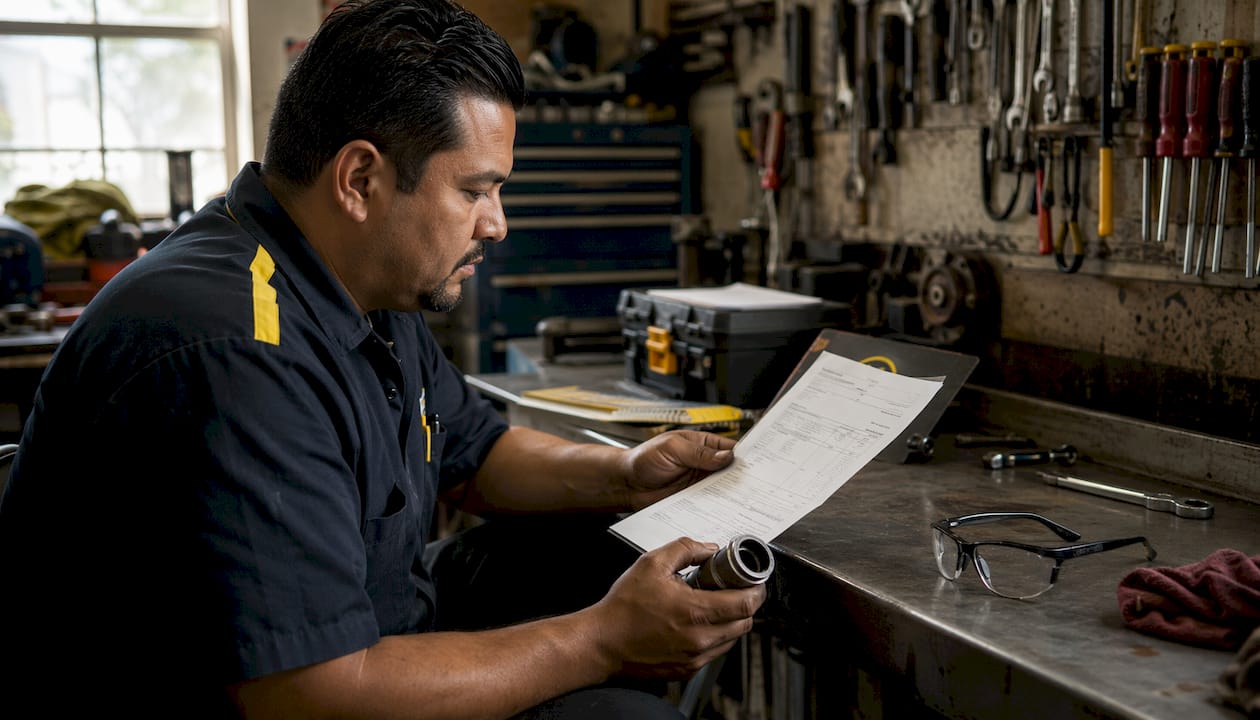
Pro Tip: Ask the shop to retain your replaced parts in a bag. This is the simplest way to confirm the parts were actually changed. California law requires shops to offer customers the opportunity to reclaim replaced parts when possible.
Labor line items
Labor is typically billed using a flat-rate system based on published labor guides, not the actual clock time a technician spent. The invoice should show a description of the work, the number of hours billed, and the shop’s posted hourly labor rate. Verify the math: hours × rate = labor subtotal. If hours seem high for a routine job, ask the service advisor which labor guide they used and request the technician’s time log.
Common fees explained
- Diagnostic fee: Charged for the time spent identifying the problem. Some shops credit this fee toward the repair cost if you approve the work. Ask upfront whether the diagnostic fee applies if you decline repairs or take the car elsewhere.
- Shop supplies: Covers consumables like rags, cleaners, and small fasteners. This should be a specific dollar amount, not a vague percentage.
- Hazardous waste disposal: Applies to fluids, batteries, and tires. A legitimate fee with a specific amount.
- Sales tax: Applied to parts in most states; labor taxability varies by state.
Worked verification example
Say your invoice lists labor hours, parts, and fees, but the sales tax calculation does not match the expected amount based on the tax rate and parts total.
That $1.20 discrepancy is worth a quick question. Small math errors happen, but they should be corrected before you pay. Understanding how auto repair pricing works helps you spot when a number is genuinely off versus just unfamiliar.
What are the red flags on a repair invoice?
A vague invoice is often the clearest sign of a problem. MotorWeek’s consumer guidance specifically warns that generic entries for shop supplies or miscellaneous labor should trigger a request for a line-by-line explanation before payment.
Red flag checklist:
- Vague descriptions: “Misc. labor” or “general service” with no breakdown. Ask for a specific description of every task.
- Missing VIN, odometer, or date: Legally required in most states. A missing identifier means you cannot prove the work was done on your vehicle.
- Duplicate charges: The same part or labor task appears twice. Cross-reference every line.
- Parts listed but not installed: Ask to see the old parts or photos of the repair area.
- Labor hours that don’t match the job: A brake pad replacement listed at 4 hours when the standard is 1–2 hours deserves an explanation.
- No written warranty terms: The FTC notes there is no standard auto repair warranty; insist that any guarantee be written on the invoice with specific time and mileage limits.
- Unusually high shop supplies or admin fees: A flat percentage with no itemization is a red flag.
- Work performed without your authorization: Any repair not on the original authorized estimate requires your explicit approval before the shop can charge for it.
When to escalate: If the shop refuses to explain or correct a charge, contact your state Attorney General’s consumer protection office, file a complaint with the Better Business Bureau, or bring the matter to small claims court. FindLaw’s consumer pages confirm that small claims court does not require an attorney, and documentation matters more than legal representation.
How do you compare the final invoice to the original estimate?
Step-by-step reconciliation
- Pull out the original written estimate and place it next to the final invoice.
- Match every line item: confirm each part and labor task on the invoice appears on the estimate.
- Verify labor math on each line: hours × rate = labor subtotal.
- Check parts quantities and unit costs against what was quoted.
- Identify any new line items that were not on the estimate. Each one requires your prior authorization.
- Confirm the warranty statement matches what was discussed before work began.
For a deeper look at how estimates are structured before work starts, a repair estimate breakdown guide walks through each section in detail.
State rules that protect you
Washington State’s AG guidance requires a written estimate before work begins when charges exceed certain thresholds, and some states limit how much the final bill can exceed the authorized estimate without additional customer approval. Florida and California both mandate written estimates and require shops to obtain authorization before performing work beyond the original scope.
| State | Written Estimate Required | Overage Rule | Source |
|---|---|---|---|
| Florida | Yes, for most repairs | Must authorize additional work | Florida § 559.911 |
| California | Yes, before work begins | Must notify and get approval for overages | California Bureau of Automotive Repair regulations |
| Washington | Yes, above threshold | Some states limit overage without authorization | WA AG guidance |
Quick reconciliation example
Original estimate includes labor and parts costs. The final invoice adds a new charge for additional diagnostics that was not on the estimate.
The $90 diagnostic charge was not on the estimate. Before paying, ask: Was this authorized in writing or verbally? If it was verbal, ask the shop to document the authorization date, time, and who approved it. If it was never authorized, you have grounds to dispute it. Learning how to compare auto repair estimates can save you real money on exactly this kind of situation.
What should you do if something looks wrong on the invoice?
Same-day documentation steps
- Keep the original invoice and estimate together. Do not sign anything that waives your right to dispute.
- Photograph the invoice, the estimate, and the vehicle (odometer, VIN sticker, any visible repair areas).
- Request your replaced parts in writing. If the shop says they were already discarded, note that in writing.
- Ask for a written explanation of any charge you do not recognize, with the technician’s name and the date.
- Preserve all communication: texts, emails, and written notes with names and timestamps.
Escalation order
- Service manager: Start here. Most billing errors are resolved at this level.
- Shop owner: If the manager cannot resolve it, ask to speak with the owner directly.
- State Attorney General / consumer protection office: File a formal complaint. Most states have an online form.
- Better Business Bureau: A BBB complaint creates a public record and often prompts a response.
- Small claims court: No attorney required. Bring your invoice, estimate, photos, and all written communication.
What to request from the shop in writing:
- Signed authorization for any work added after the original estimate
- Returned replaced parts or photos if parts cannot be returned
- Technician notes and diagnostic printouts
- Written warranty statement with time and mileage terms
- Itemized breakdown of any bundled or vague charges
How do you avoid invoice surprises before service starts?
The best time to prevent a dispute is before the shop touches your vehicle. Ask for a written estimate that separates parts and labor, and confirm the shop’s posted hourly labor rate. Request the shop’s diagnostic fee policy in writing: specifically, ask whether the fee is credited toward the repair if you approve the work, and whether it applies if you take the car elsewhere.
Sample authorization language you can ask the shop to include on the estimate:
Pre-service red flags:
- No posted labor rate visible in the shop or on the estimate
- Refusal to provide a written estimate for work above a minor threshold
- Pressure to approve work before you have seen a written breakdown
Pro Tip: For any repair quoted above $500, get a second opinion from another licensed shop. A second estimate takes an hour and can reveal whether the original quote is in line with local rates.
Warranty terms should also be confirmed before work starts. Understanding dealership warranty options can help you know what written coverage to expect and how to compare it against what the shop offers.
What credentials and practices should a reputable shop have?
A shop’s invoice practices reflect its overall standards. Before you book, look for these trust signals:
- ASE certification: Technicians certified by the National Institute for Automotive Service Excellence have passed standardized competency tests. ASE-certified shops are required to employ a minimum number of certified technicians.
- RepairPal or NAPA AutoCare affiliation: These networks require shops to meet quality and pricing standards and often back repairs with their own warranty programs.
- Posted labor rate: Legally required in many states. If you cannot find it on the wall or the estimate, ask.
- Written warranty policy: A reputable shop states warranty terms on every invoice. The Florida DACS invoice requirements and FTC guidance both confirm that a written warranty is your primary protection if a repair fails.
Shop transparency checklist:
- Itemized written estimate provided before work begins
- Technician name or ID on the invoice
- Old parts returned on request
- Invoice includes VIN, odometer in/out, and date
- Warranty terms stated in writing (time and mileage)
- No generic “shop supplies” or “misc.” charges without a breakdown
Kwik Kar Oil Change & Auto Care uses ASE-certified technicians and provides written estimates before work begins, with post-repair documentation and warranty terms included on every invoice. Credentials matter in disputes: a shop with documented ASE certification and a written warranty policy gives you a stronger foundation if you ever need to escalate a claim.
Key Takeaways
Reading a repair invoice carefully before you pay is the single most effective way to catch errors, unauthorized charges, and missing warranty protections.
| Point | Details |
|---|---|
| Verify vehicle identifiers | Confirm VIN, odometer reading, and date match your vehicle and visit on every invoice. |
| Check itemized math | Multiply labor hours by the posted rate, add parts and fees, and confirm the total matches. |
| Insist on written authorization | Any work not on the original estimate requires documented approval before the shop can charge for it. |
| Request part numbers and old parts | Part numbers and returned parts confirm the work was actually done and the right parts were used. |
| Confirm written warranty terms | Time and mileage limits must appear on the invoice; without them, your post-repair recourse is limited. |
| Kwik Kar Oil Change & Auto Care | Provides written estimates, ASE-certified technicians, and warranty documentation on every completed repair. |
Why invoices sometimes read vague, and what you can do about it
Most vague invoices are not the result of bad intent. They usually come from shop-side habits that were never designed with the customer in mind. Technician notes are written for other mechanics, not for car owners. Bundled charges like “shop supplies” often reflect a dozen small consumables that no one bothered to list individually. Parts substitutions happen mid-repair when the originally quoted part is unavailable, and the invoice does not always reflect the change clearly.
That said, vague is not acceptable. A shop that cannot explain a charge in plain language is a shop that has not done the work of communicating with its customers. The fix is straightforward: ask for a line-by-line explanation of any entry you do not recognize. Most service advisors will walk you through it without hesitation. If they cannot, that tells you something important about how the shop operates.
The most productive approach is to ask questions before the invoice is finalized, not after. A quick review with the service advisor when the work is complete, before you hand over payment, catches most errors on the spot. Shops that welcome those questions are the ones worth returning to.
Transparent service starts before the first wrench turns
At Kwik Kar Oil Change & Auto Care in Spring Valley, TX, every service begins with a written estimate that separates parts and labor before any work starts. ASE-certified technicians perform the repairs, and every completed job comes with a final invoice that includes your vehicle’s VIN, odometer readings, itemized charges, and written warranty terms. You will know exactly what was done, what it cost, and what is covered.
Bring your vehicle in with your questions ready. Whether you need a diagnostic visit, a routine maintenance service, or a full repair, the team at Kwik Kar Oil Change & Auto Care will walk you through the estimate and the invoice so nothing is a surprise. Check current service specials or book your appointment directly through the full auto repair services page.
Useful U.S. sources and references
These are the primary sources used in this guide. Each one covers a specific aspect of your rights and the rules shops must follow.
- FTC Auto Repair Basics: Federal consumer guidance on written estimates, warranty documentation, and dispute preservation.
- Florida Statute 559.911: Full text of Florida’s invoice requirements, including odometer, parts disclosure, and warranty statement mandates.
- Florida DACS Invoice Requirements: Plain-language summary of what Florida shops must include on every invoice.
- California Bureau of Automotive Repair: Detailed California rules on invoice content, prohibited generic billing, and authorization documentation.
- Washington State AG Auto Repair Guidance: Washington’s written-estimate requirements and consumer protections.
- FindLaw: Car Repairs and the Law: Overview of consumer rights, state-level protections, and small claims court options.
- MotorWeek: Understanding Your Repair Bill: Practical consumer guide to reading line items and verifying math.
FAQ
How do you read a repair order?
Match each line item to the work you authorized, verify the math (labor hours × rate + parts + fees + tax), and confirm the VIN, odometer, and date are correct. Any charge not on the original estimate requires documented authorization.
What should a repair order invoice list?
A valid invoice must include the shop’s name and license number, the vehicle’s VIN and odometer reading, an itemized list of all parts (with condition noted) and labor, subtotals, applicable taxes, and a written warranty statement with time and mileage terms.
What are the three C’s of repair order documentation?
The three C’s are Complaint (the problem the customer reported), Cause (what the technician found), and Correction (what was done to fix it). These entries should appear on the repair order and give you a clear record of why each repair was performed.
How do you dispute a charge on a car repair bill?
Start with the service manager, then the shop owner. If unresolved, file a complaint with your state Attorney General’s consumer protection office or the Better Business Bureau, and consider small claims court. Bring your invoice, original estimate, photos, and all written communication.

When does a diagnostic fee apply on a repair invoice?
Shops charge a diagnostic fee for the time spent identifying the problem. Policies vary: some shops credit the fee toward the repair if you approve the work, while others charge it regardless. Ask about the policy before authorizing any diagnostic work.