



If your car heater stopped working, the likely causes fall into three buckets: a blower, fuse, or resistor problem; a lack of hot coolant reaching the heater core (low coolant, a stuck thermostat, or a water pump issue); or a stuck blend door or actuator. Watch for steam, a sweet smell, or wet carpet, those mean stop driving and call a shop. Otherwise, work through the checklist below.
TL;DR:
- After warming the engine for 5 to 10 minutes, check fan speeds, the cabin filter, fuses, and both heater hoses before replacing parts.
- Air only on high points to a failed blower resistor; no airflow at any speed points first to a fuse, motor, or wiring fault.
- Check coolant with a cold engine; one hot and one cold hose suggests restricted flow, while two cold hoses point to a coolant circulation problem.
- Clicking behind the dash or an unresponsive temperature dial points to a blend door actuator, which often requires professional access.
- A heater core flush may restore heat when performance has declined gradually from warm to lukewarm, but it cannot repair a leaking or corroded core.
Table of Contents
- How do you diagnose a car heater that won’t blow hot air?
- What low-risk checks can you do yourself?
- Why does the blower only work on high, or not at all?
- Could low coolant or a bad thermostat be the real problem?
- What if air flows but never gets warm?
- When should you stop troubleshooting and book a shop visit?
- What does a Kwik Kar heater diagnosis actually involve?
- How does heater core flushing help restore cabin heat?
- How do you check whether the heater control valve is working?
- Can engine overheating affect how well your heater works?
- Can a scanner read HVAC and heater error codes?
- How do electric heater problems differ from coolant-based ones?
- What’s the one thing most heater troubleshooting advice gets wrong?
- Get your heater checked at Kwik Kar Spring Valley
- FAQ
- Sources
How do you diagnose a car heater that won’t blow hot air?
Before you touch anything mechanical, rule out the simple stuff. A surprising number of “broken heater” complaints trace back to a control setting bumped to defrost-only or a temperature dial left on a cold setting.
Work through this sequence in order, since each step narrows down where the problem actually lives:
- Confirm engine temperature and settings. Let the engine warm up fully (5 to 10 minutes of driving), then verify the temperature dial is set to hot and the fan is on.
- Listen and feel for blower operation. Turn the fan through every speed and feel the vents. No air at any speed points to electrical; air only at high speed points to the blower motor resistor.
- Check the cabin air filter. A clogged filter restricts airflow and can mimic a weak blower. Pull it and inspect it; replace it if it is gray, caked, or hasn’t been swapped in a while.
- Feel both heater hoses at the firewall. Both should be hot. One hot and one cold suggests restricted flow; both cold points to coolant, thermostat, or pump issues.
- Check fuses before swapping parts. Some vehicles have separate interior and under-hood blower fuses, and a blown one is the cheapest possible explanation for a dead fan according to Cars.
- Look for coolant leaks, wet carpet, or steam. Any of these means stop troubleshooting yourself and get the vehicle looked at.
Pro Tip: Do this checklist in order. Skipping straight to parts replacement is how people pay for a thermostat when the real problem was a $5 fuse.
What low-risk checks can you do yourself?
A few checks are safe for most owners to handle in a driveway, using nothing more than a flashlight and a little patience.
- Check blower fuses first. Locate the fuse box (usually under the dash and sometimes also under the hood), pull the blower fuse, and look for a broken filament; swap with an identical-amperage spare if you have one.
- Run the blower through every speed. If it works only on high, that pattern is consistent with a failed resistor, since high speed typically bypasses it entirely, per Cars.
- Check coolant level only when the engine is cold. Never open a hot cooling system. Top off with the correct coolant type if the level sits below the “low” line.
- Feel the heater hoses carefully. Warm hoses on both sides mean coolant is circulating; stop if you feel dampness or smell coolant.
- Stop immediately if you see steam, hear hissing, or smell something sweet. Those are leak or overheating signs, not DIY territory.
AAA’s belts and hoses guidance recommends replacing cabin air filters regularly as part of winter readiness, which helps airflow problems masquerade less often as heater failures, according to AAA Car Care.
Why does the blower only work on high, or not at all?
Blower problems are some of the most common heater complaints we see, and the pattern of the failure usually tells you where to look.
- No air at any fan speed usually means a blown fuse, a dead blower motor, or a wiring break somewhere in the circuit.
- Air only on the highest setting is a classic sign of a failed blower motor resistor, since high speed often routes around the resistor entirely.
- Grinding, clicking, or squealing from the vents points to debris in the blower housing or a motor with worn bearings.
- Intermittent fan operation that comes and goes with vibration often means a loose electrical connector rather than a failed part.
The practical sequence is to test the fuse, then the switch, then the resistor, then the motor itself, since replacing parts out of order wastes money on pieces that were never the problem. Resistors themselves are inexpensive, often under $50, but they sit close to the blower motor behind or below the glove box, which makes access the real cost driver rather than the part, per Cars.com’s resistor glossary. A motor caked in leaf debris may just need cleaning; a motor with failed bearings needs replacement. If the fix requires removing dash panels or glove box housings to reach the resistor, that is a reasonable point to book a service appointment rather than push through it yourself.
Could low coolant or a bad thermostat be the real problem?
Heat only reaches your cabin if hot coolant actually makes it to the heater core, so any break in that chain (low coolant, a failing water pump, a stuck thermostat, or a leaking core) shows up as cold air at the vents even when the blower works fine.
- Low coolant or a weak water pump reduces flow through the heater core, leaving it lukewarm at best even with the engine fully warmed up.
- A thermostat stuck open keeps the engine running cooler than normal, so the coolant never gets hot enough to heat the cabin effectively.
- A thermostat stuck closed causes the opposite problem: the engine overheats quickly while the heater often still blows warm, since coolant isn’t circulating through the radiator.
- A leaking heater core shows up as wet carpet near the front passenger footwell, a sweet smell inside the cabin, or fogging on the inside of the windshield.
If you notice a wet floor mat or a sweet odor, stop driving and have the system inspected. Those are classic signs of a leaking heater core, and continuing to drive risks losing enough coolant to overheat the engine, according to AAA’s coolant leak guidance. Replacing a thermostat is not automatically the fix either; the issue could just as easily be air routing rather than coolant temperature, so the diagnosis should confirm which side failed before any parts get swapped, per Cars.com’s heater troubleshooting guide. For a deeper look at coolant leak patterns, see our guide on diagnosing a coolant leak, and if you want a stepwise check for a stuck-open thermostat, we’ve laid one out in this quick-check guide.
Pro Tip: Heater core replacement is labor-intensive because it usually sits buried behind the dash, so a quote that seems high often reflects hours of disassembly rather than the part’s cost.
What if air flows but never gets warm?
Sometimes the blower runs fine, coolant is hot, and the air coming out of the vents is still cold or inconsistent. That pattern usually points to the blend door, the small flap that mixes hot and cold air before it reaches the cabin.
- A stuck or broken blend door can jam open to the cold side, leaving the cabin cold no matter what the dial says.
- Clicking or ticking noises behind the dash when you adjust the temperature are a strong clue the actuator that moves the blend door has failed.
- Temperature that doesn’t respond to dial changes often means the actuator is no longer communicating with the control module, even though the blower itself works.
- Inconsistent or fluctuating cabin temperature can point to a damaged actuator gear or a wiring fault rather than a coolant issue.
A damp area under the dash points toward a leaking heater core, while clicking and erratic airflow more often points toward a failed actuator, according to AAA Northeast’s car-care column. Fixing an actuator typically means removing dash trim to reach it, and older vehicles sometimes have more than one actuator fail around the same time. This is squarely professional-shop territory rather than a driveway fix.
When should you stop troubleshooting and book a shop visit?
Some symptoms mean the smart move is to stop testing and get the car inspected rather than keep working through steps on your own.
- Steam from under the hood or at the vents signals an overheating or pressurized-leak condition.
- A sweet smell inside the cabin or wet carpet usually means a leaking heater core.
- Rising engine temperature gauge paired with heater trouble can mean a stuck thermostat or low coolant that needs attention now.
- Burning smells from the blower or dash suggest an electrical fault that shouldn’t be ignored.
- No response at all to fuse, filter, or hose checks means the problem is likely deeper in the electrical or HVAC system.
A shop visit for heater issues typically includes a coolant system pressure test, electrical and fuse checks, and in many cases a scan for actuator or module fault codes. Hissing combined with visible steam calls for immediate attention, since it often signals a weak radiator cap or a real leak rather than trapped air, per AAA’s coolant leak signs guide. Bring a clear list of what you’ve already checked (fuses, filter, hose temperatures) so the technician can skip redundant steps and get to the real cause faster. For overheating specifics, we cover the safety steps in our overheating guide.
What does a Kwik Kar heater diagnosis actually involve?
Our technicians start with the same logic covered above: confirm coolant temperature, check airflow and blower patterns, and inspect for leaks before recommending any repair. We walk through the estimate with you before any work begins, covering what needs fixing now versus what can wait. If you want to speed things up, jot down when the problem started and whether it’s constant or only shows up at idle or highway speed. For a closer look at common no-heat causes, see our guide on troubleshooting a heater that won’t get hot.
How does heater core flushing help restore cabin heat?
A heater core that runs warm but not hot sometimes just needs clearing out rather than replacing. Over years of operation, small amounts of rust, scale, and sediment build up inside the core’s narrow passages, restricting flow even when the rest of the cooling system is healthy.
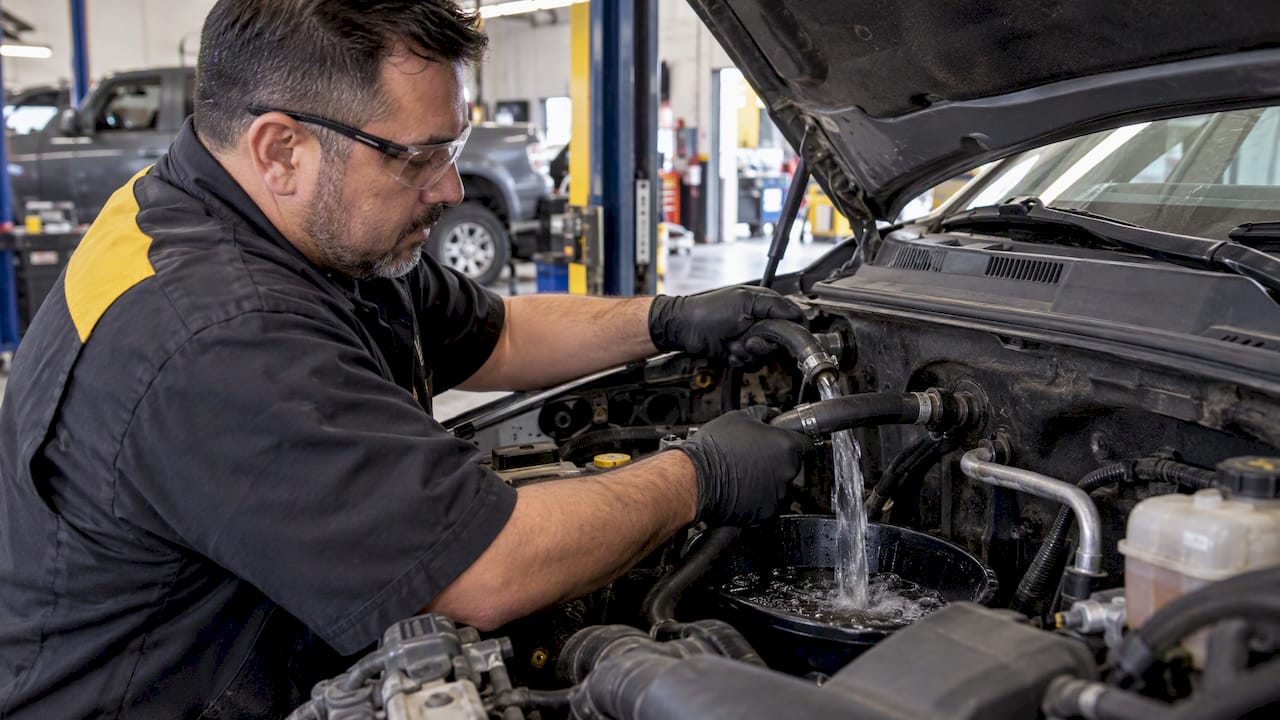
A flush involves disconnecting the heater hoses and running a cleaning solution or plain water through the core in both directions to dislodge debris, followed by a full coolant refill and a bleed to remove trapped air. Technicians typically check flow rate before and after to confirm the flush actually improved circulation rather than assuming it worked.
Flushing works well when the core is simply clogged, but it won’t help a core that’s physically leaking or corroded through. In that case the part needs replacement rather than cleaning, since no amount of flushing seals a crack in the core’s housing. If your heater has gone from warm to lukewarm over months rather than failing suddenly, a flush is a reasonable first step before assuming the worst. A shop can confirm which situation applies with a simple flow and pressure check, which avoids paying for a core replacement that a flush could have solved.
How do you check whether the heater control valve is working?
Some vehicles use a heater control valve to regulate how much hot coolant reaches the core, rather than relying only on a blend door. When this valve sticks closed, the heater core never gets hot coolant even though the rest of the engine runs at a normal temperature. When it sticks open, you may get heat you can’t turn off regardless of dial position.
To check it, locate the valve along the heater hose line (often near the firewall) and feel the hose on each side with the engine warmed up. If one side stays cold while the other is hot, the valve likely isn’t opening fully. On vehicles with a vacuum-operated valve, a cracked or disconnected vacuum line is a common and inexpensive cause, worth checking before assuming the valve itself has failed.
A valve that’s stuck due to mineral buildup sometimes frees up with gentle manipulation, but a valve that’s cracked or corroded needs replacement. Because the valve sits in the coolant path, any work on it involves draining coolant and bleeding the system afterward, which is reasonable for a confident home mechanic but is just as often handled during a routine coolant service at a shop.
Can engine overheating affect how well your heater works?
It can, and the relationship runs in both directions. An engine that’s overheating sometimes still produces a working heater, and turning the heater on full blast is actually a recognized short-term trick to pull some heat away from the engine and toward the cabin, buying a few minutes before you need to pull over.
But overheating itself is often a symptom of the same root problems that cause heater failures: low coolant, a failed thermostat, or a water pump that isn’t circulating fluid properly. If your temperature gauge is climbing toward the red zone and your heater has also gone cold, that combination points strongly toward a coolant circulation problem rather than an electrical or blend-door issue.
Never continue driving with the gauge near or past the red line. Overheating can warp a cylinder head, blow a gasket, or crack the block, damage that costs far more than any heater repair. If you see steam or smell coolant alongside a rising gauge, pull over safely and let the engine cool before checking anything. Our overheating safety guide walks through exactly what to do in that moment.
Can a scanner read HVAC and heater error codes?
Many newer vehicles route climate control through the same electronic systems that manage the engine, which means a diagnostic scanner can sometimes pull fault codes related to blend door actuators, blower motor modules, or HVAC control units, not just the engine and emissions codes most people associate with a check engine light.
A scan is most useful when the problem seems electronic rather than mechanical: inconsistent temperature, a blend door that won’t respond, or a blower that behaves erratically despite good fuses and a clean resistor. The scanner can sometimes point to a specific actuator or module rather than leaving you to guess by symptom pattern alone.
A basic code reader won’t catch everything an HVAC system can throw, especially on older vehicles without integrated climate modules, so a clean scan doesn’t always rule out a mechanical actuator failure. For a broader look at how diagnostic scans help beyond just the heater, see our piece on why a diagnostic scan matters, and our engine light diagnostic guide covers the broader code-reading process in more detail.
How do electric heater problems differ from coolant-based ones?
Most gasoline vehicles rely entirely on engine coolant for cabin heat, but some hybrids and electric vehicles use a supplemental or primary electric heating element, and the symptoms that point to each type of failure look different.
Coolant-based failures tend to show gradual warning signs: a slowly rising temperature gauge, hoses that feel progressively cooler, or a sweet smell building over days. Electric heater failures tend to be more abrupt: the heat simply stops working with no gradual decline, often alongside a dashboard warning light related to the climate or battery system rather than engine temperature.
If your vehicle is a standard gasoline model and the heat fails suddenly with no warning lights, the coolant-side checklist above (coolant level, thermostat, hoses, heater core) is still the right starting point. If you drive a hybrid or EV and the heat cuts out alongside unusual dashboard alerts, that points more toward the electric heating circuit or battery thermal management system, which generally needs a scan tool rather than a hose-and-fuse check.
What’s the one thing most heater troubleshooting advice gets wrong?
Most online guides treat a broken heater as a single problem with a single fix. In practice, it’s usually a chain of three separate systems (electrical, coolant, and mechanical airflow) and the fix depends entirely on which link failed. The advice to “just replace the thermostat” or “just swap the blower motor” skips the diagnostic step that actually tells you which one is broken, and that’s how people end up paying for parts that were never the problem.
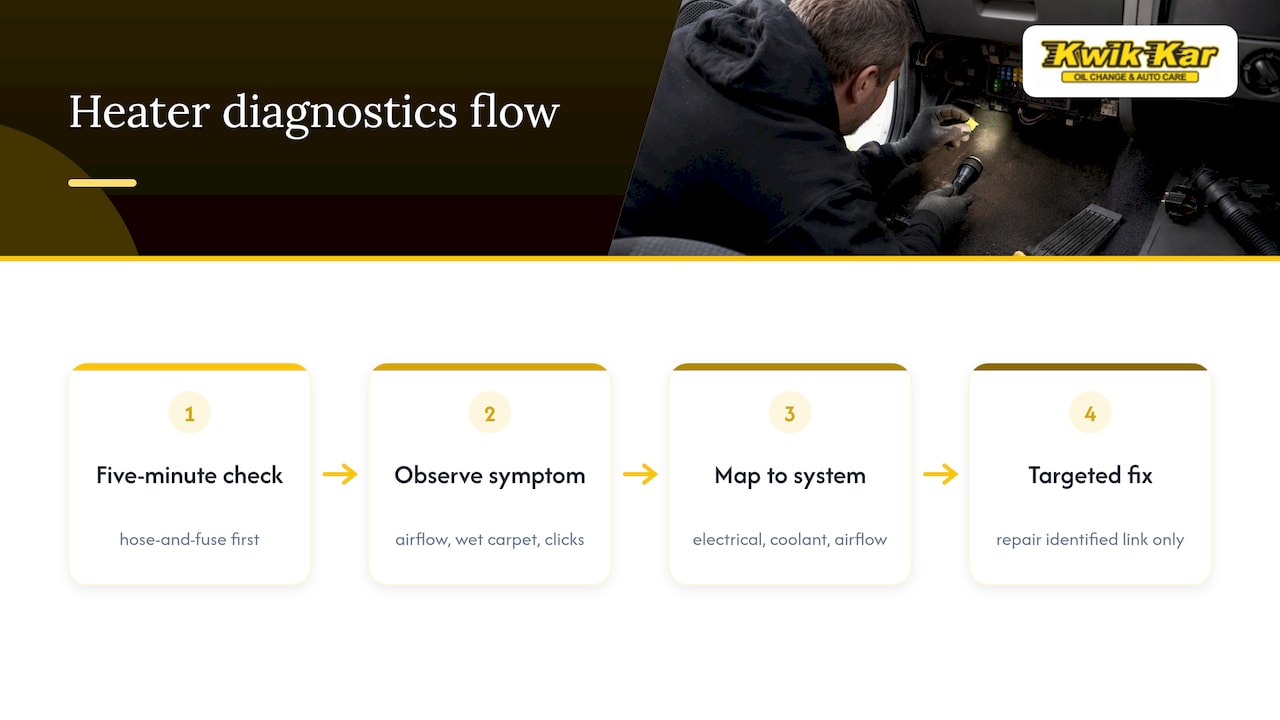
The symptom pattern matters more than the part people assume is guilty. Only-high-speed airflow almost always means the resistor, not the motor. A wet carpet almost always means the heater core, not the thermostat. Clicking behind the dash almost always means an actuator, not a coolant issue. Reading the pattern first saves money and guesswork.
If there’s one thing worth prioritizing, it’s the five-minute hose-and-fuse check before anything else; for expert help with these steps, consider diagnostics and warning lights services that pinpoint the issue accurately. It costs nothing, risks nothing, and rules out the two cheapest explanations before you consider anything that requires a lift or a technician.
— Kwik Kar
Get your heater checked at Kwik Kar Spring Valley
Winter mornings aren’t the time to find out your heater quit. Our ASE-certified technicians diagnose heater and HVAC issues with the same photo-and-video documented process we use for every repair, and we walk you through a transparent estimate before any work starts.

- Fast scheduling that fits around your commute or family routine.
- Clear, itemized estimates before we touch your vehicle.
- Diagnostics that cover blower, coolant flow, and actuator systems in one visit.
If your vents are blowing cold or your dash is clicking when you adjust the temperature, book a heating and cooling diagnostic with us today and get it sorted before the next cold front rolls in.
FAQ
Why did my heat stop working in my car all of a sudden?
A sudden loss of heat usually means a blown fuse, a failed blower motor resistor, or a sudden coolant loss rather than a gradual mechanical wear issue. Check fuses and hose temperatures first, since those are the fastest to rule out, and stop driving if you notice steam or a dropping coolant level.
Why is my car blowing out cold air when the heat is on?
Cold air with the heat on usually points to low coolant, a stuck-open thermostat, or a blend door that isn’t routing air through the heater core properly. Feel both heater hoses at the firewall: if one is cold while the other is hot, coolant isn’t reaching the core correctly, according to Cars.com’s heater troubleshooting guide.
How much does it cost to fix car heat?
Cost depends entirely on which component failed, and we don’t publish fixed repair pricing since every vehicle and diagnosis differs; the fairest way to get an accurate number is a diagnostic visit with a written estimate before any work begins. You can check current service offerings and request an estimate directly.
Can I drive my car if the heater is not working?
A heater that simply blows cold air with no other symptoms is usually safe to drive, though uncomfortable and a defrosting risk in cold weather. If the issue comes with steam, a sweet smell, wet carpet, or a rising temperature gauge, stop driving and have it inspected, since those point to a coolant leak or overheating risk rather than just a comfort issue, per AAA’s coolant leak guidance.